
Marcello Barenghi’s Hyperreal 3D Drawings: Chrome, Shadow, and Belief
Italian artist Marcello Barenghi turns flat paper into convincing objects—here, a polished spectacle helmet whose reflections and cast shadow sell true weight.
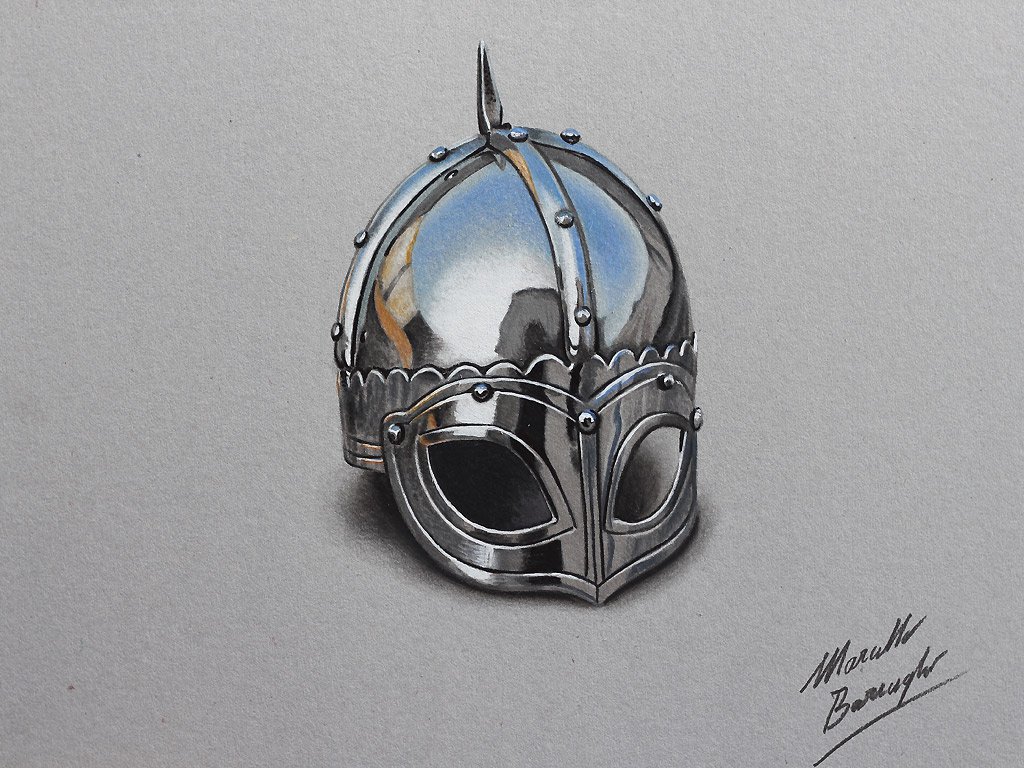
Hyperrealism on paper is a quiet kind of magic. No projection, no digital trickery in the final sheet—just pigment, patience, and an eye trained to notice how light actually behaves when it hits metal, plastic, or skin. Italian artist Marcello Barenghi belongs to that lineage of draughtsmen who make flat surfaces argue, convincingly, that something solid is sitting on them. Look long enough and the mind starts reaching for an object that is not there.
The drawing preserved here is a small masterclass in that argument: a polished spectacle helmet—conical crown, riveted bands, almond eye openings—rendered so that chrome reflections and a soft cast shadow seem to lift it off gray paper. It is the kind of piece that stops a scroll. You lean in to check the edge of the highlight, then lean back again because the shadow still feels physical.
Why Barenghi’s “3D” drawings feel dimensional
Calling these works “3D drawings” is popular shorthand, but the craft is older than the phrase. Trompe-l’oeil painting and hyperrealistic graphite or marker studies have always hunted the same effect: persuade the viewer that depth, weight, and material exist where only marks do. Barenghi’s particular gift is industrial intimacy. He favors objects you might hold—tools, packaging, toys, metal forms—rather than distant landscapes. Close viewing becomes part of the joke. The nearer you get, the more the reflections hold up, and the more absurd it feels that you cannot pick the thing up.
Dimension, in this practice, is mostly a product of three decisions. First, value structure: the darkest darks and brightest lights must be placed where a real object would cast and catch them, not where a decorative composition wants them. Second, edge control: hard edges announce contact with light or a sharp plane change; soft edges dissolve into atmosphere or paper grain. Third, environment mapping—especially on metal. A polished helmet does not simply look “shiny.” It carries warped windows, cool sky, warm interior lamps, and the vague silhouette of a room. Get those reflections wrong and the object collapses into cartoon chrome. Get them right and the brain invents a studio around the drawing without being asked.
Barenghi’s helmet uses that third skill aggressively. Warm yellowish light pools on one side of the dome; cooler blue rides the opposite curve. Rivets catch tiny specular points. The scalloped trim where crown meets face guard breaks the silhouette into a rhythm that feels manufactured, not sketched. Underneath, a soft, directional shadow anchors the form to the sheet. That shadow is not an afterthought. Remove it in your mind and the helmet floats; keep it and the paper becomes a tabletop.
Reading the helmet as craft, not prop
Spectacle helmets—those Nordic forms with protective “eye” plates—carry historical weight, but this drawing is not a museum reconstruction lecture. It behaves more like a still-life of a collectible or model: compact, highly finished, photographed (in effect) under controlled light. The conical spike, the vertical and horizontal reinforcing bands, and the almond apertures are drawn with the patience of someone who has studied how each plane turns. You can almost feel the cold of the metal because the highlights are so specific.
Notice how little background competes. The gray field is textured enough to declare “paper,” which is crucial. Hyperreal objects need a believable stage. If the background were busy, the eye would hunt for narrative. Here the narrative is material: steel versus matte fiber, gloss versus tooth. The signature in the lower corner, slanted and underlined, does not break the illusion so much as frame it—an artist’s claim that this deception was handmade.
That handmade claim matters culturally. In an era when photoreal images can be generated or composited in minutes, a drawing that still looks like a photograph gains a second layer of wonder. Viewers do not only ask “Is that real?” They ask “How long did that take?” Process becomes part of the spectacle. Barenghi has long been associated with time-lapse documentation of his work—sessions where layers of marker, pencil, and color build until a soda can, a banknote, or a toy feels edible or spendable. Even without watching a video, the finished helmet implies hours of controlled repetition: lay reflection, adjust temperature, deepen shadow, protect highlight, repeat.
Materials, light, and the discipline of looking
Hyperrealistic drawing is often misunderstood as mere copying. Good practitioners do copy carefully, but they also edit. A camera records everything; a draughtsman decides which reflections clarify form and which clutter it. Barenghi’s metal surfaces tend to keep just enough environmental information to sell polish without turning the object into a mirror maze. On the helmet, the window-like shapes on the left and the cooler field on the right are readable as light sources without demanding that you reconstruct the entire room.
Color temperature is another quiet teacher in the piece. Warm and cool are not decorative preferences; they are spatial cues. Warm light advances; cool light can recede or suggest open air. Placing both on a single curved surface makes the dome turn in space. Students who flatten metal usually do so by repeating one gray everywhere. Barenghi’s chrome is never one gray. It is a weather system of hues restrained inside a metallic envelope.
Then there is patience with small hardware. Rivets, seams, and trim lines are where amateur realism dies. Draw them too dark and they look glued on; too soft and the object loses engineering. The helmet’s fasteners sit in their sockets with believable occlusion—tiny crescents of shadow that say “this bit is proud of that bit.” Those micro-decisions accumulate into trust. Once the rivets feel true, the larger dome is allowed to be spectacular.
Where this sits among Barenghi’s wider subjects
Anyone who has followed Marcello Barenghi’s public body of work knows the helmet is one note in a larger chord. He is widely recognized for consumer still lifes that flirt with advertising photography: glossy packaging, translucent plastics, crisp paper money, food that looks ready to stain the page. The through-line is tactile greed. You want to touch the condensation, fold the bill, lift the toy. The “3D” label spreads online because photographs of the drawings are shared beside the real objects, or because time-lapses end with a hand entering the frame to prove the sheet is flat. The proof is half the entertainment.
That entertainment has a serious undercurrent. Drawing at this level is observational athleticism. It trains the eye to separate local color from reflected color, form shadow from cast shadow, texture from value. It also trains humility. A single wrong highlight can make steel look like plastic; a single wrong edge can make a solid object look pasted. Barenghi’s reputation rests on rarely making those mistakes in public-facing finishes.
There is also a cultural hunger for handmade proof in digital culture. Feeds reward instant astonishment. A hyperreal drawing delivers astonishment and then withholds the shortcut. Even when the image is consumed on a phone, the brain still models labor: layers, drying time, hand cramp, corrections. That modeled labor is part of why these posts travel. People do not only share beauty; they share evidence of effort that feels almost unfair.
How to look at a piece like this
Start at the brightest specular hit and walk your eye around the form the way light would. Ask what each reflection is doing: describing curvature, announcing a light source, or simply decorating. Then drop to the cast shadow and check contact. Does the object meet the paper with a darker, sharper line before the shadow softens outward? In the helmet, that contact logic is sound, which is why the “resting on the page” sensation holds.
Next, inspect edges that should be mechanically crisp—the eye apertures, the spike, the band intersections—and edges that should breathe, such as the outer shadow. Hyperrealism fails when everything is equally sharp. Barenghi’s control of that hierarchy is as important as his chrome fireworks.
Finally, step back until the drawing reads as a photograph, then step in until it dissolves into marks. That oscillation is the point. Illusion art is not about permanently fooling anyone; it is about letting belief and disbelief trade places in the same minute. The helmet wins that game because both distances are rewarding. Far away, it is an object. Close up, it is a record of decisions.
Paper as stage, object as actor
One reason Barenghi’s compositions feel theatrical is their staging. Neutral grounds, centered or near-centered subjects, and lighting that could belong to a product shoot turn the sheet into a miniature set. The helmet does not need a battlefield backdrop. Context would dilute the material performance. By isolating the form, the drawing asks a single question: can graphite, marker, or colored media imitate industrial finish well enough to trigger muscle memory—the urge to lift, turn, and weigh?
That urge is the real 3D effect. Stereoscopic depth cues help, but desire completes the illusion. When a drawing makes you want to handle it, your body has already accepted mass. Barenghi’s best pieces recruit that bodily agreement. The helmet’s polished skin and grounded shadow are invitations to grip something cold and heavy that exists only as carefully ordered pigment.
For artists studying the work, the lesson is not “draw Vikings” or “draw chrome.” The lesson is to choose subjects that reveal light’s complexity and then refuse shortcuts. Reflective metal exposes every error. Soft paper backgrounds expose every false shadow. Signatures and empty margins remind the viewer that the miracle is bounded—framed, authored, finite. Within those bounds, Marcello Barenghi keeps proving that a flat page can still feel crowded with presence.
If you return to the image after reading, try ignoring the historical costume associations for a moment. Watch only the temperature shifts across the dome, the rivet highlights, and the soft oval of shade on the left. Those are the sentences of the drawing. The helmet is the paragraph they form. And the paragraph’s closing line is simple: belief, briefly, is optional—and somehow you choose it anyway.

Comments
Continue reading
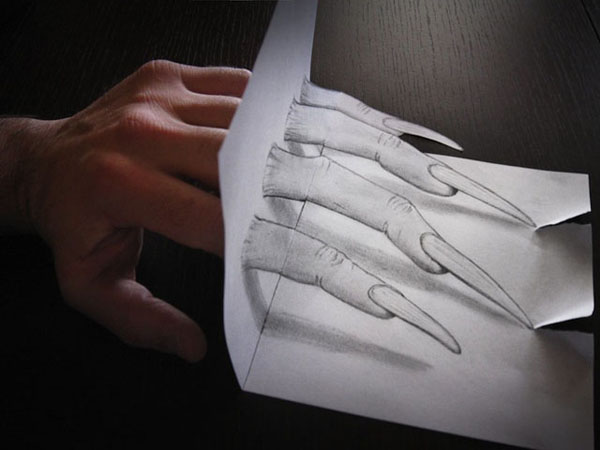
Alessandro Diddi’s Anamorphic 3D Drawings: Hands, Folds, and False Depth
Italian artist Alessandro Diddi folds paper, locks a camera angle, and drafts shadows until claws, bridges, and bitten fingers seem to leave the page.
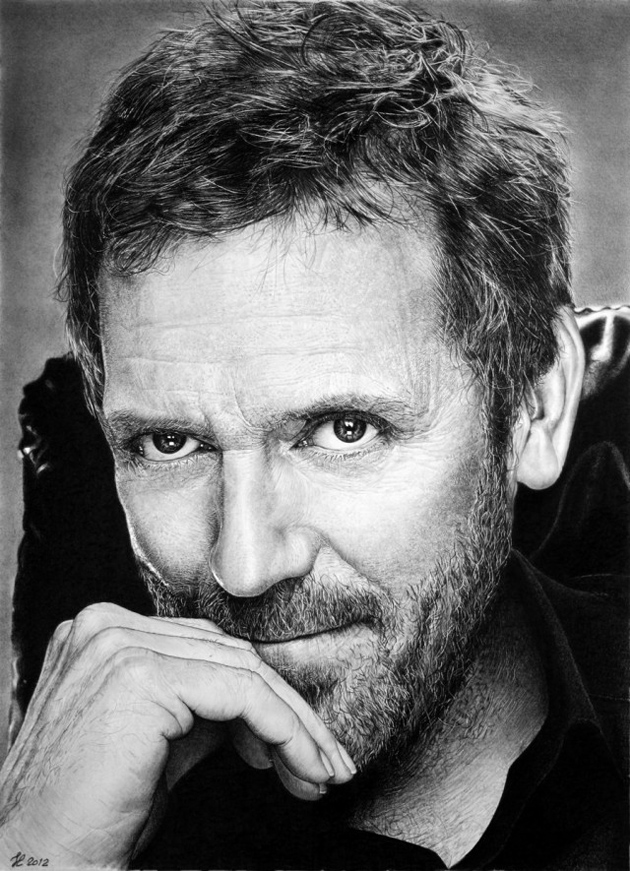
10 Photorealistic Pencil Drawings by Franco Clun
Ten photorealistic graphite portraits attributed to Italian artist Franco Clun—celebrity likenesses, reflections in glasses, a macro eye, and unflinching studies of age.
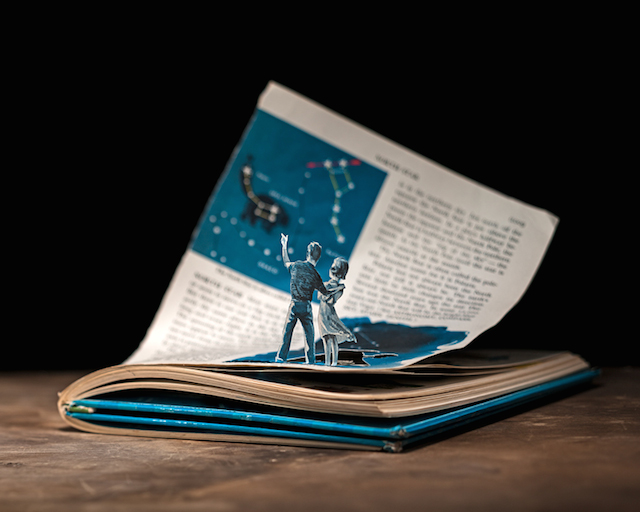
Thomas Allen’s Book-Cut Illustrations
Michigan illustrator Thomas Allen cuts pulp paperback figures into 3D tableaux, photographs them in shallow focus, and gathers the practice in his Aperture book Uncovered.