
10 Photorealistic Pencil Drawings by Franco Clun
Ten photorealistic graphite portraits attributed to Italian artist Franco Clun—celebrity likenesses, reflections in glasses, a macro eye, and unflinching studies of age.
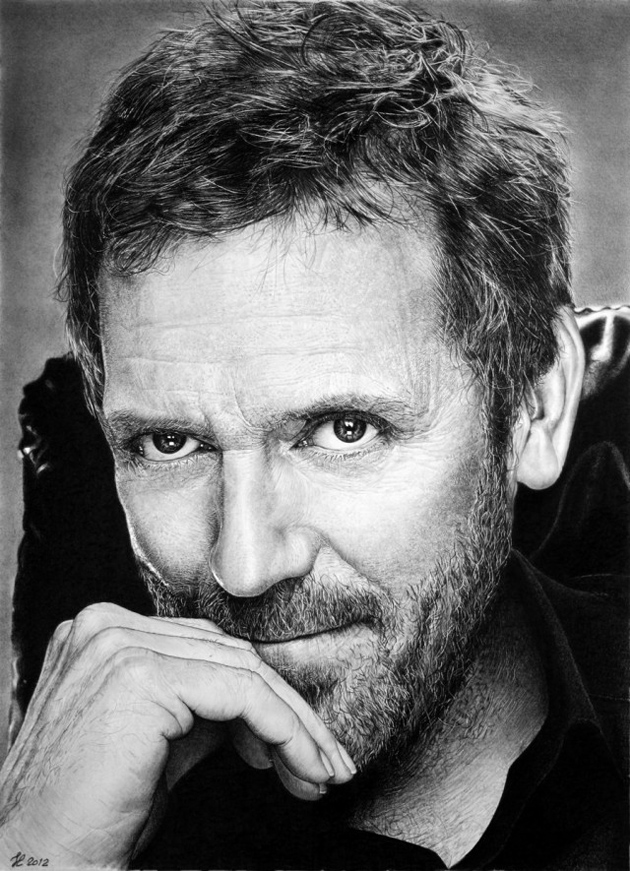
Italian artist Franco Clun works in graphite and charcoal until a face stops looking drawn and starts looking photographed. Photorealistic drawing of this kind is not a trick of software; it is patience with value, edge, and texture—pores, stubble, catchlights, fabric weave—built mark by mark until the brain accepts the page as a lens. The ten works below show how far that discipline can go: celebrity likeness, intimate strangers, macro eyes, and age mapped in wrinkles that never flatten into cartoon.
Look slowly. The first glance says “photo.” The second glance should ask how many hours the midtones took.
1. Contemplative male portrait
A head-and-shoulders study of a middle-aged man—widely recognized as a likeness of Hugh Laurie—meets the viewer with a hand at the chin and an unhurried stare. Forehead lines, crow’s feet, and salt-and-pepper stubble are not suggested; they are inventoried. Catchlights keep the eyes wet. Soft light from one side turns the face into a landscape of planes.
Clun’s strength here is restraint in the darks. The background falls away without competing, so skin and hair carry the drama. A portrait like this teaches why photorealism still needs composition: crop, gesture, and negative space decide whether detail feels alive or merely busy.
2. Glasses and layered reflections
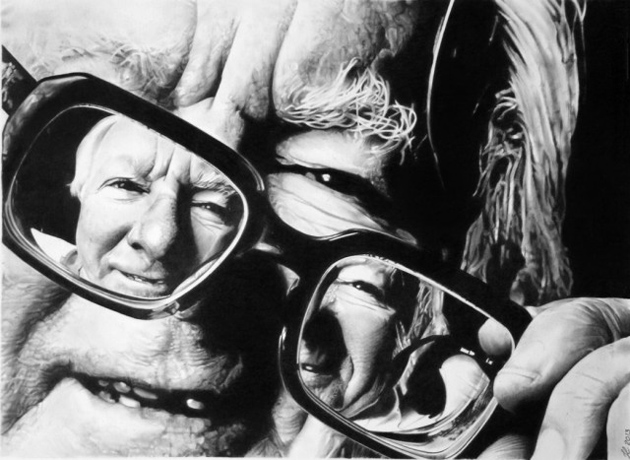
An extreme close-up of an older face holds thick-rimmed glasses so that each lens contains another face—reflections nested inside the primary subject. Frames shine with plastic highlights; knuckles and nails on the holding hand refuse to blur into vagueness. Aged skin around the mouth stays specific: folds, spots, and the soft collapse of tissue that flatter drawings usually erase.
Multiple focal planes are the technical dare. The artist must keep the primary face coherent while rendering secondary likenesses inside curved glass, where distortion is part of the truth. High contrast pushes the illusion; without deep blacks, the lenses would not feel optical.
3. Profile with volume in the hair
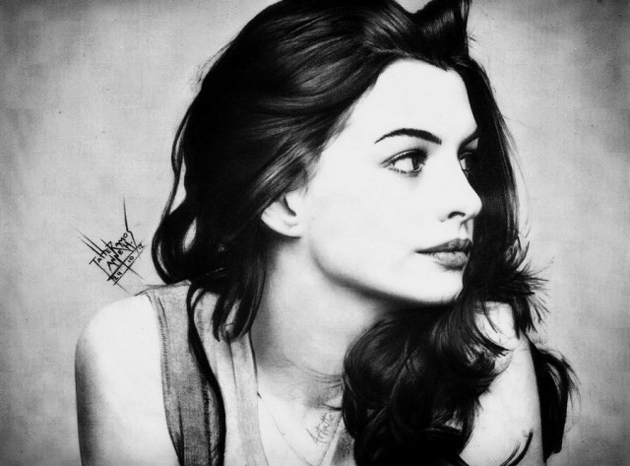
A three-quarter view of a woman with dark, wavy hair and a sleeveless top shows how photorealism handles softer skin and larger hair masses. Smooth gradients on forehead and cheek sit beside strand-by-strand work in the hair, where highlights skim the ridges of curls and shadows pool underneath.
Celebrity or not, the drawing’s job is the same: convince you that light is traveling across a real volume. Edges sharpen near the nose and soften into the background so the head turns in space. That selective focus is borrowed from photography and earned by pencil control.
4. Freckles and shallow depth
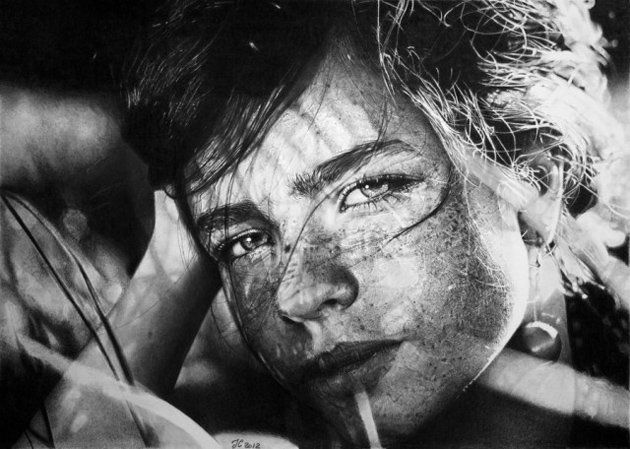
A young woman’s face fills the frame under hard directional light. Freckles scatter across nose and cheeks with individual patience; flyaway hairs catch white; eyes hold clean reflections. Blurred forms in the near foreground mimic camera depth of field—an effect that, on paper, requires deliberate softening rather than a lens ring.
Intimacy is the mood. Melancholy gaze plus dark surround equals a portrait that feels overheard rather than posed for a press kit. Photorealism here is emotional as well as technical: specificity of skin becomes specificity of person.
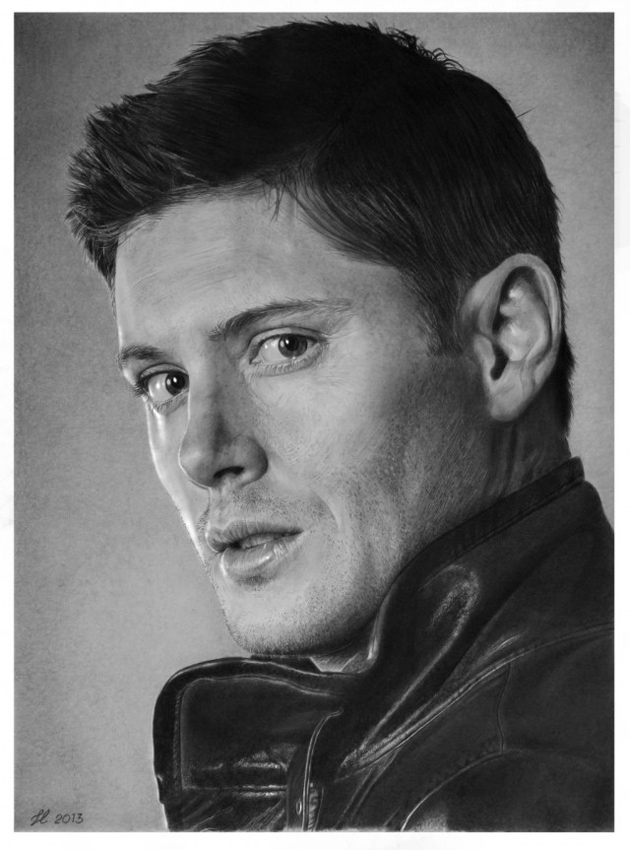
5. Over-the-shoulder leather jacket
A vertical chest-up portrait—often read as a likeness of Jensen Ackles—turns the head toward the viewer across a dark leather collar. Stubble, pore-level skin, and the gloss-and-crease behavior of leather are all argued in graphite. Side light splits the face into lit plane and soft shadow so the skull reads solid.
Clothing texture is where many “realistic” drawings fail. Leather needs specular hits and matte valleys in the right places; stitching must stay subordinate. When those hierarchies hold, the jacket stops being a black shape and becomes a material you believe you could touch.
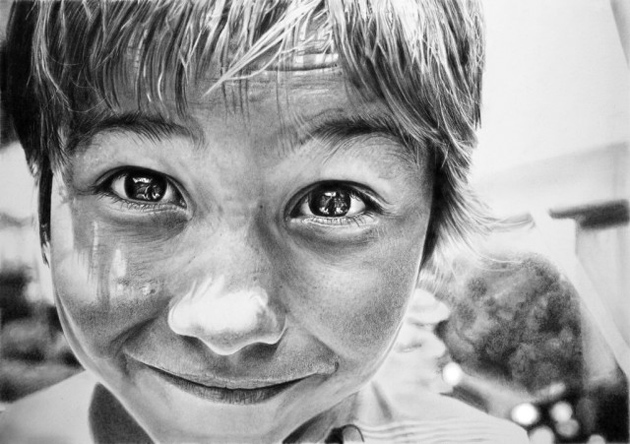
6. Wide smile, child’s close-up
A young boy’s face, pushed close enough to feel slightly wide-angle, breaks into a broad closed-mouth smile. Laugh lines, bright nasal highlights, and complex reflections in dark eyes sell the moment. Straight bangs are drawn as individual strands with a full value range from white to near-black.
Children’s skin is a different problem from aged skin: fewer deep wrinkles, more subtle transitions, easier to oversmooth into plastic. This drawing keeps life in the cheeks and eyes. Soft background bokeh again borrows photographic language so the expression stays primary.
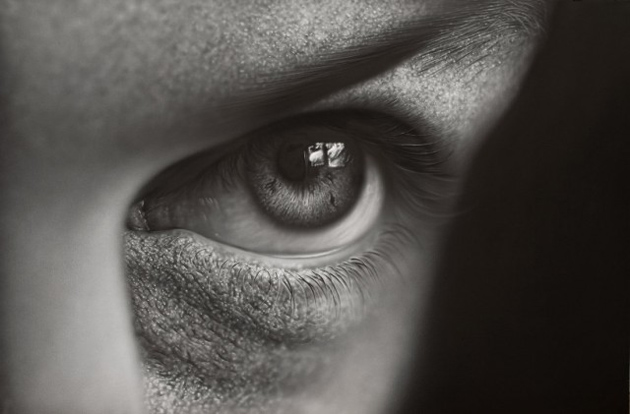
7. Macro eye study
One eye, brows, and the bridge of a nose occupy the whole sheet. Iris fibers radiate; lashes vary in thickness; corneal reflection shows window panes or studio lights; periocular skin shows pores and fine creases. Macro photorealism is a stress test: every square centimeter must earn its keep because there is nowhere for the viewer’s eye to rest on a “simple” area.
Artists study eyes this way to learn wetness, transparency, and the way skin changes at the lid margin. Viewers study them to feel watched by graphite.
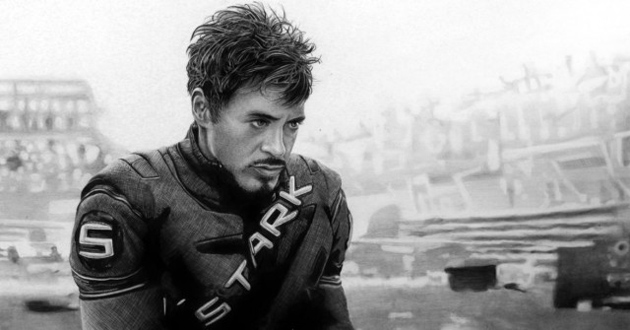
8. Racing suit and downward gaze
A waist-up figure in a textured racing suit—lettering across the chest, a shoulder patch, mesh fabric rendered at punishing detail—looks down and aside with messy hair and a precise goatee. The blurred stands behind him complete a cinematic depth of field. Viewers often read a Tony Stark / Robert Downey Jr. likeness; the drawing’s real subject is costume plus exhaustion held in a single glance.
Letterforms in graphite must stay sharp without looking pasted on. Fabric pattern must diminish as it turns away from light. Those two tasks, done together, are why costume portraits take as long as faces.
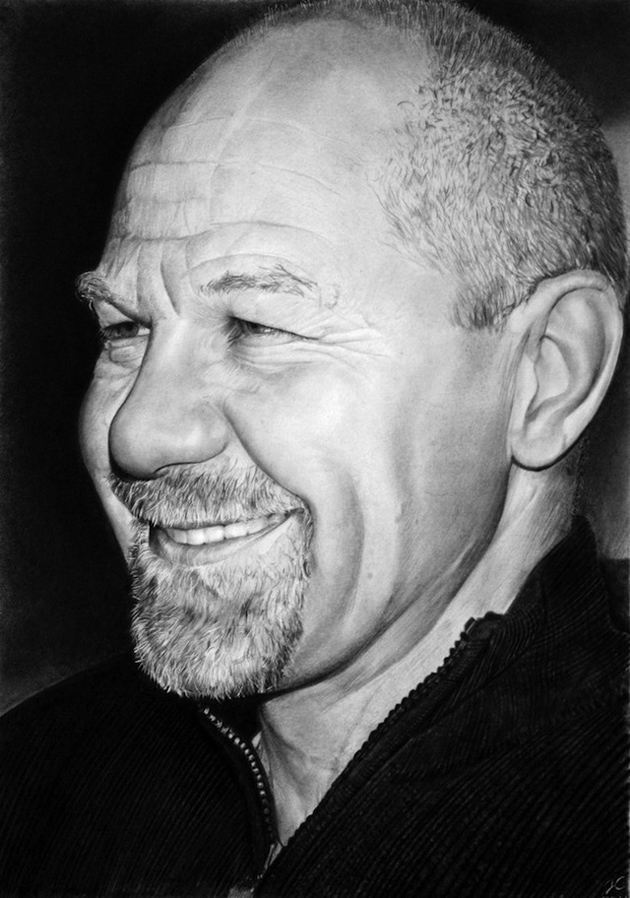
9. Shaved head, open smile
Against a velvet-black field, a middle-aged man with a cropped scalp, salt-and-pepper goatee, and ribbed zippered garment smiles toward the side. Crow’s feet and nasolabial folds activate; scalp texture shows; stubble on the neck refuses simplification. Bright frontal light pops forehead and cheekbones while the back of the head sinks into dark.
Black backgrounds are merciless. Any muddy midtone on the face will look dirty; any false edge will glow. Clean separation between subject and void is part of the craft on display.
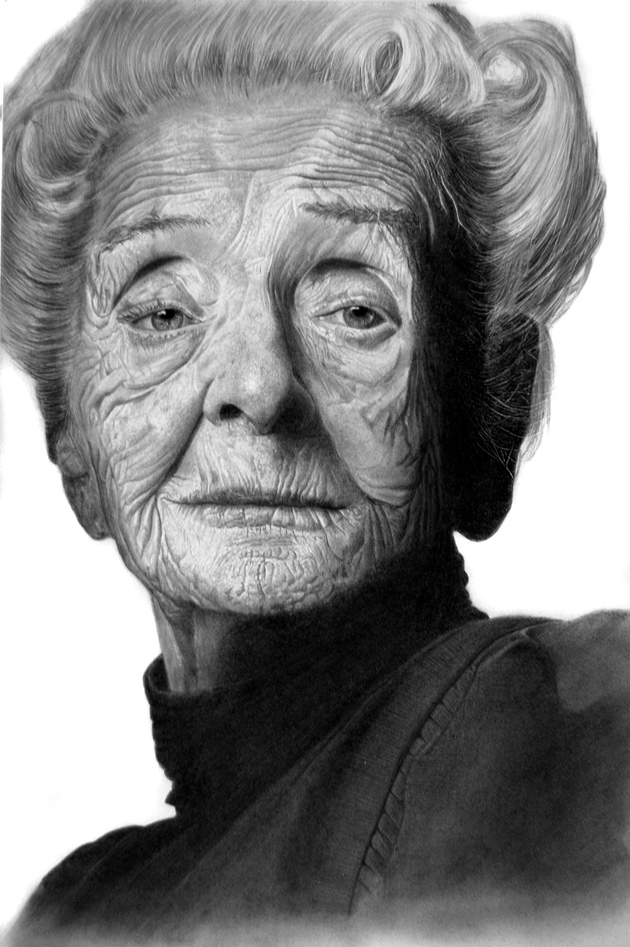
10. Elder woman in turtleneck
A vertical portrait of an older woman on a pale ground closes the set with the hardest honesty photorealism can offer: forehead furrows, sparse lashes, neck folds, light eyes with moisture, and white wavy hair drawn strand by strand. A dark turtleneck anchors the bottom of the composition. Light from upper left leaves half the face in contemplative shadow.
Youthful celebrity likenesses draw clicks; aged faces test whether an artist loves detail enough to stay when beauty standards leave the room. This drawing stays. The map of a long life is the content, not a flaw to be airbrushed in graphite.
Why the pencil still wins the double take
Franco Clun’s reputation rests on that double take—the second in which you admit the “photograph” is graphite. Across these ten images the lessons repeat: protect a full value range, let edges vary, render materials as optics not symbols, and choose crops that feel intentional. Celebrity faces prove likeness; anonymous and elder faces prove empathy; the macro eye proves obsession.
If you draw, steal the process more than the subjects: longer sessions, sharper references, fewer shortcuts in the midtones. If you only look, give these works the minutes they spent earning their realism. The page is quiet. The faces are not.

Comments
Continue reading
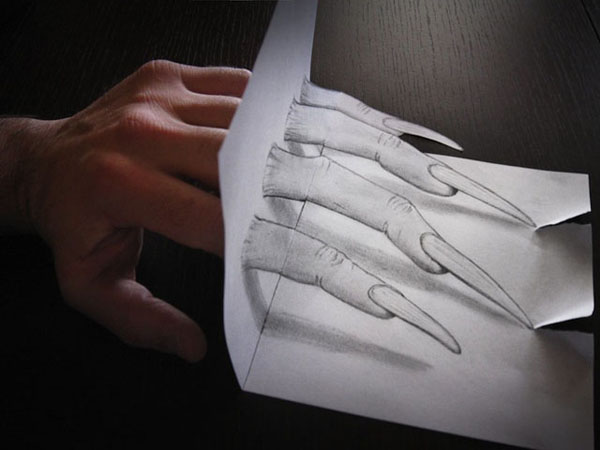
Alessandro Diddi’s Anamorphic 3D Drawings: Hands, Folds, and False Depth
Italian artist Alessandro Diddi folds paper, locks a camera angle, and drafts shadows until claws, bridges, and bitten fingers seem to leave the page.
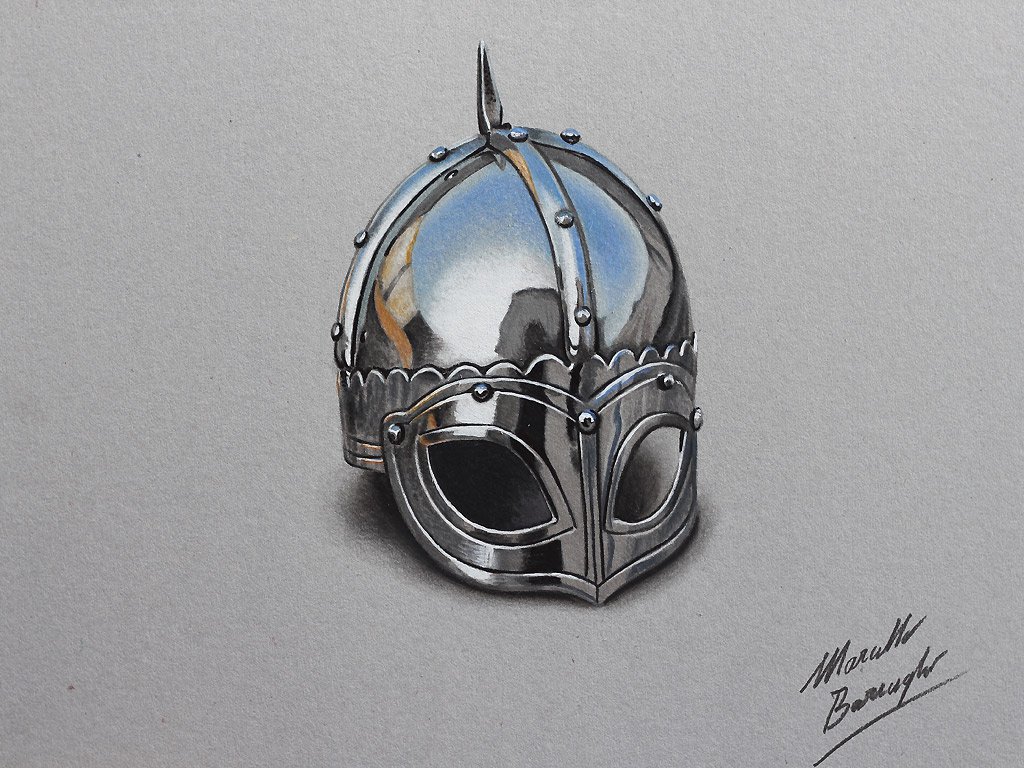
Marcello Barenghi’s Hyperreal 3D Drawings: Chrome, Shadow, and Belief
Italian artist Marcello Barenghi turns flat paper into convincing objects—here, a polished spectacle helmet whose reflections and cast shadow sell true weight.
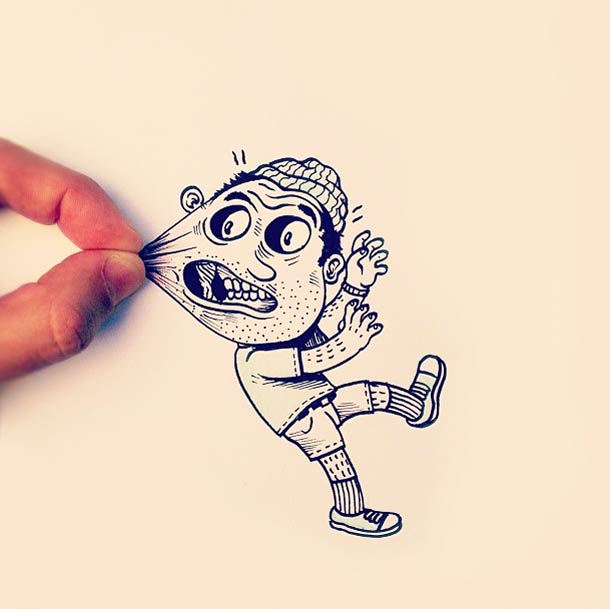
Funny Illustrations With Everyday Objects by Alex Solis
Chicago illustrator Alex Solis turns hands, chips, bananas, and rulers into punchlines—how his object-and-ink hybrids work, with the full gallery.