
30 Creative Examples of Staircase Photography
From museum double-helices and terracotta atriums to abandoned wells and selective-color spirals—creative staircase photographs that treat vertical geometry as the whole subject.
Staircases are architecture doing two jobs at once: moving bodies between floors and drawing lines through space. Photographers love them because those lines already behave like composition—spirals, nested rectangles, diagonals that pull the eye before you invent anything. This gallery gathers creative staircase photographs by many makers, from museum double-helices and department-store atriums to abandoned wells and selective-color experiments. Treat it as a field notebook of angles, not a single style guide.
What repeats across the set is viewpoint discipline: look straight up, look straight down, or climb until geometry becomes the subject and the building becomes a frame around it.
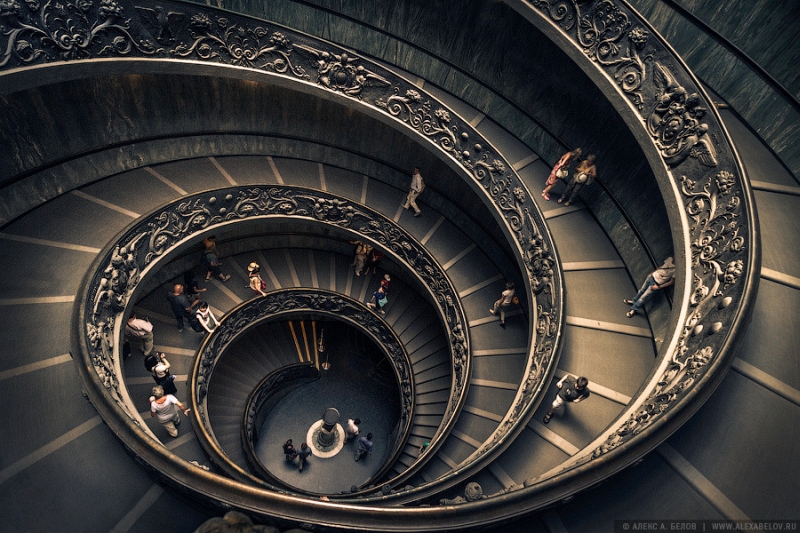
1. Alex A. Belov — ornate spiral from above
A top-down view into a grand double-spiral—bronze relief railings, concentric stone ramps, visitors reduced to scale markers. People keep the frame honest: without them, the swirl risks becoming pure ornament; with them, the photograph is about monumental circulation. Soft overhead light fades into the well so depth reads as atmosphere, not only pattern.
2. Christopher Cove — atrium looking up
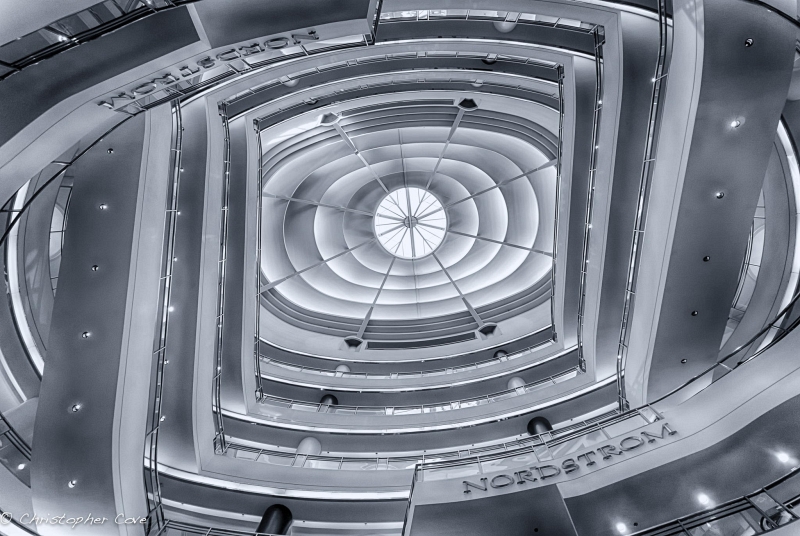
Worm’s-eye monochrome turns a multi-level retail atrium into a tunnel of curves aimed at a spoked skylight. Branding on the fascia is secondary; the real subject is concentric motion. Black and white strips color noise so recessed lights and glass rails become rhythm marks on the spiral.
3. Dan Tivadar — painted underside spiral
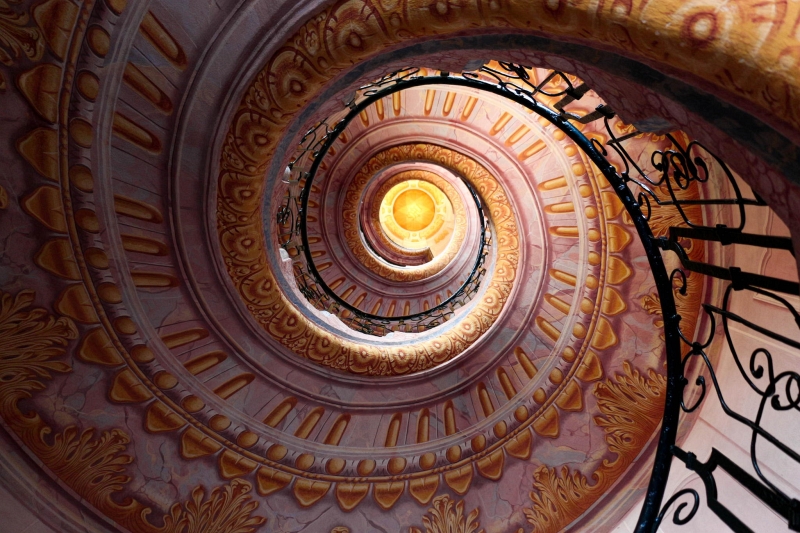
Looking straight up, ochre and dusty-pink painted soffits wrap a dark iron rail toward a gold-lit oculus. Decoration that tourists ignore become the photograph’s surface. Warmth against black metal is the craft lesson: color can carry geometry as firmly as contrast does.
4–5. Paul Kilgour — oval well and patterned wall spiral
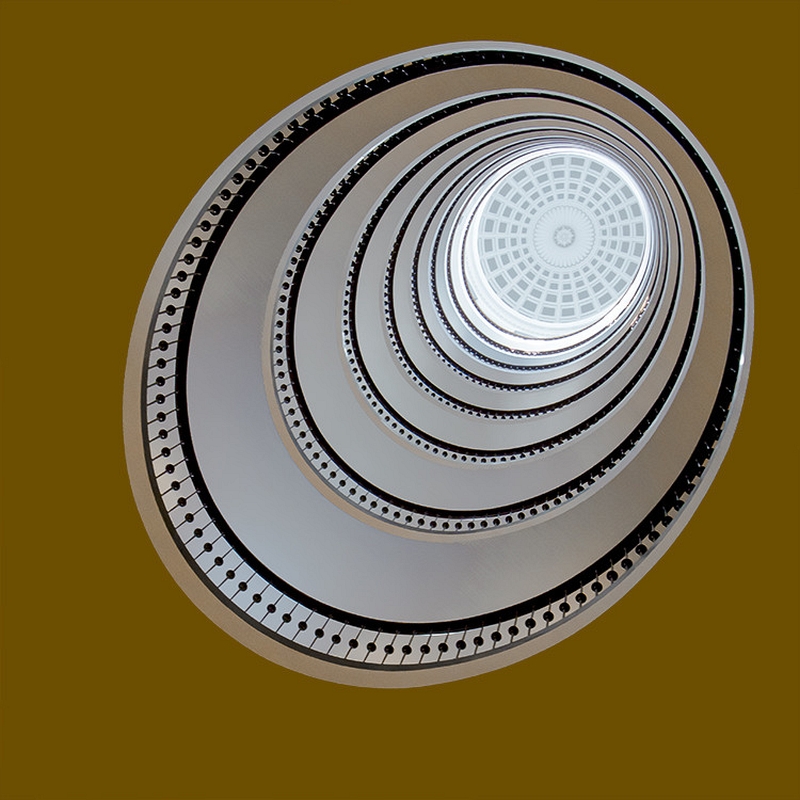
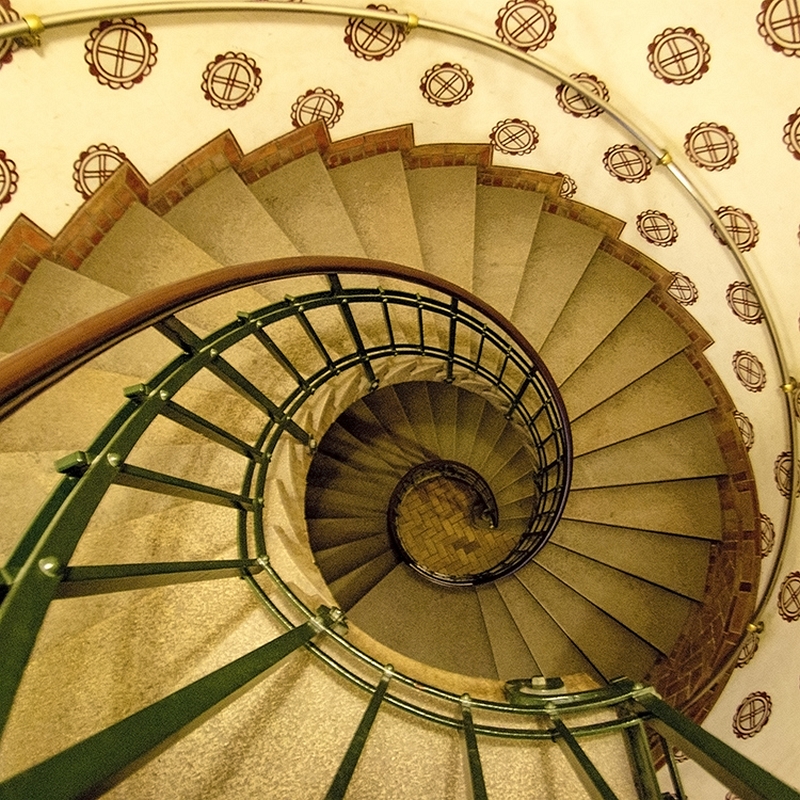
First, nested ellipses against a flat mustard field—almost graphic design, with a mandala-like skylight as the bull’s-eye. Second, a classical top-down spiral: speckled stone, red-brick rim, dark green rail, and a wall stamped with circular motifs. Together they show Kilgour’s range from abstracted modern to decorative heritage without changing the core move—center the well and let repetition work.
6. Tayo Okusanya — terracotta court spiral
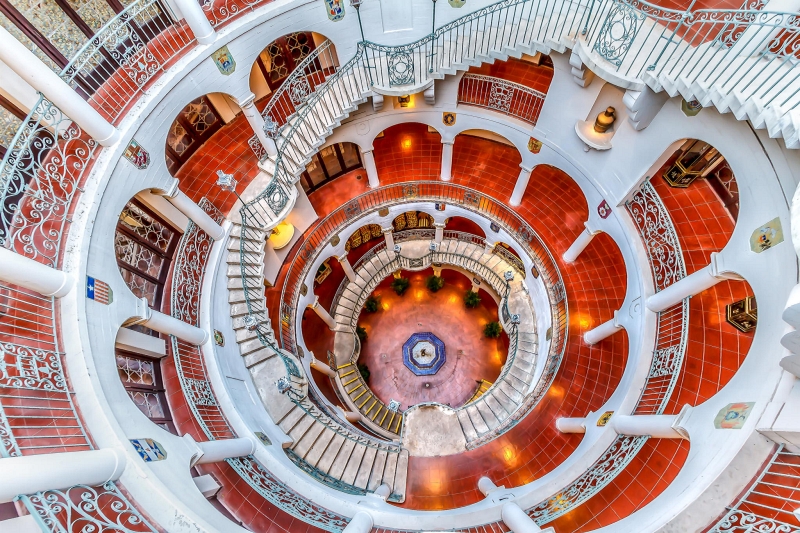
From high above, white arches, wrought iron, and glowing terracotta floors ring a blue-tiled fountain. Warm floors against cool tile give the plunge a destination. Wide framing keeps the full circle intact—architecture as courtyard theater rather than a cropped detail.
7. Alexander Warias — ruined stair and light
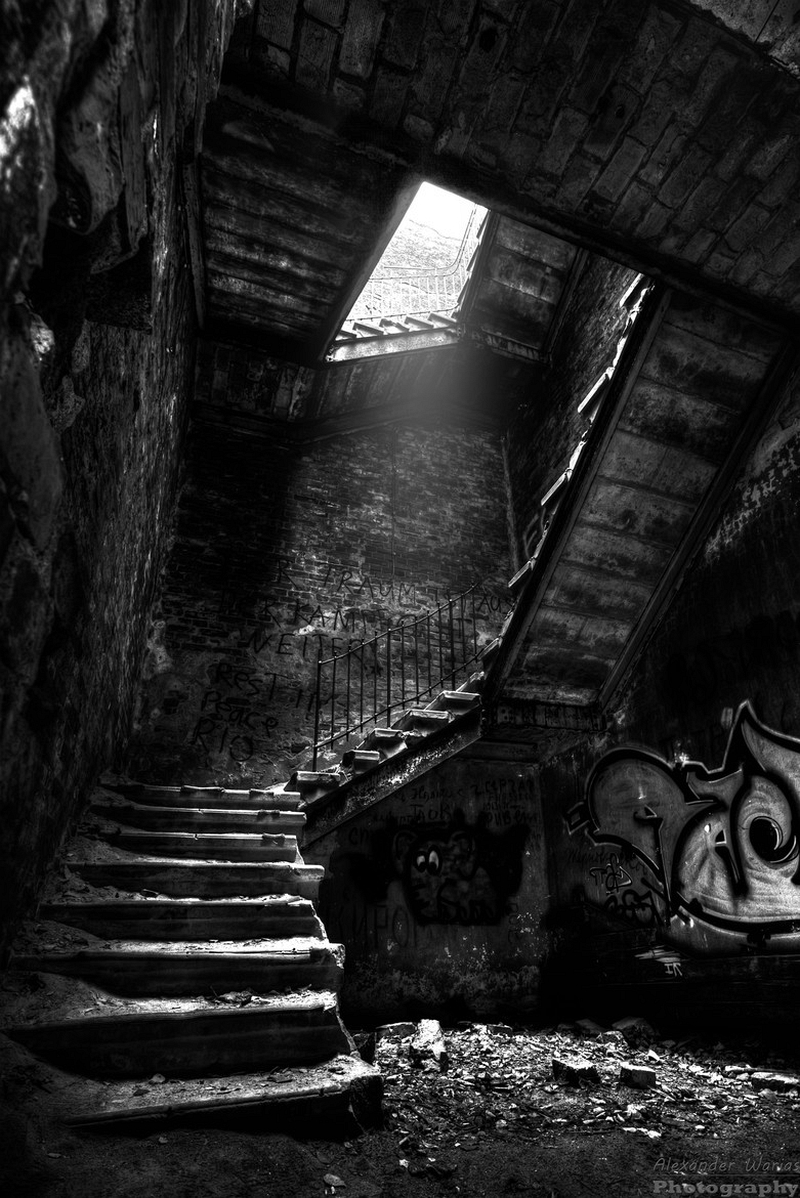
Not every staircase photograph needs polish. Low angle, high-contrast black and white, brick vaults, graffiti, and debris turn a broken flight into narrative. Light pouring from the upper opening finishes the story: ascent toward air. Urbex ethics still apply—look, do not destroy—but photographically the lesson is texture and chiaroscuro over perfection.
8–9. Alfon No — marble rectangle and teal metal nest
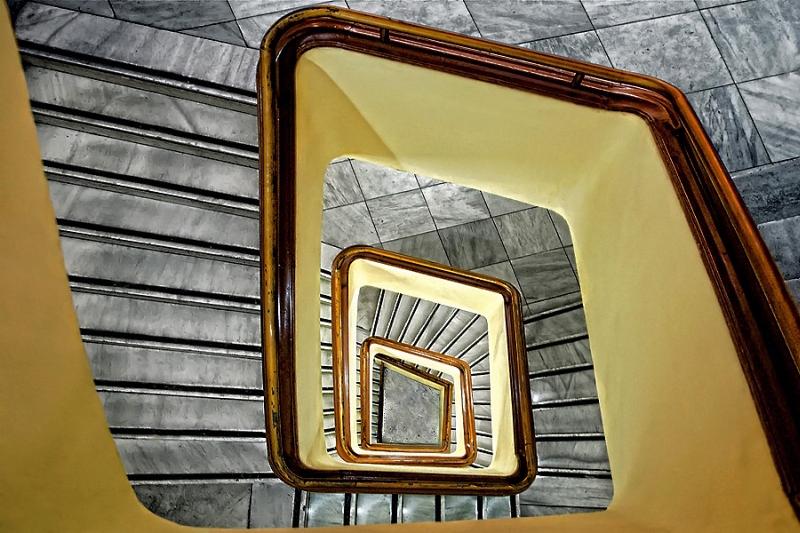
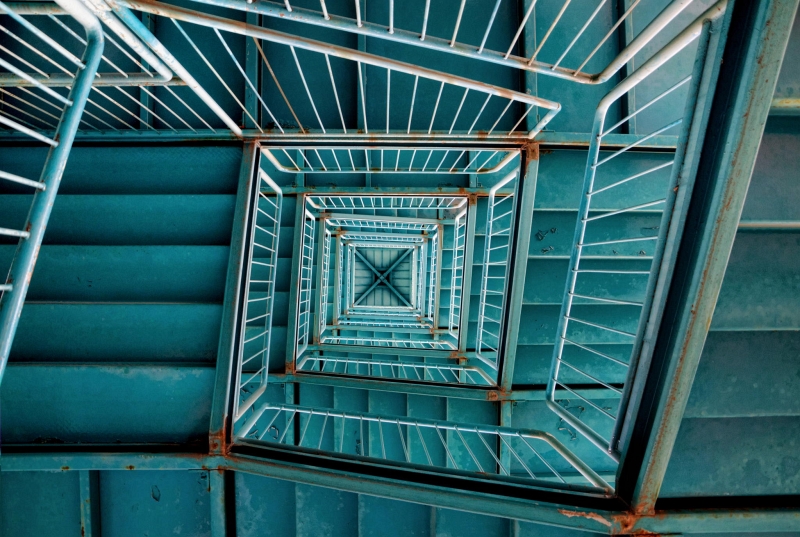
A cream well with a continuous wooden rail coils down marble tiles—warm wood against cool stone. Then a teal industrial nest of metal plates and thin balusters, rust at the joints, light pooling in the deepest square. Same photographer, opposite moods: hotel-lobby elegance versus warehouse geometry. Square wells can hypnotize as thoroughly as circles.
10. Angelo Ferraris — bronze helix again
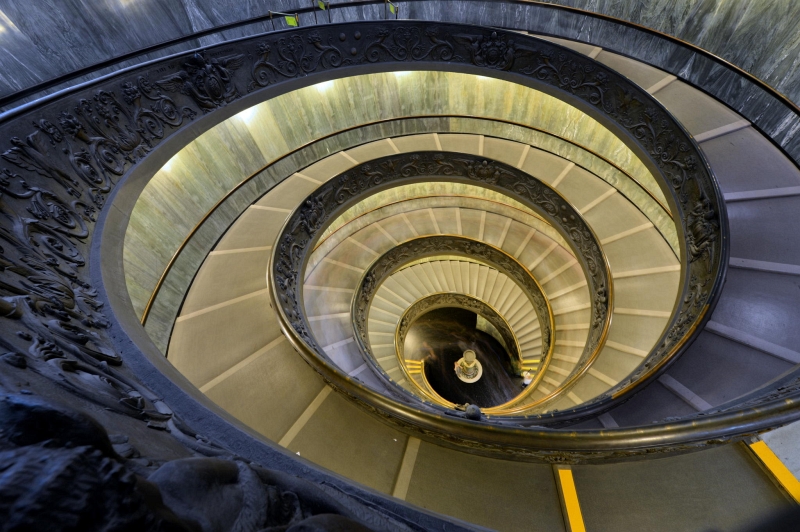
Another plunge into an ornate double helix—carved bronze, veined dark marble walls, recessed warm lights. Compared with Belov’s wider tourist-filled frame, this crop leans tighter on spiral purity. Famous stairs reward returning; each photographer chooses how much human traffic to keep.
11. Eduardo Barbosa — stone nautilus in monochrome
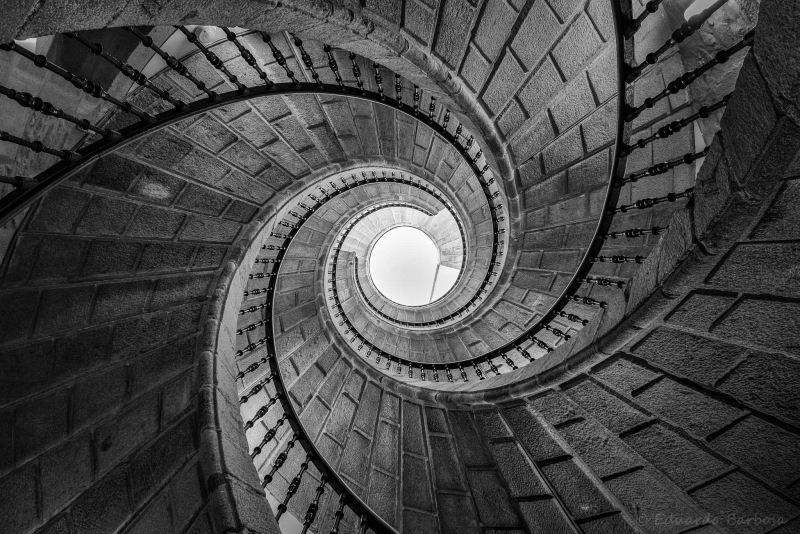
From the base, heavy stone blocks and dark iron rail spiral toward a bright circular opening. Monochrome turns mortar lines into radial drawing. Rough texture is the point: these steps feel walked, not rendered. Center the camera carefully; a few degrees off and the nautilus collapses into a mess of wedges.
12. Edward Bozzard — ornate iron and skylight
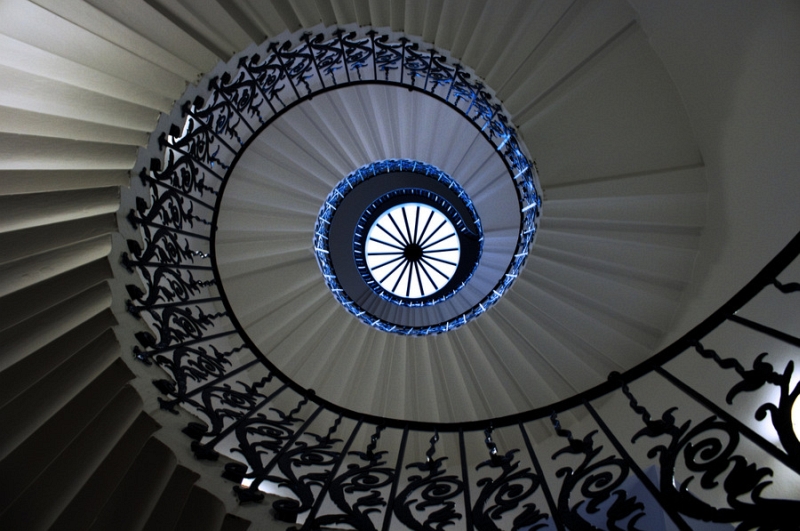
Pale stone, scrollwork iron silhouetted against it, and a wheel-spoke skylight overhead—classic “Tulip Stair” energy even when the location changes. High contrast between black metal and light tread makes the spiral read as calligraphy. Expose for the bright oculus or accept bloom; both choices can work if the iron stays sharp.
13–15. Joe@Plasmatico — brick globes, blue spiral, color tunnel
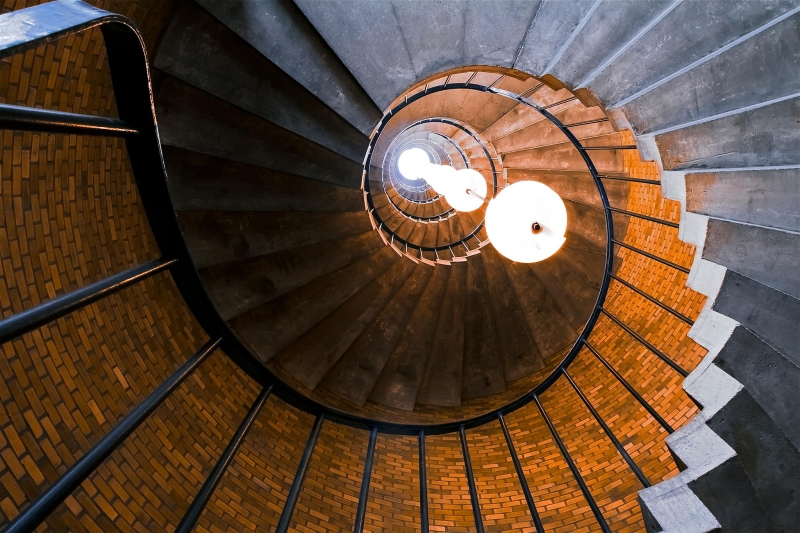
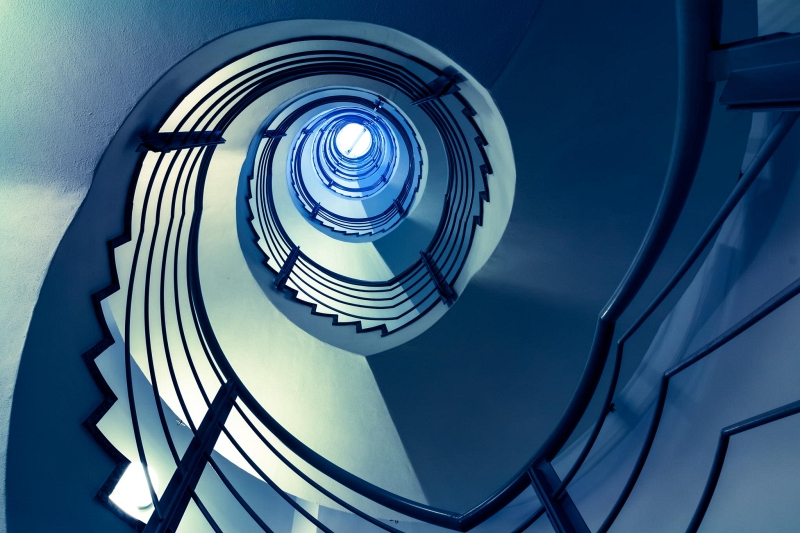
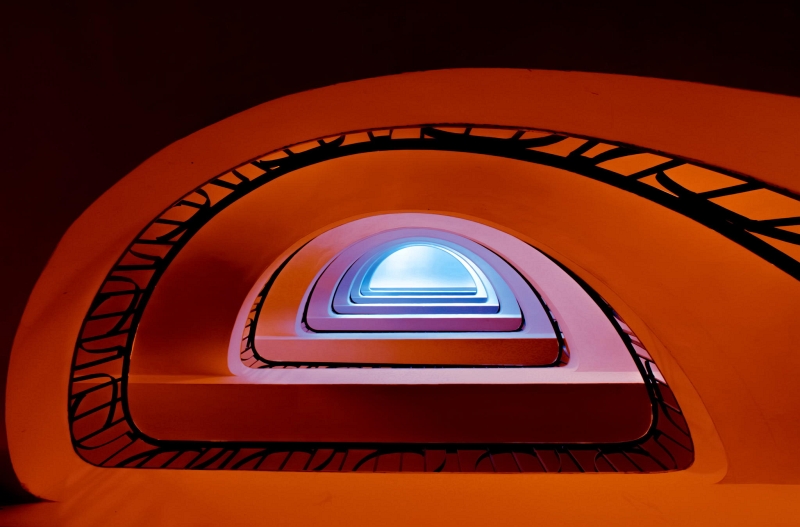
Three moods from one eye: warm brick wrapping grey treads with hanging globe lamps; a cool blue-toned climb toward a circular skylight; then nested arches graded from terracotta orange into lavender and cerulean. The third frame especially treats the stairwell as a color instrument. Grade boldly if the structure can hold it—soft architecture plus timid color often reads as a snapshot.
16. Laszlo Gal — selective red on grey stone
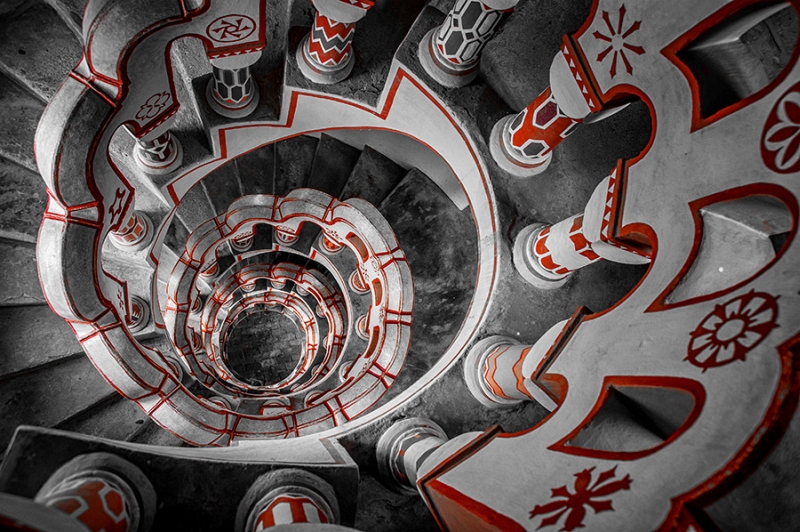
Top-down spiral mostly desaturated, with red reserved for carved stars, scalloped edges, and patterned balusters. Selective color is easy to overdo; here it behaves like a highlighter for ornament. The dark center still does the depth work while red keeps the eye touring the craftsmanship.
17–22. Nils Eisfeld — six studies in the well
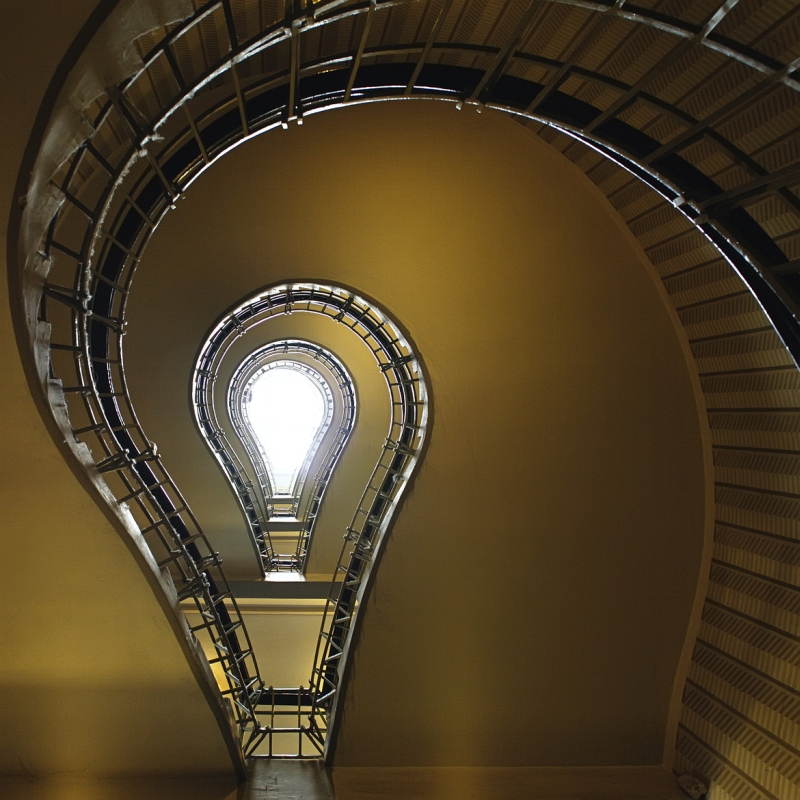
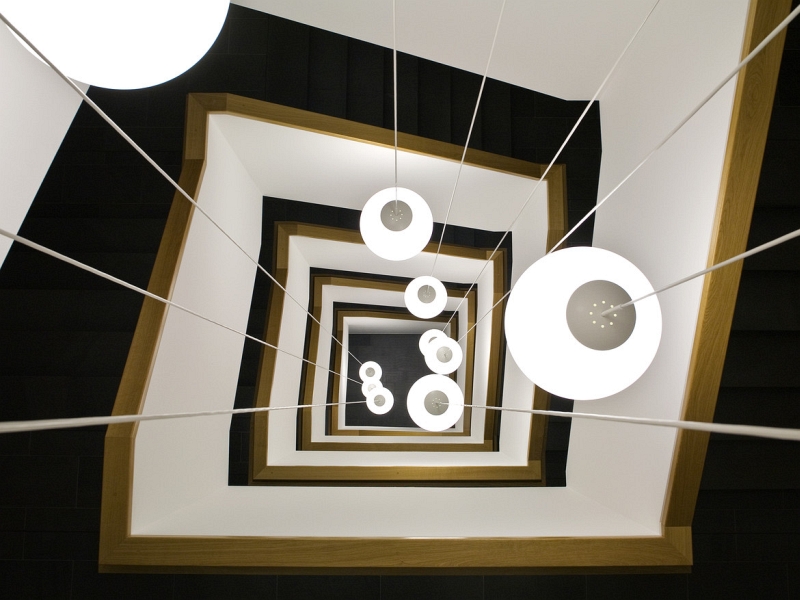
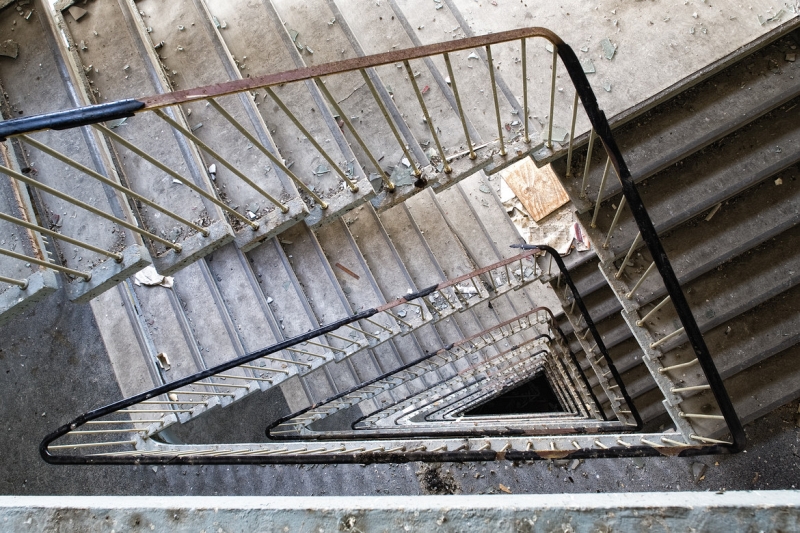
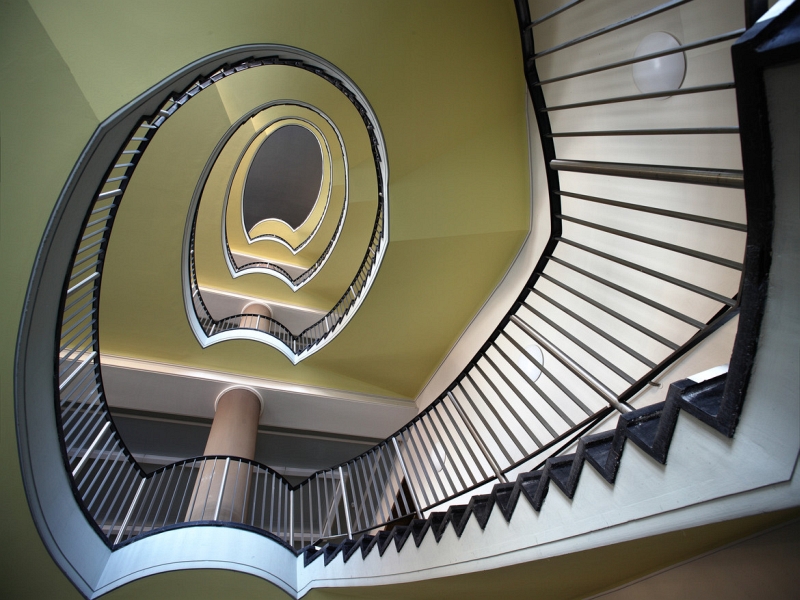
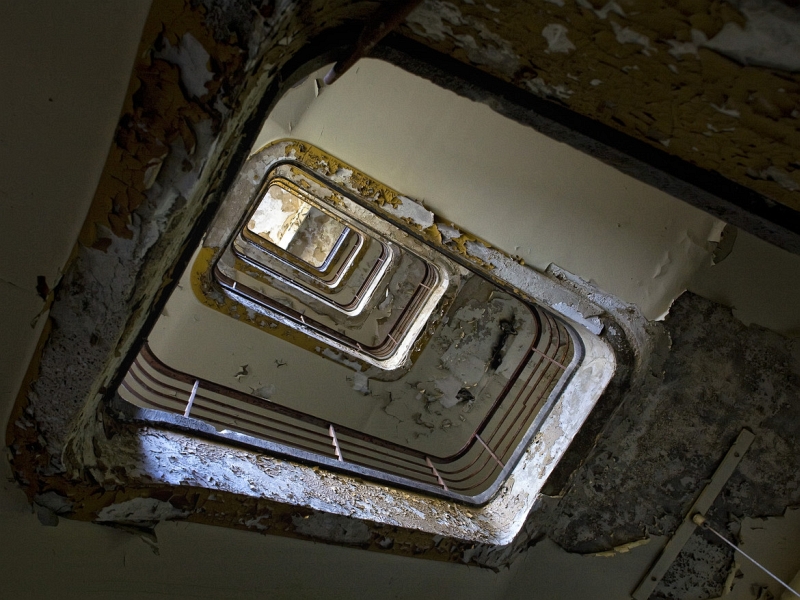
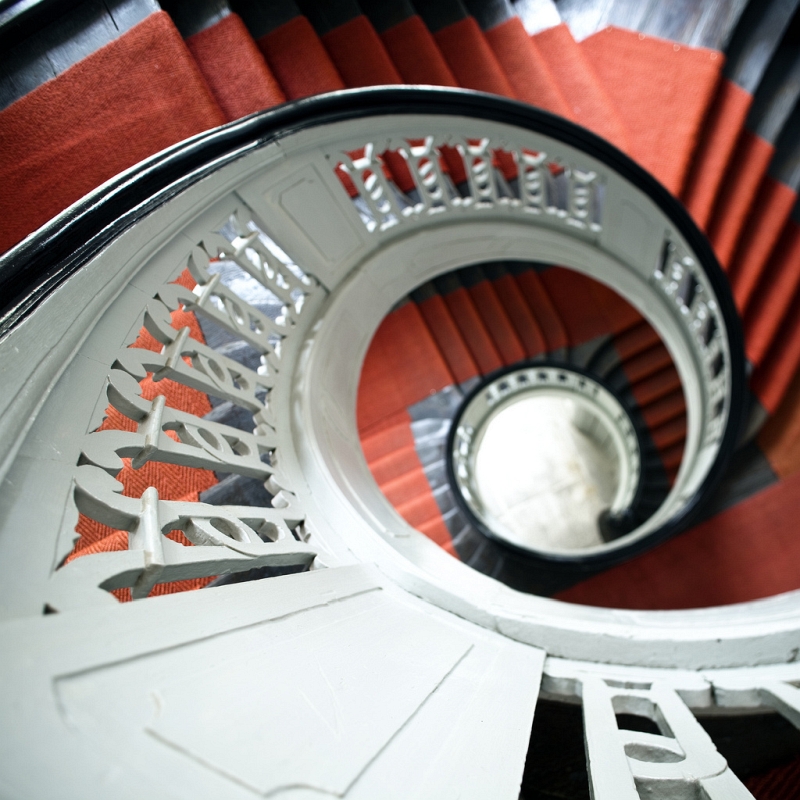
Eisfeld treats stairwells like instruments with interchangeable moods. A silhouette that reads almost like a lightbulb outline against cream walls. A crisp white square well with wooden rails and hanging globes. Dust and debris in an abandoned rectangular shaft. An olive-and-mustard upward view with a rounded “Q” void repeating floor by floor. Peeling ochre paint turning decay into surface drama. A plunging red-carpet spiral with white cutwork banisters. Across six frames the constant is centering: find the axis of the well, then decide whether beauty or ruin is the story.
23. Sergey Alimov — blue wall teardrop spiral
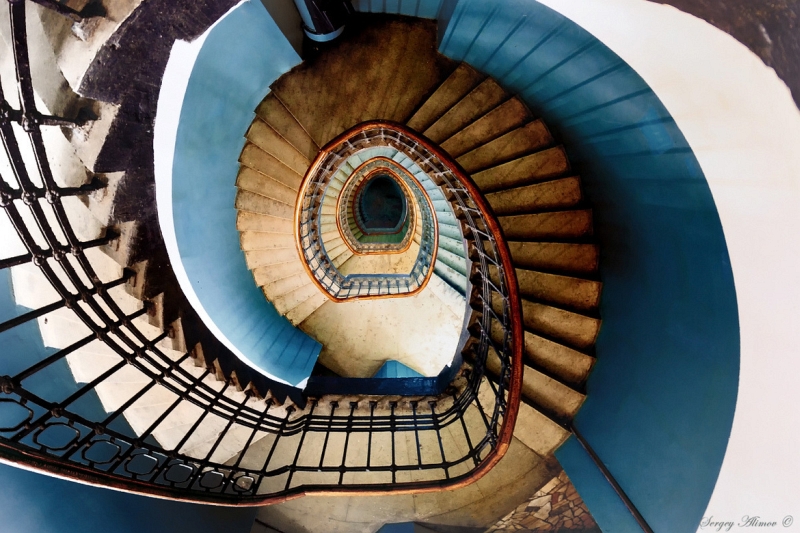
Medium-blue walls hug a teardrop-shaped descent of worn beige stone and black iron with a brown handrail. Color contrast does half the composition; the irregular plan does the rest. Perfect circles are not required—odd wells often feel more alive because your eye cannot predict the next turn.
24. Stacy White — perforated metal monochrome
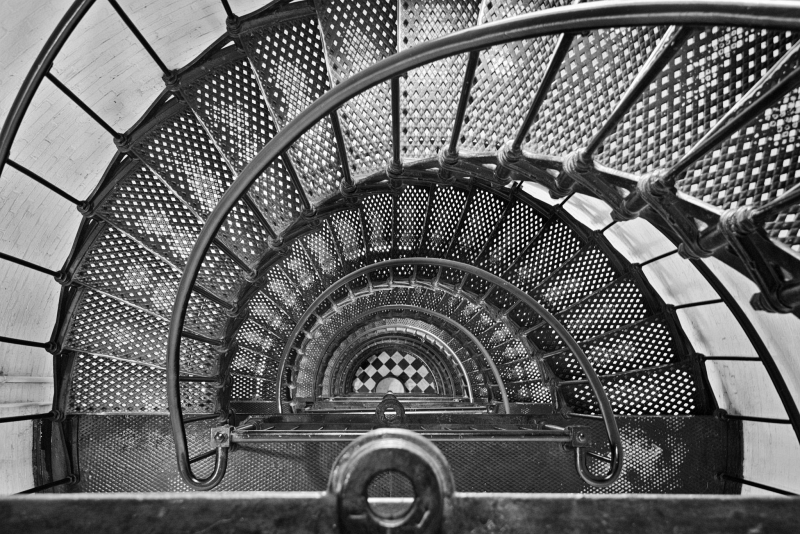
Diamond-grid metal treads, tubular rail, checkered floor at the bottom—black and white makes industrial texture sing. Light leaking through perforations doubles the pattern onto walls. Material is the subject; the spiral is only the delivery system.
25. Udo Dittmann — blue treads and white twist
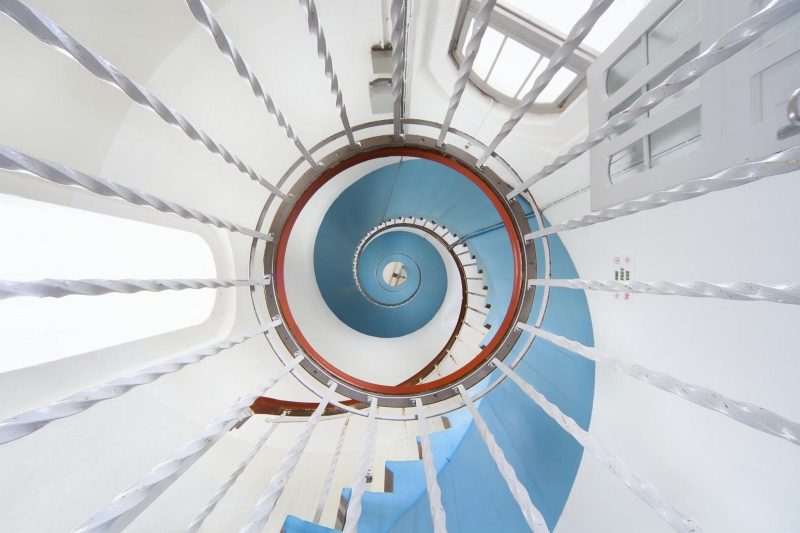
Looking up: sky-blue tread tops, reddish-brown rail, twisted white spindles radiating like spokes. Bright windows and pale walls keep the mood airy rather than dungeon-dark. Clean domestic modernism still rewards the same vertical commitment as museums and ruins.
26. vulturelabs — cream stone and royal blue iron
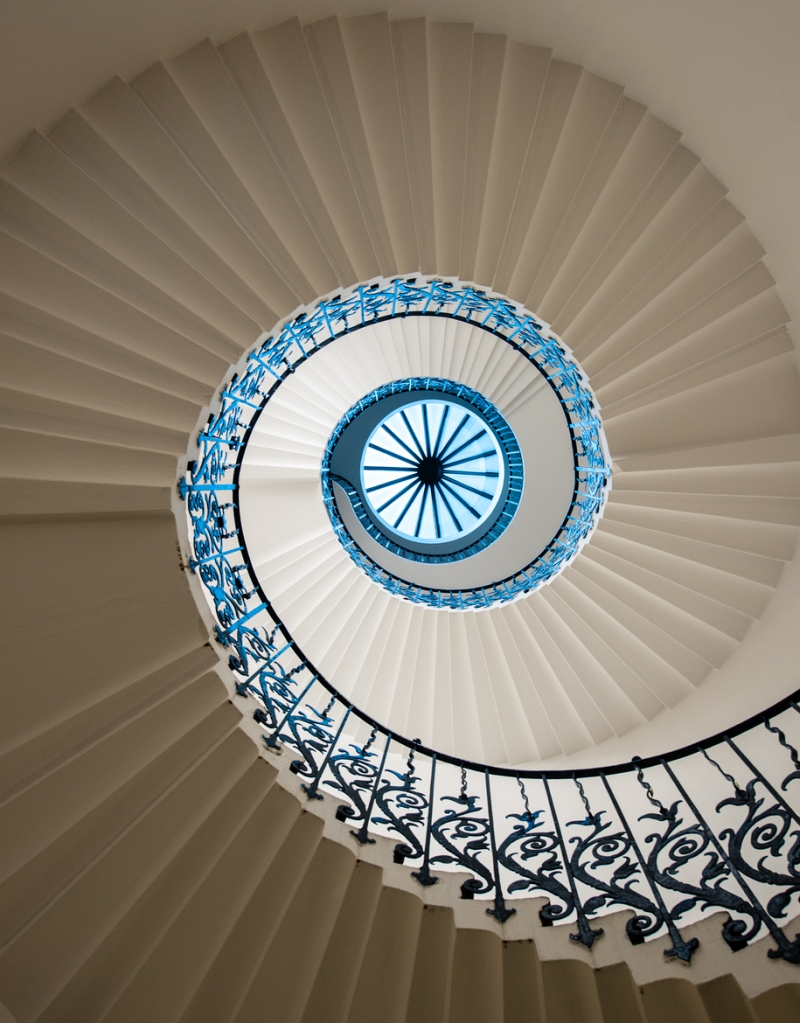
Fan-blade cream undersides and a dark-blue scrolled railing aim at a spoked skylight with real sky beyond. The blue-on-cream pairing is almost heraldic—elegant, restrained, and centered hard enough that the photograph feels inevitable. End on craft: when railing color and sky agree, the spiral stops looking clever and starts looking complete.
Shooting notes from the set
Carry a wide lens for tight wells, watch for people who become accidental scale models, and prefer one decisive axis over a casual tilt. Tripods help in dim atriums; permission matters in museums and private buildings. Try both directions—up for soffits and skylights, down for floors, carpets, and fountain centers. Monochrome clarifies structure; color can become the structure when walls or carpets already shout.
The next time a stairwell opens under your feet, pause before you climb. Stand in the middle if you safely can, look both ways, and wait for a moment when the geometry is quieter than the crowd. The creative staircase photograph is rarely the one you grab while hurrying to the next floor—it is the one you make when the staircase itself becomes the destination.

Comments
Continue reading
Dramatic Photo Art by Sukron Ma’mun (Ipoenk Graphic)
Cirebon, Indonesia photographer Sukron Ma’mun uses theatrical natural light to frame village life, play, and place in lyrical photo art.

Bird’s-Eye Views: Florian Beaudenon’s Instant Life
Paris photographer Florian Beaudenon’s Instant Life series captures people in their rooms from above—intimate, collaborative overhead portraits of everyday joy.
Abandoned Cars Reclaimed by Nature: Rust, Growth, and Quiet Ruin
When neglected vehicles are left outdoors long enough, rust, moss, and trees rewrite them into strange still lifes—sad, photogenic, and slowly returning to the ground.