
Mark Littlejohn: Misty Lake District Landscapes from Early Walks
Scottish-born photographer Mark Littlejohn turns Ullswater mornings and Lake District weather into quiet, award-noticed landscapes of mist, reflection, and local light.
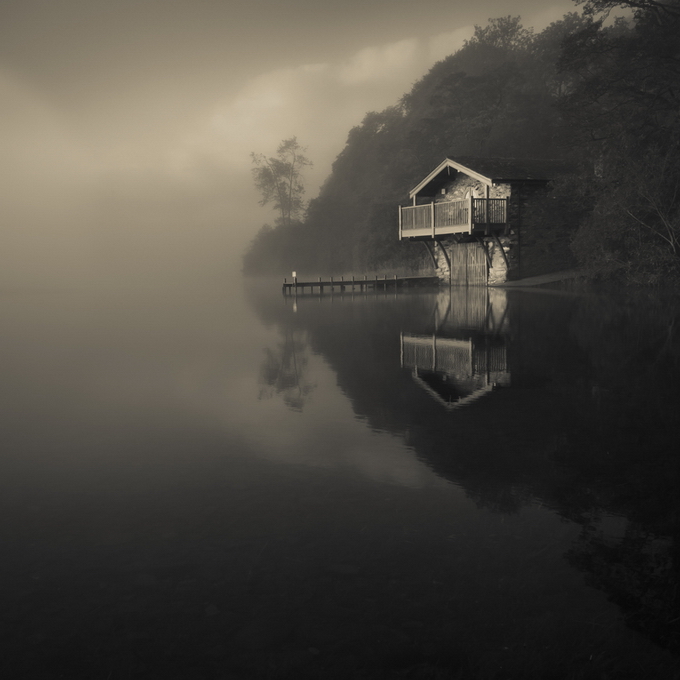
Mark Littlejohn photographs the English Lake District the way a local walks it: early, repeatedly, and with more interest in weather than in postcard viewpoints. Born in Scotland and later based near Penrith on the edge of Ullswater and the Eden Valley, he came to the camera as a way to freeze moments from ordinary walks. What began as a pastime around misty mornings and lake reflections grew into a body of work that magazines noticed and awards later recognized—still rooted in the same quiet shoreline light that first pulled him outdoors.
His pictures do not shout for exotic destinations. They argue that atmosphere close to home can be enough. Sunrise and sunset matter because that is when lakes hold color longest and when fog still hangs in the valleys. The drama is meteorological rather than touristic: low cloud, mirrored water, a ridge half-erased by haze. Browse a selection of his Lake District work and you meet the same motifs again and again—not because he ran out of subjects, but because he treats familiar water as a lifelong study.
From early walks to a serious landscape practice
Littlejohn has described himself as a latecomer to landscape photography. He did not arrive with a polished technique borrowed from workshops. He arrived with curiosity about Ullswater and the surrounding fells, and with a stubborn preference for discovering what interested him by going out rather than by copying a checklist of famous viewpoints. That origin story still shows in the work. The compositions feel walked into, not scouted from a guidebook. Paths, shorelines, and weather windows matter more than branded “must-shoot” summits.
Living near Penrith puts him between lake country and the Eden Valley—close enough to chase conditions without turning every session into a multi-day expedition. That geography shapes his ethic. Why constantly travel for spectacle, he has suggested in interviews and profiles, when a strong image can sit a short drive from home? The Lake District rewards that patience. Mist can rewrite a familiar bay overnight. Autumn color can arrive in patches rather than as a single theatrical blaze. Winter light can flatten or silver the same stretch of water depending on cloud height. A photographer who returns often learns those moods the way a sailor learns tides.
He also tends to favor the less crowded view. Popular lakeshores fill quickly at golden hour; quieter angles require earlier alarms and longer acquaintance with a place. Littlejohn’s preference for early light is practical as well as aesthetic. Soft dawn haze softens hard edges, lengthens reflections, and keeps the frame from filling with hikers. It also matches the emotional register of much of his work: contemplative rather than triumphant, more about immersion than conquest.
Mist, water, and the Lake District as subject
Look for three recurring elements in Mark Littlejohn’s landscapes: water as mirror, atmosphere as subject, and landforms as quiet structure. Ullswater and neighboring lakes become both location and collaborator. When the surface is still, hills and sky duplicate themselves; when wind arrives, the duplicate breaks into texture. Mist does not merely decorate the scene—it edits it. Distant ridges vanish, midground trees become silhouettes, and foreground stones or reeds gain unexpected importance because everything else has been simplified.
That simplification is why his photographs can feel painterly without imitating painting. Watercolor-like soft edges appear when fog is thick; sharper graphic structure appears when air clears and shorelines cut cleanly across the frame. Sunrise and sunset supply warm bands across cooler water, but he does not seem to chase neon drama for its own sake. The color is often restrained: pearl greys, muted greens, a thin line of peach along a ridge. Emotion comes from stillness and scale, not from overcooked saturation.
Because he works locally and repeatedly, seasonal change becomes a narrative. Spring brings fresh greens against remaining winter browns. Summer can be harder—harder light, busier paths—yet early starts still deliver quiet water. Autumn is famous for Lakeland color and for morning fog as temperatures swing. Winter offers bare trees, low sun angles, and days when the lake looks like hammered metal. Across those seasons, the same photographer’s habits remain: walk, wait, react to conditions instead of forcing a preconceived “hero shot.”
A reactive, conditions-first approach
Profiles of Littlejohn often emphasize that he is conditions-dependent. He is less interested in flat light rescued later in software than in being present when the landscape itself becomes exciting. That stance treats photography as fieldwork. If the weather is dull, the answer may be to wait, move, or come back—not to invent drama on a screen. Processing still matters; he has spoken about using tools such as Lightroom to enhance the mood he felt at the time. The key word is enhance. The atmosphere originates outdoors.
That reactive method also explains why his portfolio rewards slow looking. A single misty morning image may look “simple”: lake, hills, sky. Stay with it and notice how much of the frame is transition—fog thinning, reflection fading, a small bright opening that tells you where the sun is trying to break through. Those transitional moments are hard to schedule. They are why an early trek along the shore can outperform a midday visit to a famous viewpoint.
His path from hobbyist to published and awarded photographer is part of the story without becoming the whole story. By the early 2010s his Lake District images were circulating widely enough to draw magazine attention; recognition in major UK landscape competitions followed, including a Landscape Photographer of the Year win in 2014 and multiple commendations in later years. Those milestones matter as proof that careful local work can travel. They do not change the basic invitation of the pictures themselves: go out early, stay near water, and let weather do half the composing.
How to look at these Lake District frames
When you browse Mark Littlejohn’s misty mornings and lake reflections, try reading them as studies rather than as souvenirs. Ask where the camera stood relative to the water—low enough to emphasize reflection, high enough to show shoreline shape? Ask what the fog is hiding and what it is revealing. Notice whether the brightest area is a sunrise band, a patch of open sky, or a silver highlight on the lake. Those choices decide whether the photograph feels hushed, hopeful, or stark.
Also notice what is absent. There is often little human clutter. Boats, paths, and distant buildings may appear, but they rarely dominate. The Lake District is heavily visited; omitting the crowd is itself a craft decision, usually paid for with timing. Early light and lesser-known angles become tools for protecting the sense of solitude that many people come to the Lakes hoping to feel.
If you photograph landscapes yourself, Littlejohn’s example is useful precisely because it is not glamorous travel advice. It is a case for depth over distance. Learn one stretch of water through seasons. Treat sunrise not as a cliché but as a working window. Accept that some mornings will be empty of magic and still walk them, because the mornings that are not empty cannot be predicted from a couch.
What would your nearest lake or river look like if you met it only at dawn for a month? Mark Littlejohn’s photographs suggest an answer: more varied, more atmospheric, and more personal than any single postcard from farther away.

Comments
Continue reading
Dramatic Photo Art by Sukron Ma’mun (Ipoenk Graphic)
Cirebon, Indonesia photographer Sukron Ma’mun uses theatrical natural light to frame village life, play, and place in lyrical photo art.

Bird’s-Eye Views: Florian Beaudenon’s Instant Life
Paris photographer Florian Beaudenon’s Instant Life series captures people in their rooms from above—intimate, collaborative overhead portraits of everyday joy.
Abandoned Cars Reclaimed by Nature: Rust, Growth, and Quiet Ruin
When neglected vehicles are left outdoors long enough, rust, moss, and trees rewrite them into strange still lifes—sad, photogenic, and slowly returning to the ground.