
Superheroes in Nature by Benoit Lapray
In The Quest for the Absolute, Paris photographer Benoit Lapray sets comic heroes alone in alpine and coastal landscapes until nature becomes the larger character.
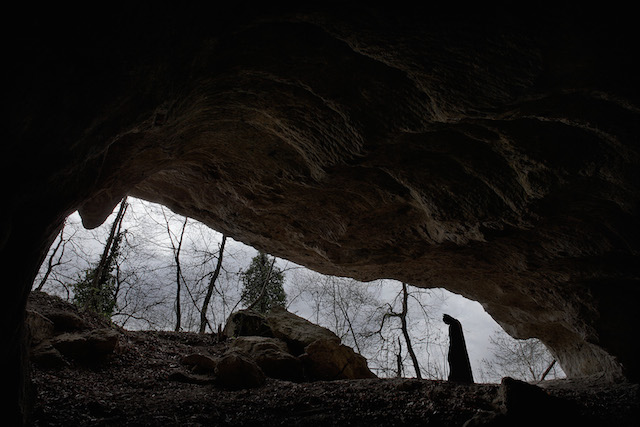
Comic-book heroes usually arrive with cities to save, villains to punch, and skylines that look like product packaging. In Benoit Lapray’s series The Quest for the Absolute, they arrive without any of that. Superman, Batman, Spider-Man, and their peers stand or sit inside open country—French alpine edges, coastal rock, Brittany light, Jura slopes, stretches of southern England—and the landscape does most of the talking.
Lapray, a Paris-based photographer and retoucher who has also worked as a commercial photography assistant, built the series as a study of solitude that refuses to stay lonely. The first read is isolation: capes and masks far from crowds. The second read, which Lapray insists on in his own notes, is partnership. Nature becomes the larger character—more imposing than any vigilante—and the heroes look briefly human-scale against weather, stone, and distance.
The series circulated widely around 2014–2015 across photography and design sites precisely because it was legible without spoiler culture. You recognize the silhouette; you feel the mismatch; you do not need issue numbers. That accessibility is craft, not compromise—pop iconography used as a measuring stick for landscape scale.
What the series is actually about
Lapray has described the work as being about loneliness, introspection, beauty, nature, and force. Extraordinary beings, he argues, often live solitary lives even when their mythologies are crowded with sidekicks. Placing American comic icons alone in countryside settings makes that solitude visible. Yet the solitude is incomplete: the land is not empty backdrop. Cliffs, water, fog, and sky press forward until the costume starts to look like a small bright detail in a larger weather system.
That reversal is the series’ quiet joke and its seriousness. On a comics page, the hero dominates the panel. In Lapray’s frames, the panel belongs to geology and light. The figures still carry their iconography—silhouette, color, pose—but they no longer command the frame the way a poster would demand. You notice how little space a famous body occupies when the horizon is honest.
Locations as co-authors
The original circulation of the work pointed to terrains Lapray used as stages: Haute-Savoie and the Haute-Alpes, Brittany, the Jura, and southern England among them. These are not generic stock mountains. They are walkable European landscapes with their own weather habits—hard light on rock, wet greens, sea haze, alpine cold. Choosing them matters because the series needs believable scale. A fake matte-painting mountain would turn the project into costume fan art. Real distance keeps the heroes slightly absurd and slightly reverent at once.
Commercial retouching skill is part of how the images hold together. Lapray’s practice sits between photography and constructed image-making; the series is widely discussed as photographic work with digital finishing rather than candid street documentary. The finish is careful enough that costume and cliff share one climate, one color temperature, one gravity. Seams exist for those who hunt them; the emotional register does not depend on pretending Photoshop never happened. It depends on whether the loneliness feels earned.
Costume accuracy matters less than costume clarity. A readable cape line against fog does more narrative work than microscopic logo fidelity. Lapray’s retouching background helps here: commercial images train you to make a product legible at thumbnail size. These heroes remain legible when reduced—useful for a series that lives as much online as on a gallery wall—while the surrounding land keeps enough texture to punish lazy backgrounds.
Romanticism without the city
Writers covering the series have linked it to a contemporary revival of romanticism: small figures, large nature, inward mood. Classic romantic painting often put wanderers on cliffs to measure the self against the sublime. Lapray swaps the wanderer’s cloak for licensed myth—Batman in a cave mouth, Wonder Woman at water, a speedster cutting through grass—and asks what remains of the sublime when the wanderer can, in fiction, move planets.
What remains is pause. These are not fight scenes. They are off-duty portraits, or pilgrimage portraits, depending on how you read the faces you cannot fully see under masks. The question hanging over the set is not “who wins?” but “what are they seeking when no one needs saving?” Lapray’s own text suggests a quest toward an absolute—existential rather than criminal—shared with nature as ally. Whether you take that framing literally or treat it as poetic scaffolding, the pictures still work as studies of costume against weather.
How to look at the two images here
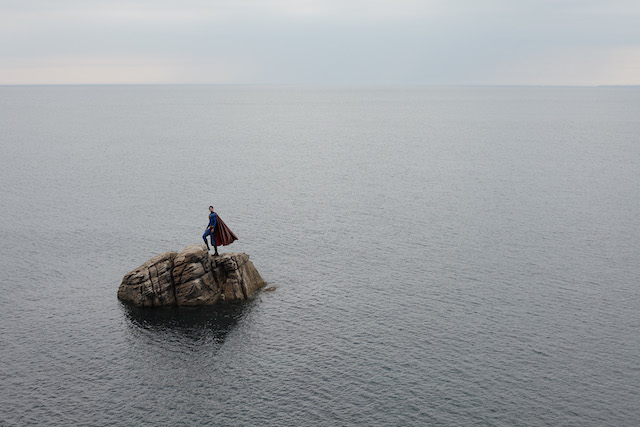
Give the landscape the first five seconds. Name the weather: hard sun, overcast, wind you can almost map on grass or water. Only then inventory the hero—colors, stance, where the feet meet ground. Notice whether the figure feels planted or perched. Notice how much negative space Lapray leaves around the body. Crowding would turn the project into a cosplay catalogue. Space is the argument.
Then look for the second character Lapray names: nature as presence. Is the land sheltering the figure, dwarfing it, mirroring a cape line with a cliff edge, or simply continuing as if the hero were a temporary guest? That relationship changes from frame to frame across the wider series—Spider-Man against cavernous rock, Superman offshore, quieter walks through trees—but the rule stays stable. The land is not wallpaper.
Why the series still lands
Superhero imagery saturates advertising, trailers, and memes until costumes risk becoming noise. Lapray’s move is subtractive. Remove the city. Remove the crowd. Remove the punch. What is left is a person-shaped myth standing where hikers stand, looking small in the useful way. The pictures do not need you to know continuity or crossover events. They need you to recognize the costume and then feel the mismatch of scale.
For photographers, the series is also a reminder that composite craft can serve mood instead of spectacle. The technical feat is not “look how real the cape is.” The feat is atmosphere: one climate shared by fiction and geography. For comics readers, it is a sideways character study—power idle, landscape active.
Collectors and print editions later extended the life of individual frames, but the conceptual unit remains the series: repeated encounters with the same rule under different weather. Looking at only one image teaches the joke; looking at several teaches the method. Repetition without sameness is how Lapray keeps pop symbols from exhausting themselves.
When you leave the page, try carrying the framing into ordinary walks. A bright jacket on a ridge, a cyclist on an empty coastal road, anyone briefly solitary against a wide view—these are Lapray’s afterimages without the license. The absolute he aims at is not a plot spoiler. It is the moment a famous silhouette stops commanding the story and starts sharing it with wind, rock, and distance—an alliance that makes even invulnerable figures look thoughtfully, productively small.

Comments
Continue reading
Dramatic Photo Art by Sukron Ma’mun (Ipoenk Graphic)
Cirebon, Indonesia photographer Sukron Ma’mun uses theatrical natural light to frame village life, play, and place in lyrical photo art.

Bird’s-Eye Views: Florian Beaudenon’s Instant Life
Paris photographer Florian Beaudenon’s Instant Life series captures people in their rooms from above—intimate, collaborative overhead portraits of everyday joy.
Abandoned Cars Reclaimed by Nature: Rust, Growth, and Quiet Ruin
When neglected vehicles are left outdoors long enough, rust, moss, and trees rewrite them into strange still lifes—sad, photogenic, and slowly returning to the ground.