
Stage of Mind by Jee Young Lee
Korean artist Jee Young Lee builds surreal self-portrait stages in a tiny Seoul studio—handmade sets, no Photoshop backdrops, photographed from the inside.
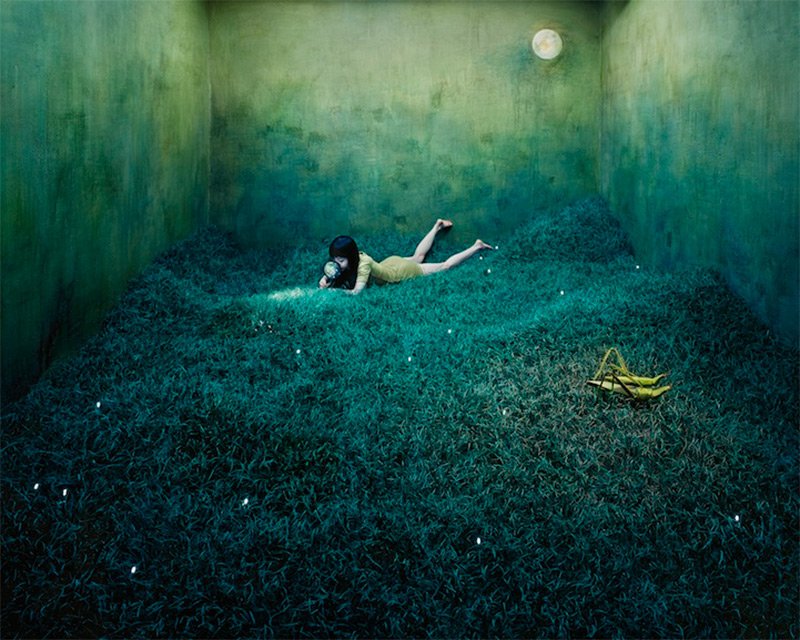
Jee Young Lee is a Korean artist who builds entire worlds inside a room scarcely larger than a storage unit, then photographs herself inside them. The backdrops are not digital composites pasted behind a model. They are physical stages—painted, papered, flooded, stacked with objects—constructed in her Seoul studio measuring about 3.6 × 4.1 × 2.4 meters. The finished images look like dreams with carpentry. Patience is the invisible medium: weeks or months of making often collapse into a single exposure that has to carry the whole fiction.
A studio the size of a constraint
Working small forces invention. When walls are close, perspective becomes a tool: floors tilt in paint, corridors are suggested with diminishing props, and color fields do the work that landscape acreage would do outdoors. Lee’s practice turns limitation into grammar. The viewer reads “elsewhere”—sea, forest, ruined interior, symbolic weather—while the production reality remains a sealed box in the city. That double knowledge is part of the pleasure. Once you learn the room’s true size, every image becomes a puzzle about how she stretched space without software shortcuts.
Self-portraiture keeps authorship tight. She is builder, performer, and photographer of the same scene. The body in the frame is not a hired stand-in illustrating a mood board; it is the person who mixed the paint and waited for the glue to dry. Themes draw from personal life—emotional weather, transitions, memories that refuse to stay politely in the past—translated into objects and architecture rather than diary captions. You do not need the private key to feel the charge; the sets are legible as states of mind because they behave like theaters of feeling.
Handmade surrealism, not filter surrealism
Contemporary photography is crowded with one-click impossibility. Lee’s work belongs to a slower lineage: constructed photography, installation meeting the camera, the still from a play that was never staged for an audience. Paper flowers, painted waves, hanging threads, stacked furniture, and meticulous color control create illusions that still show the labor of edges and seams if you look carefully. Those seams are not failures. They are evidence that the dream was built by hand.
Because the scenes are physical, light behaves honestly. Shadows fall where bulbs and openings put them. Reflections obey geometry. When water appears, it has weight and risk inside a real room. That material stubbornness gives the images a density CGI often lacks—even when the content is fantastical. The camera does not invent the world; it records a temporary architecture of symbols.
Reading a Stage of Mind image
Start with scale. Find the human figure and measure the room against her. Then track recurring tactics: flooded floors that turn interiors into shallow seas; walls that open onto painted infinities; domestic objects asked to act mythically. Ask what emotion the color temperature suggests—cold blues, bruised purples, fever warm reds—before you hunt for a single “meaning.” Lee’s titles and series framing help, but the photographs are built to be inhabited visually first.
Notice duration implied by craft. A background that looks airbrushed smooth may be layers of pigment and paper. A “landscape” may be a painted scrim a few feet behind the subject. The longer you look, the more the miracle relocates—from “How is this possible?” to “How long did this take, and what was destroyed when the next set began?” Temporary worlds are expensive in hours. That cost sits inside the stillness of the final print.
Performance without an audience—until the print
While constructing, the artist lives with the set as roommate. Sleep, work, and doubt share square meters with unfinished illusions. Entering the finished stage to be photographed is a last act of performance: costume, pose, and expression must complete a narrative the walls already half-tell. Unlike theater, there is no nightly repeat. Once dismantled, the set survives mainly as image. That ephemerality sharpens why the photograph matters. It is the archive of a place that existed briefly for one person’s psychic weather and for anyone later willing to look.
Self-portrait constructed work also negotiates privacy. The artist appears, yet the scenes are masks as much as revelations. A figure turned away, a face half-hidden, or a body small in a large-feeling set can protect intimacy while still offering presence. Viewers project their own stories into the gaps—an intended hospitality of surrealism when it is not over-explained.
Context: Seoul studio practice, international walls
Lee’s reputation grew as images of these painstaking interiors circulated through art and photography platforms, drawing attention to process as much as to final frames. Exhibitions have carried the work beyond the studio; one early European presentation noted in coverage of this series was at OPIOM Gallery in Opio, France (February 7–March 7, 2014). Dates and venues change across a career; what stays consistent is the proposition: a small room can hold an outsized inner landscape if the builder is stubborn enough.
Pairing her with peers in constructed photography is useful only up to a point. Some artists lean on models and crews; others lean on heavy post-production. Lee’s signature is the unity of maker and subject inside a craft-heavy box. Comparisons can locate her historically; they should not erase the specific patience of painting a horizon that will be torn down after the shutter clicks.
Why the work still lands
Screens train us to distrust images. Paradoxically, learning that these scenes are “real sets” restores trust of a different kind—trust in labor. In an era of instant generative backdrops, a flooded studio floor and a handmade paper forest read as almost radical. The surreal becomes credible because someone risked time and bodily scale to make it. Viewers who build anything—sets, meals, code, gardens—recognize the ethic: iteration until the room finally matches the feeling.
There is also a quiet feminist and autobiographical current in controlling the entire pipeline of image-making. The artist is not waiting to be directed inside someone else’s fantasy. She authors the fantasy, then steps into it on her own terms. That control does not make the work cold; the vulnerability is relocated into symbols and space rather than into confessional text.
How to sit with the photograph
Give it longer than a scroll. Let your eye travel the perimeter for construction clues, then return to the figure’s posture. Imagine the smell of paint and damp if water is present; imagine the heat of lamps. Wonder what was sacrificed for the composition—what corner of real life was postponed while the set consumed the calendar. Then release the logistics and let the emotional weather of the color field work on you the way a short film’s establishing shot does.
Jee Young Lee’s Stage of Mind pictures argue that imagination is a construction site. They reward anyone willing to honor both halves of the experience: the dream you feel, and the meter-by-meter room that made the dream photographable. Keep the image in view, remember the studio’s true dimensions, and the surreal tightens instead of floating away—proof that the mind’s stages can be built, lived in briefly, and shared without abandoning the handmade.

Comments
Continue reading
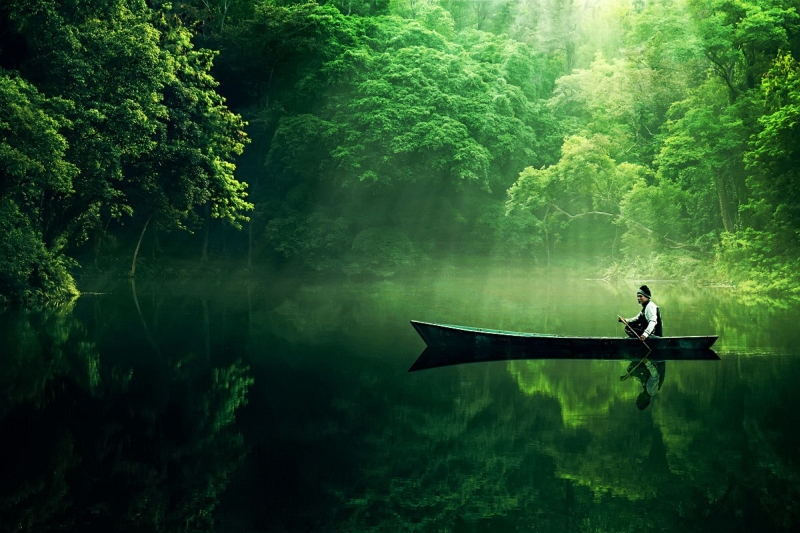
Dramatic Photo Art by Sukron Ma’mun (Ipoenk Graphic)
Cirebon, Indonesia photographer Sukron Ma’mun uses theatrical natural light to frame village life, play, and place in lyrical photo art.
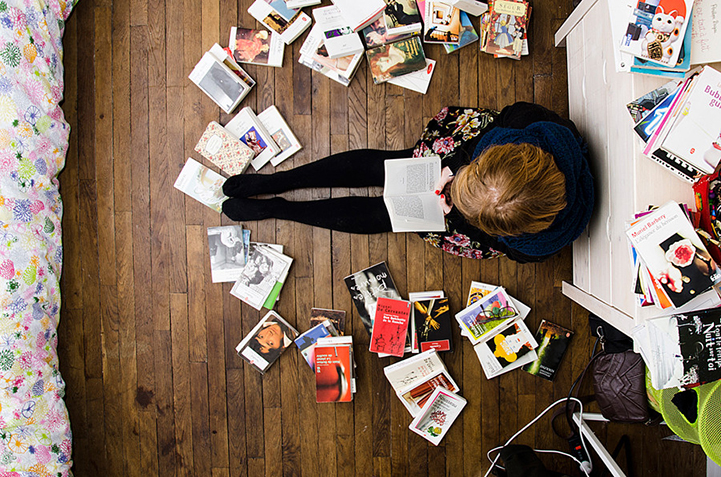
Bird’s-Eye Views: Florian Beaudenon’s Instant Life
Paris photographer Florian Beaudenon’s Instant Life series captures people in their rooms from above—intimate, collaborative overhead portraits of everyday joy.
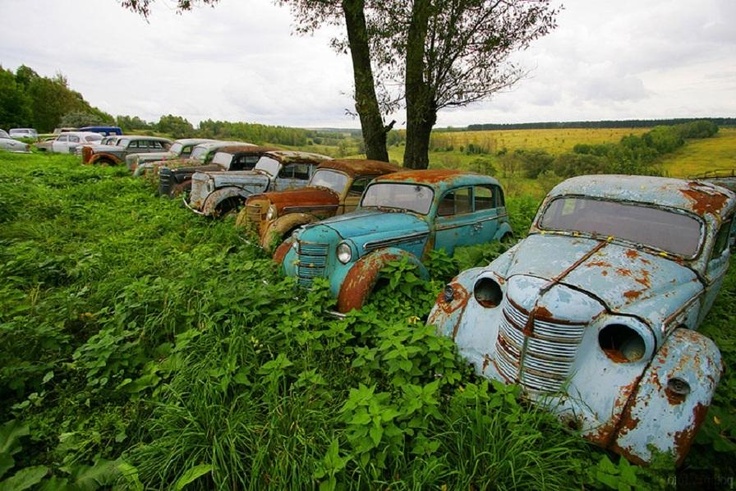
Abandoned Cars Reclaimed by Nature: Rust, Growth, and Quiet Ruin
When neglected vehicles are left outdoors long enough, rust, moss, and trees rewrite them into strange still lifes—sad, photogenic, and slowly returning to the ground.