
Overwhelming Tulip Fields of the Netherlands
Early-to-mid April bloom turns Dutch bulb country into a sea of colour—where to look, how light works, and why the fields stop you cold.
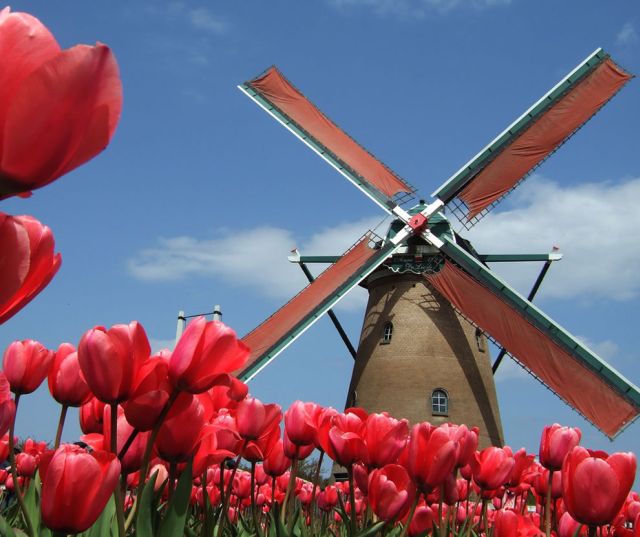
Few landscapes announce spring as loudly as the tulip fields of the Netherlands. When the bulbs open together, commercial strips and garden displays turn into continuous bands of red, yellow, pink, purple, and white—a sea of colour that looks almost unreal until you smell the flowers and feel the wind off the North Sea. Photographers chase that week every year. Travellers book long weekends around it. Locals watch bloom reports the way skiers watch snow.
Peak colour usually lands in early to mid-April, though a warm or cold spring can slide the window by a week or two. Go then if you can. Arrive earlier and you may catch hyacinths and daffodils leading the parade; arrive much later and many commercial fields will already have been headed—flowers cut so the bulbs can strengthen for next season. Timing is part of the experience, not a footnote.
Where the colour concentrates
The classic tulip country is the Bollenstreek, the bulb district around Lisse, Hillegom, Noordwijkerhout, and neighbouring towns between Amsterdam and The Hague. Rectangular plots run toward the horizon in graphic stripes. Keukenhof Gardens in Lisse concentrates millions of bulbs into curated beds, canals, and woodland plantings—a designed spectacle rather than a working field, and still one of the densest floral experiences on earth for roughly two months each spring.
Other provinces add their own chapters. Flevoland and the Noordoostpolder offer vast, newer polder geometries with long, unbroken sightlines. Fields in North Holland near Alkmaar and Schagen can feel quieter than the Lisse corridor on a weekday morning. Wherever you go, remember that many brilliant strips are private farmland. Stay on paths and public edges unless a farm invites visitors. Trampling a row for a slightly better angle is not a harmless souvenir.
The photograph above—the low view through crimson blooms toward a brick windmill with terracotta sails—compresses everything people expect from Dutch spring into one frame: flower density, traditional silhouette, hard blue sky. That combination is why the fields overwhelm. Scale does the work. A single tulip is pretty; ten thousand in a block become architecture you can walk beside.
Light, wind, and how to photograph without wrecking the crop
Midday sun can bleach reds and throw harsh shadows between rows. Golden hour at sunrise or sunset rakes light across petal ridges and deepens colour. Overcast Dutch skies wrap beds in soft, even light so saturation holds without blown highlights. After rain, droplets cling to petals and the colours look freshly painted. Many of the strongest field images come from grey mornings rather than postcard blue—though a clear day with a windmill in frame, as here, still stops traffic for good reason.
Composition helps when the subject is already spectacular. Kneel so foreground blooms blur into a colour wash while a windmill, farmhouse, or tree line anchors the distance. A longer lens compresses stripe after stripe into a tapestry; a wider lens makes you feel swallowed by the plot. Avoid stepping into the crop. Farmers notice, and the image is not worth the damage.
Wind is constant on the open polder. Petals flicker; stems lean. Use a faster shutter for crisp edges, or lean into motion for a painterly smear. Either choice is honest to the place. Stillness is rare; the fields are alive with air. Pack a lens cloth, layers, and patience—April in the Low Countries can deliver four seasons before lunch.
Keukenhof and the open fields are different jobs
Keukenhof is choreography: themed borders, bridges, pavilions with rotating indoor displays, and the famous windmill area where visitors gather for the postcard shot. It rewards early entry, waiting for gaps in the crowd, and mixing wide garden views with closer studies of variety plantings. Indoor halls save a rainy hour and show cultivars you might miss outside.
Open fields are rawer. Colour arrives in industrial blocks. Tractors, irrigation lines, and muddy verges share the frame with beauty. That honesty is why so many photographers prefer a dawn drive through the Bollenstreek even if they also buy a Keukenhof ticket. One place is a garden masterpiece; the other is agriculture at its most theatrical. Seeing both explains why the Netherlands owns this particular spring myth.
Crowds intensify on weekends and during school holidays. Weekday mornings and late afternoons are kinder. Parking and bike paths fill quickly near famous viewpoints; a bicycle remains one of the best ways to skim between plots without circling for a space. Check local bloom updates in the days before you travel—colour can surge or fade faster than a fixed itinerary expects.
Colour as design, and as a crop
What overwhelms the eye is not only brightness but order. Growers plant in bands for harvest logistics and for the visual punch that has become a tourist asset. Red against yellow, purple against white, pink fading into cream—the palette is deliberate. From a bridge or a slight rise, the land looks quilted. From inside a row-end, it looks infinite.
Historical depth sits under the spectacle. Bulb growing shaped the region’s economy for centuries. Tulip mania is the famous cautionary tale; the quieter modern story is skilled horticulture timed to a short public window. The flowers that stop buses for photographs are also crops with calendars, labour, and export markets. Knowing that does not diminish the wonder. It explains why the colour vanishes on schedule when fields are headed.
If you visit once, choose mid-April when forecasts and local reports agree the fields are open. Walk slowly. Let one colour block hold your attention before you chase the next. Notice how a windmill or a line of trees gives the eye a place to rest inside the intensity. Then look again at a frame like the red field and mill under clear sky—and decide whether any description can outrun the feeling of standing there when the whole horizon is petals.
Stand at the edge of a red strip with a mill on the horizon, wait for the wind to lean the blooms toward you, and take the picture—or simply look. The tulips will be headed soon enough. That saturated week is what travellers and photographers carry home, and why Dutch tulip fields remain one of the world’s most overwhelming spring destinations.

Comments
Continue reading
Dramatic Photo Art by Sukron Ma’mun (Ipoenk Graphic)
Cirebon, Indonesia photographer Sukron Ma’mun uses theatrical natural light to frame village life, play, and place in lyrical photo art.

Bird’s-Eye Views: Florian Beaudenon’s Instant Life
Paris photographer Florian Beaudenon’s Instant Life series captures people in their rooms from above—intimate, collaborative overhead portraits of everyday joy.
Abandoned Cars Reclaimed by Nature: Rust, Growth, and Quiet Ruin
When neglected vehicles are left outdoors long enough, rust, moss, and trees rewrite them into strange still lifes—sad, photogenic, and slowly returning to the ground.