
Kazuki Yamamoto’s 3D Latte Art: Foam Sculptures in the Cup
Osaka barista Kazuki Yamamoto builds three-dimensional latte sculptures from steamed milk—animals and characters that rise above the rim before heat and time erase them.
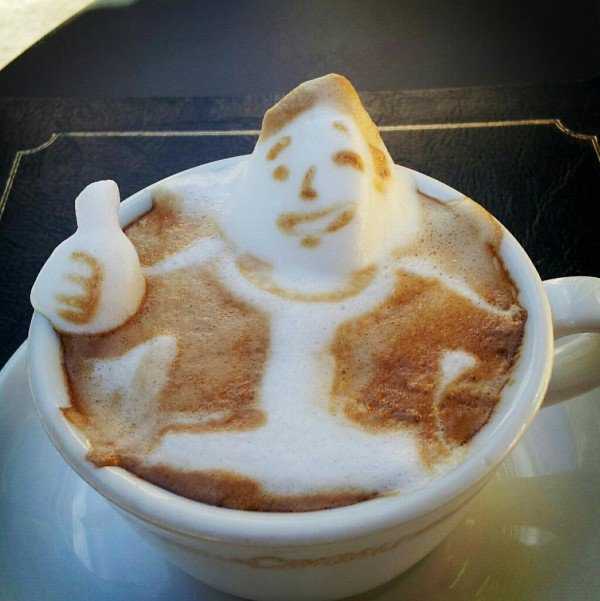
Most latte art lives on a flat plane: a heart, a rosetta, a swan poured in seconds across microfoam. Kazuki Yamamoto, working in Osaka in his mid-twenties when these images first traveled widely, treated foam as sculpture. Using steamed milk, a spoon, a pin, and a patience that ignores how quickly coffee cools, he built figures that rise out of the cup—cats, giraffes, characters, even forms that climb from one mug toward another.
The craft sits at an odd intersection. It is barista work with the constraints of temperature and drinkability, and it is miniature sculpture with a medium that collapses if you hesitate. That tension is why 3D latte art feels more miraculous than poured patterns. You know the material will not last. The photograph becomes the lasting object; the cup is a performance.
From pour to build
Traditional latte art depends on contrast and flow. The barista pours to place white foam against crema, then cuts and wiggles to shape leaves or hearts. Yamamoto’s three-dimensional pieces begin after that vocabulary. Foam must be stiff enough to hold peaks and limbs, yet fine enough to look clean rather than soapy. He shapes with small tools—spoon for volumes, pin for edges and expression—stacking and carving while the drink is still hot enough to serve in spirit, if not always in practice.
Time is the hidden ingredient. A poured rosetta can be finished before the customer’s phone leaves a pocket. A foam giraffe with a reading neck asks for minutes of focus. During those minutes the base cools, the foam settles, and gravity argues with every protruding ear. The winning pieces look inevitable in photos; in the hand they are races against physics.
Yamamoto also kept a parallel practice in flat latte art—portraits, pop icons, manga faces—which shows the same observational control on a two-dimensional stage. The 3D work is not a rejection of pouring skill. It is an expansion: the cup rim becomes a ground plane, and the foam is allowed to leave it.
Cafe 10g and the Osaka context
In the early 2010s he was associated with Cafe 10g in Osaka, a setting where customers could encounter the sculptures as drinks rather than only as viral images. Japan’s cafe culture already rewarded meticulous presentation; Yamamoto pushed the brief toward play. Kawaii cuteness helped the work travel—cats batting at foam fish, characters peeking over ceramic lips—but technique is what separates novelty from craft. Soft ears that hold shape, clean seams between body and drink surface, and compositions that read from a phone thumbnail all require rehearsal.
He documented new pieces frequently on social channels of the time, treating the stream almost like a daily sketchbook. That publishing habit mattered. Ephemeral sculpture needs a record, and the record trained an audience to expect invention rather than a single signature trick. One day a melting clock nodding to Dalí; another day an animal spanning two cups. The through-line is curiosity about what foam will tolerate.
Reading a 3D latte photograph
When you look at a frame like the one on this page, try separating three layers:
- Structure: Where is the weight? A figure that leans without a hidden support will sag; good builds keep mass over the cup’s center or use the rim as a brace.
- Surface: Fine foam reads as fur or fabric; coarse bubbles read as accident. The best pieces look matte and even, like fondant with a coffee scent.
- Story: Is there a gesture—reach, peek, stretch—that justifies the third dimension? Without a gesture, a lump of foam is only taller latte art.
Those criteria keep appreciation grounded. Viral captions call the work unbelievable; craftspeople call it controlled moisture, air, and timing. Both can be true.
Why the multi-cup trick matters
Some of Yamamoto’s best-known ideas refuse the single vessel. A cat reaches from one cup toward fish drawn on the foam of another. Foam becomes a bridge. That move is conceptually sharp: latte art is usually trapped by ceramic walls, and he treats neighboring cups as a tiny stage set. It also raises the difficulty. Two drinks must be prepared in sequence, temperatures managed, and the join aligned before either side collapses.
For viewers, the multi-cup pieces clarify that this is installation thinking at tablespoon scale. The cafe tray is a gallery plinth. The customer is both audience and eventual destroyer of the work.
Ephemerality as part of the medium
People sometimes ask whether you are “allowed” to drink the art. The honest answer is that the art disappears either way. Heat and time melt detail; a spoon ends it faster. Yamamoto’s pieces accept that fate. Photography, for once, is not a lesser copy—it is how the sculpture enters lasting culture. That is a useful reminder for other perishable crafts: ice, sand, plated food, floral work. The discipline can be serious even when the object cannot be archived in a crate.
There is also a sensory irony. The more elaborate the sculpture, the less practical the beverage. Foam piled high changes the ratio of milk to espresso and cools the surface. Some creations are closer to display than to a working barista’s service speed. Holding both truths keeps the coverage honest: this is extraordinary hand skill demonstrated in a cafe vernacular, not a proposal that every morning coffee should take twenty minutes.
What aspiring foam sculptors can steal
Even without matching Yamamoto’s fluency, baristas and home enthusiasts can borrow principles:
- Dial foam texture first. Practice dense microfoam that holds a soft peak before attempting ears and snouts.
- Work from big shapes to small. Establish the torso or head volume, then cut features. Details on a weak base sink.
- Keep tools minimal. Spoon and pin (or toothpick) force clarity; a crowded toolkit slows you down while the drink dies.
- Plan the silhouette. If the outline does not read in black-and-white, more detail will not save it.
- Photograph immediately in diffuse light. Harsh overhead glare erases form; side light reveals it.
None of that reproduces his animals on demand. It does explain why the Osaka work convinced so many editors in 2013: the skill is legible, the humor is light, and the medium remains coffee—everyday, warm, and doomed to vanish.
Look again at the foam figure rising from the cup in the image above. Notice how the mass sits, how the edges are trimmed, how the drink beneath still reads as coffee rather than a prop stand. That balance—between sculpture and beverage—is Kazuki Yamamoto’s real signature. The characters change; the negotiation with melt and gravity does not.

Comments
Continue reading
Thomas Allen’s Book-Cut Illustrations
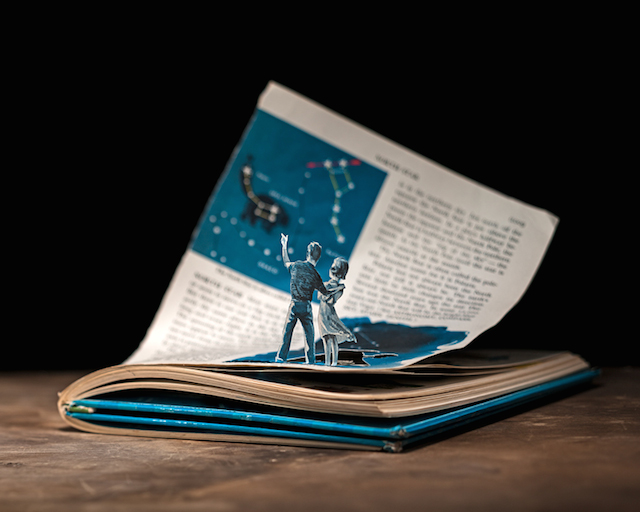
Michigan illustrator Thomas Allen cuts pulp paperback figures into 3D tableaux, photographs them in shallow focus, and gathers the practice in his Aperture book Uncovered.
Ramon Bruin’s Studio 3D Optical Illusion Drawings
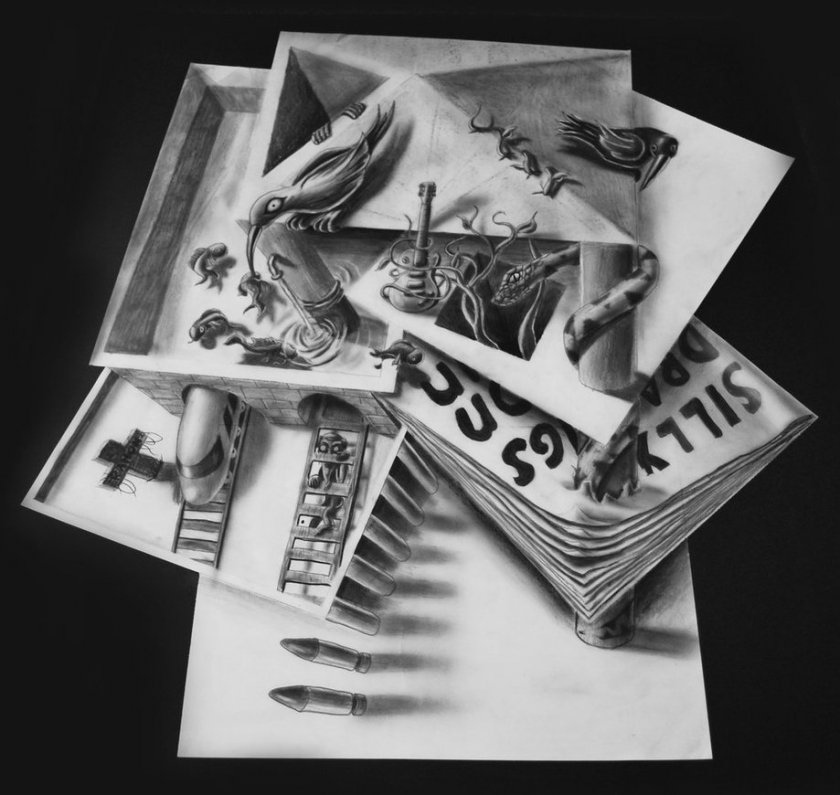
Dutch artist Ramon Bruin builds tabletop anamorphic drawings on stacked paper—airbrush and graphite illusions locked to a single camera angle.
3D Origami Sculptures by Jaroslav Mishchenko
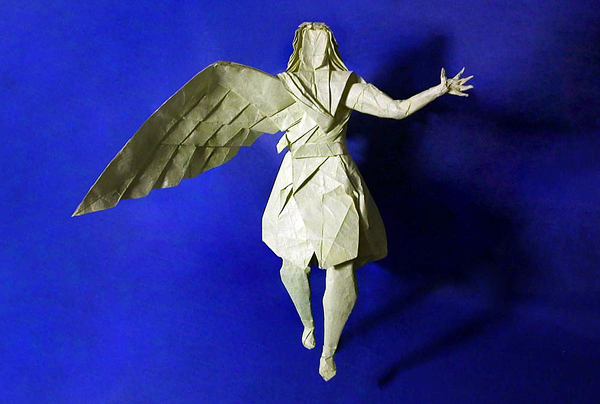
Kyiv artist Jaroslav Mishchenko folds painted three-dimensional origami sculptures—animals, objects, and abstract forms—where crease, color, and careful light share the work.