
Float and Fly With the Wind: Carnival Thrills and Dream Lift
A gallery essay on weightlessness—fairground swings, surreal bird-towed figures, and moon-hung romance—inviting you to look up and let the air carry a thought.
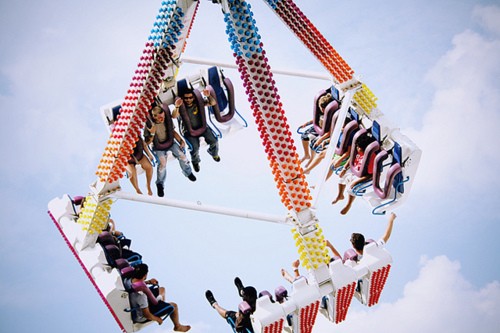
Some images do not ask you to analyze a trend. They ask you to feel air under you—the brief suspension between ground and sky, the moment when gravity seems negotiable. This collection gathers photographs and illustrations that share that sensation: carnival rides arcing into cloud, silhouettes carried by birds, lovers suspended beneath a plane and a painted moon. The invitation in the old one-line caption still holds. Relax. Let the wind take the next thought.
Floating and flying here are less about aviation manuals than about permission—permission to be weightless for a second, to trade errands for sky, to remember that bodies can still surprise themselves with lift. Browse the set as a mood, not as a catalog of brands or destinations. The subject is the feeling of being carried.
The fairground as temporary flight
Amusement parks industrialize the dream of flying. Steel arms, chains, and harnesses manufacture a few seconds of free fall and swing that the body reads as danger wrapped in safety. Shot from below, a pendulum ride becomes architecture against cloud: passengers’ legs dangling, arms raised, the machine tilted at its highest point. Colorful lights climb the white frame; purple restraints hold people who are, for that instant, more sky than sidewalk. The photograph freezes what riders feel in their stomachs—the pause at the top before the drop.
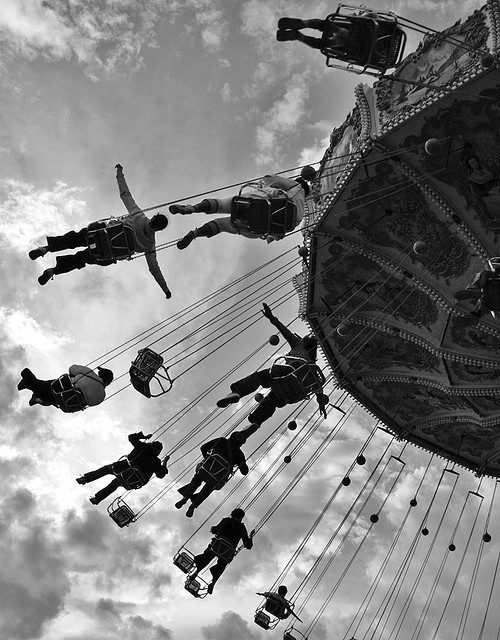
Chair swings offer a different grammar of flight. From underneath, the circular canopy becomes a dark ornament, and the riders fan outward on long chains like a living mobile. One person stretches both arms wide, as if the pose could complete what the ride already started. Black-and-white intensifies the silhouette: people become shapes of trust and thrill against a luminous sky. Nostalgia lives in these frames too—summer light, shared screams, the smell of fried food somewhere outside the shot, the music that always seems slightly too loud.
These fairground pictures matter because they are democratic. You do not need a pilot’s license to borrow the sky. You buy a ticket, buckle in, and for a minute the wind is not metaphor. It is force against your face and pressure in your chest. That accessibility is part of why carnival flight photographs keep circulating: they show ordinary people briefly rearranged by air.
Surreal lift: birds, moons, and improbable tows
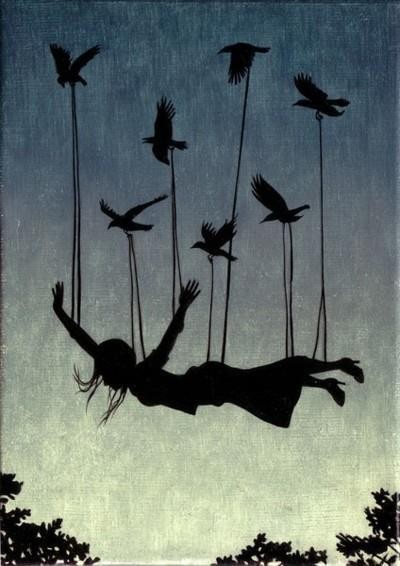
Where the fairground uses engineering, illustration uses dream logic. A figure in a dress drifts horizontally while dark birds pull strings from wrists, waist, and ankles—part marionette, part migration. The gradient sky and treeline far below insist on height. The mood is whimsical and a little haunted: freedom that still depends on thin lines and other creatures’ wings. Nothing in the frame is accidental; every tether is a statement about how lift works in stories.
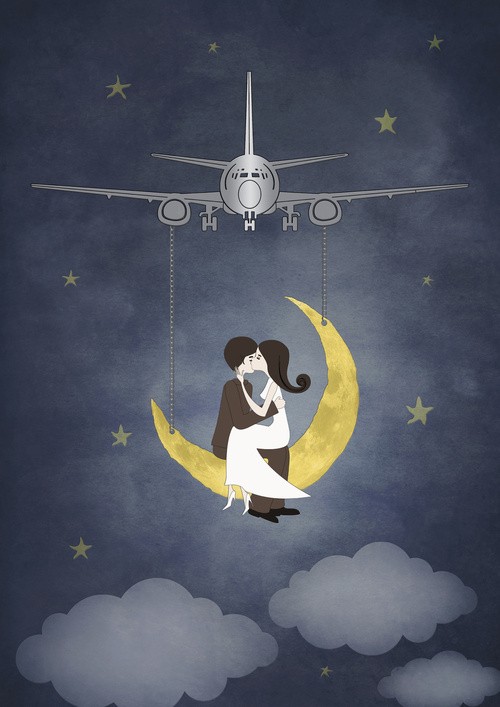
Elsewhere, a couple kisses on a yellow crescent moon hung by slender chains from the landing gear of a jet. Stars scatter on a navy field; soft clouds gather below. Romance becomes literal altitude. The image refuses realism on purpose. It says that intimacy can feel like being carried, and that flight can be tender rather than only thrilling. The airplane is almost comic in its scale, which keeps the sweetness from turning sticky.
These surreal pieces sit beside the carnival photos for a reason. Both insist that floating is an emotional state as much as a physical one. One version is mechanical and public; the other is private and impossible. Together they sketch a spectrum of escape—from the ticketed scream to the quiet fantasy you keep to yourself on a hard day.
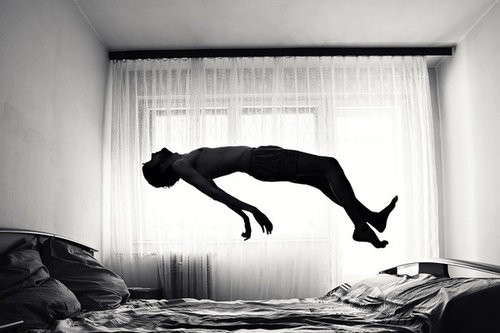
What the body remembers about air
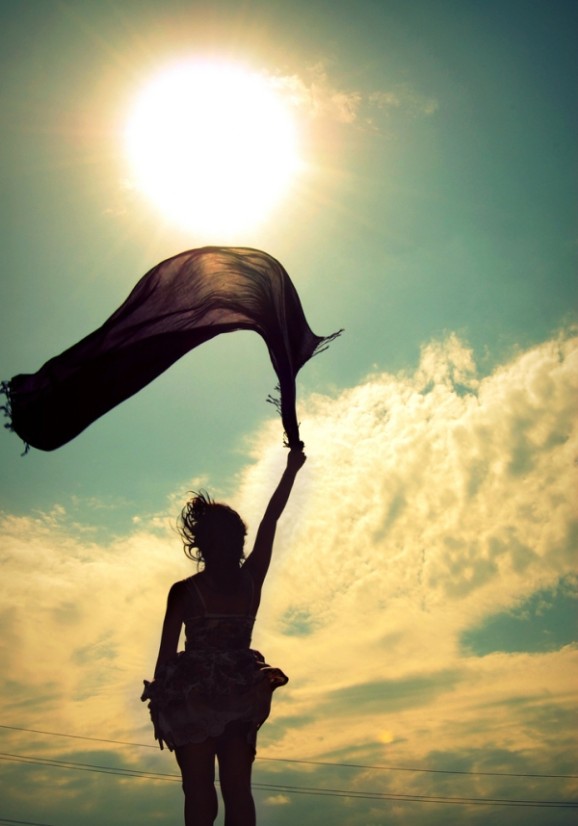
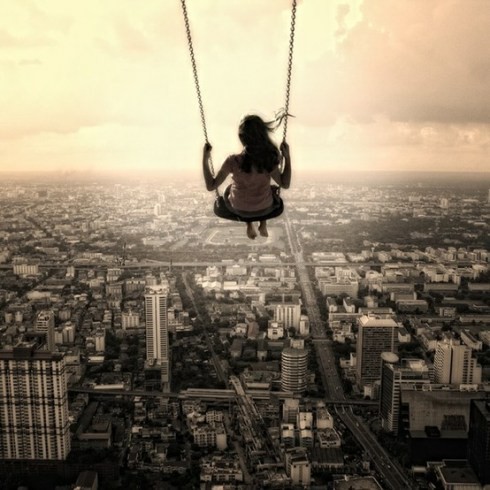
Watch enough of these images and patterns appear. Low camera angles enlarge the sky until pavement disappears. Limbs extend. Hair and clothing trail as evidence of movement. Safety restraints and chains remain visible—reminders that the fantasy has hardware. Even the most dreamlike drawings keep a tether: string, cable, bird claw, airplane strut. Pure untethered flight is rare in this collection; what we love is controlled release, the feeling of almost-falling that somehow becomes almost-flying.
That tension is why the theme endures across decades of art and snapshot culture. Adults return to fairs partly to borrow childhood’s lighter fear. Artists return to floating figures to picture longing without speeches. Photographers tilt their lenses upward because the horizon of pavement is already over-documented. Wind becomes the shared character: invisible, but proven by every raised arm and every swinging seat.
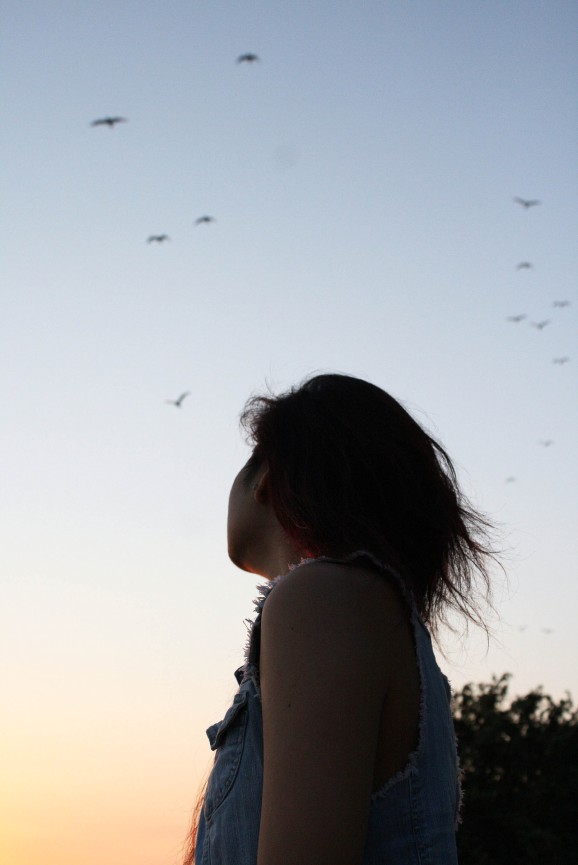
There is also a social reading. In many of these frames, people float together—rows of seats, pairs of hands, a couple on a moon. Lift is shared. Solitary floating appears too, especially in the silhouette-and-birds image, and that loneliness has its own honesty. The collection holds both: communal thrill and private drift.
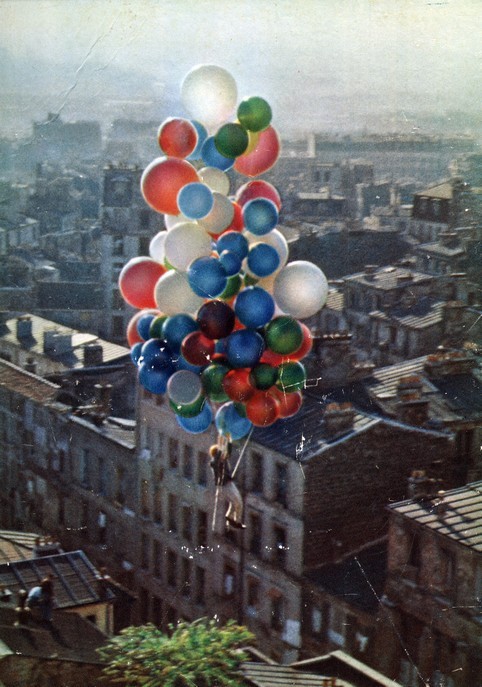
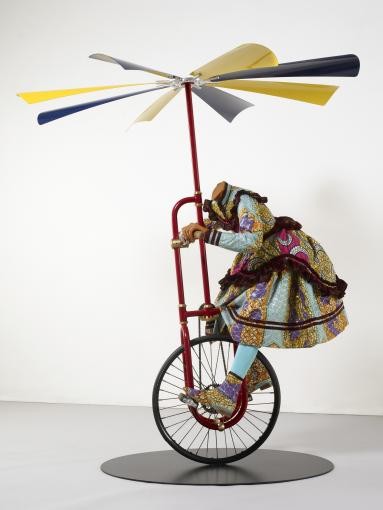
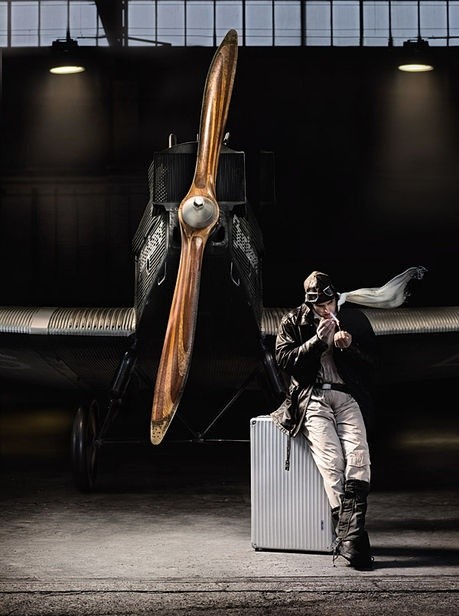
How to look—and how to borrow the mood
Move slowly through the gallery. Give each image a few breaths before scrolling on. Notice whether you feel thrill, calm, or melancholy; different pictures in this set pull different nerves. Ask what is holding the subject up, and what would happen if that hold failed. The answer is often the emotional center of the piece, whether the hold is a harness, a chain, or a flock of drawn birds.
If you make your own pictures, borrow the grammar without copying the props. Shoot from below when you can do so safely. Include sky as a major plane, not a leftover strip at the top of the frame. Catch gesture at the peak of motion—arms open, hair flung, seats at full extension. For illustration, decide whether your wind is kind or demanding, and let strings, birds, or machines show that decision. Soft gradients and hard silhouettes both work; pick one and commit.
You can also take the theme off the page. Stand on a bridge and feel the push of air. Watch laundry billow on a line. Ride something that leaves the ground, even a porch swing at dusk. Lie on grass and track a single cloud until it changes shape. The collection is a mood board for lightness; the practice is noticing when your day still allows a little lift.
When the week feels bolted to the floor, these pictures are a soft counterargument. Unclench. Look up. Somewhere between a carnival peak and a drawn bird’s string, there is still room to float—if only for the length of one held breath.

Comments
Continue reading
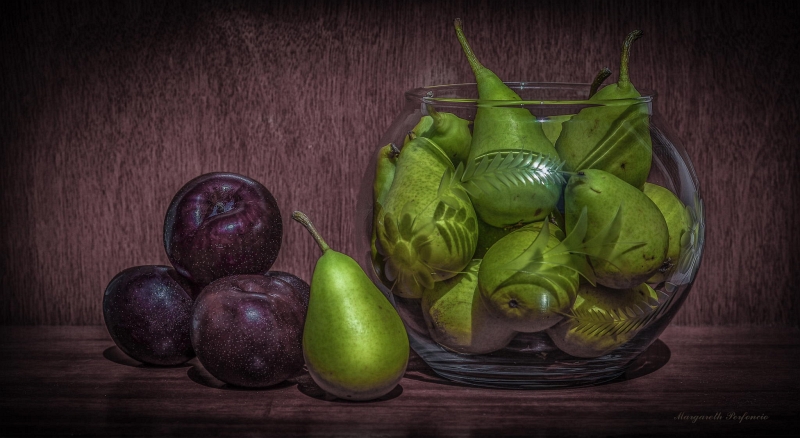
Still-Life Photography by Margareth Perfoncio
São Paulo photographer Margareth Perfoncio’s still lifes of food and flowers—Old Master light, dark wood, and tables that feel inevitable.
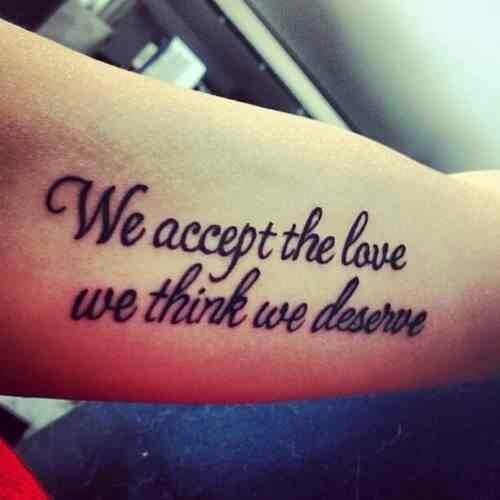
Meaningful Love Quotes for Inspiration (and Ink)
Meaningful love quotes that still feel true — short lines for tattoos, gifts, and everyday reminders, with placement and wording tips.
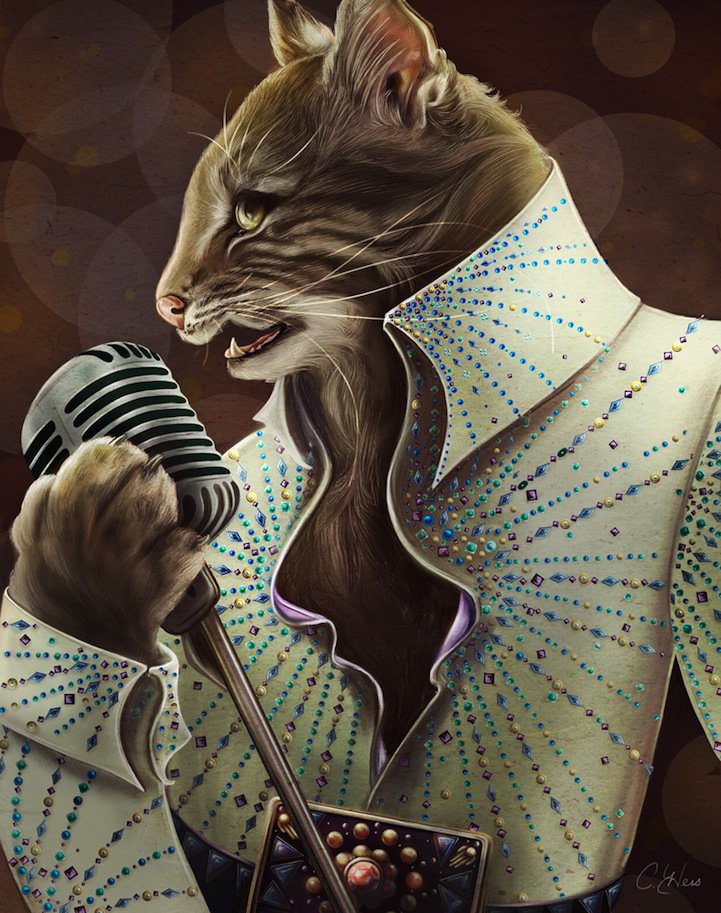
Christina Hess’s Animals From History: Costumed Pets as Playful Portraits
Illustrator Christina Hess reimagines historical icons as ornate animal portraits—Elvis Petme and friends—mixing puns, costume detail, and soft history lessons.