
Extremely Funny Head Shots by Jon Burgerman
Jon Burgerman’s Head Shots series turns NYC subway movie posters into comic interventions—posing as the missing target of on-screen weapons aimed at the crowd.
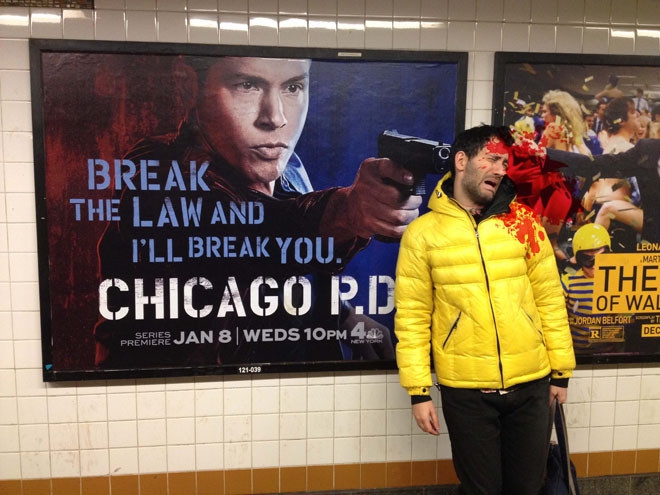
Jon Burgerman is best known for bright, playful drawing—blob-like characters, improvisation, and a sense that art should invite people to play. In his Head Shots series, that play turns sharply comic. Working in New York City subway stations around early 2014, Burgerman stood in front of advertising panels for films and television shows, placing his body where the printed guns, arrows, and weapons already pointed. He photographed the scenes so the posters appeared to “shoot” him, often finishing the gag with digital splatters of red. The result is funny, uncomfortable, and hard to ignore once you have seen it.
These extremely funny head shots are not a breaking news story; they are a record of a street-level intervention that still explains how commercial violence sits casually in public space. Burgerman did not invent the aiming pose. Advertisers did. He simply refused to leave the target blank.
Quiet interventions in loud stations
Burgerman has described projects like this as “quiet interventions”: small, often inexpensive, non-permanent actions that change how a sign, object, or situation is read. He does not vandalize the poster. He completes the composition the advertisers already suggested. The hero aims outward; Burgerman supplies the missing target. Humor does critical work that a stern essay might not—you laugh, then you notice how often you have walked past the same pose without registering it as a threat aimed at the crowd.
Subway advertising is an involuntary gallery. Commuters cannot skip the channel. Celebrities appear larger than life, weapons raised in heroic framing, while passengers stand inches away with coffee and headphones. Burgerman’s photographs collapse that distance. The famous face stays glossy; the artist’s body absorbs the punchline. The joke lands because the staging is precise: alignment of barrel and head, timing between trains, everyday clothes that refuse to turn the scene into cosplay.
That precision is easy to underestimate. Stations are crowded, cameras invite attention, and posters sit behind glass or on curved walls. Finding the angle where a printed arrow or gun barrel meets a living skull is part performance, part geometry. The photographs look spontaneous because the craft hides inside the gag.
Why the comedy stings
Funny head shots, in the portrait-studio sense, flatter a subject. Burgerman’s head shots invert that idea. The “shot” is literal in fantasy and photographic in method. Viewers who know his usual cute characters may feel the tonal whiplash; that contrast is part of the series’ charge. The same artist who celebrates play also shows how play can expose what public culture normalizes.
Coverage at the time noted how often promotional imagery treats armed poses as courage. Burgerman asked a simple visual question: who is on the receiving end? By casting himself, he avoided abstract diagrams. You see a person flinch, fall, or stand with a painted wound while franchise figures—action heroes, archers, armed detectives—hold the line of fire. The photographs do not claim that movie posters cause real violence. They claim that the graphics treat violence as ambient decoration—and that completing the picture makes the decoration feel newly strange.
There is also a class joke hiding in the frame. The exalted face on the panel stays clean, lit, and heroic. The civilian in sneakers takes the hit. Celebrity culture sells power; Burgerman performs the cost that power advertising never shows. The slapstick blood keeps the critique from becoming a sermon, which is why the images traveled so easily through blogs and newspapers when they first appeared.
Performance, photography, and the frame
Each image depends on three crafts at once. First, performance: Burgerman must find the angle where the printed weapon’s trajectory meets his body, often in a busy station where loitering invites attention. Second, photography: the camera freezes a relationship that lasts only as long as he holds the pose. Third, digital finishing: blood effects push the gag into comic-book excess, tipping parody past documentary so nobody mistakes the work for a real crime scene.
That mix keeps the series legible as art rather than prank-only content. The subway remains itself—tiles, lighting, crowds at the edge—while the poster becomes an unwilling co-author. Collaboration without permission is the point. Advertising wants immersion; Burgerman answers with interruption, then walks away leaving the panel unchanged for the next trainload of eyes. The intervention is temporary in the station and permanent in the photograph, a useful reminder that street work can document a thought without damaging property.
Compared with mural bombing or sticker campaigns, Head Shots is almost polite. Nothing is peeled, sprayed, or torn. The aggression is borrowed from the ad itself. That restraint is why the series reads as witty rather than merely rebellious—and why it fits Burgerman’s larger interest in improvisation inside existing systems.
Reading the series now
Looking at the work years later, the franchise faces may have rotated, but the visual grammar has not. Action marketing still aims weapons at the viewer. Burgerman’s method remains a useful teaching tool for anyone studying street photography, intervention art, or media literacy: change almost nothing, rearrange the reading of everything.
The work also fits his broader practice of play as a way to think. He does not build a set. He uses what the city already hung. Constraint becomes collaborator. That discipline—respond to the found image rather than invent a more dramatic backdrop—is why the photographs feel sharper than a studio parody of the same idea would. A green screen Bond shooting an actor would be a sketch. A real platform, real glass, and a real schedule of trains make the joke denser.
If you approach the series only as a meme of a man “getting shot by posters,” you catch the laugh and miss the craft. The laugh is the entry. The craft is alignment, timing, and the decision to make himself the punchline so the posters cannot pretend they were aiming at empty air.
What to notice in the images
- How close Burgerman stands to the panel—intimacy that turns an ad into a duet.
- Whether the weapon is a gun, arrow, or other prop, and how that changes the body’s reaction.
- Background station details that keep the scene ordinary and therefore more unsettling.
- The balance between slapstick blood and deadpan expression.
- How little he needs to add for the entire poster to change meaning.
Jon Burgerman’s funny head shots are less about celebrity mockery than about finishing a sentence public advertising started. Once you see the victim role filled in, the next poster that points at you on a platform may look a little less heroic—and a little more like a setup waiting for someone silly enough, and sharp enough, to complete the frame.

Comments
Continue reading

Dramatic Photo Art by Sukron Ma’mun (Ipoenk Graphic)
Cirebon, Indonesia photographer Sukron Ma’mun uses theatrical natural light to frame village life, play, and place in lyrical photo art.

Bird’s-Eye Views: Florian Beaudenon’s Instant Life
Paris photographer Florian Beaudenon’s Instant Life series captures people in their rooms from above—intimate, collaborative overhead portraits of everyday joy.

Abandoned Cars Reclaimed by Nature: Rust, Growth, and Quiet Ruin
When neglected vehicles are left outdoors long enough, rust, moss, and trees rewrite them into strange still lifes—sad, photogenic, and slowly returning to the ground.