
Creative Illustrations by Nithin Rao Kumblekar: Photo Meets Chalk Story
Mangaluru illustrator Nithin Rao Kumblekar stages models inside chalk-drawn worlds—puppeteers, motorcycles, desktop icons, and flying piggy banks—shot as playful photo-illustration hybrids.
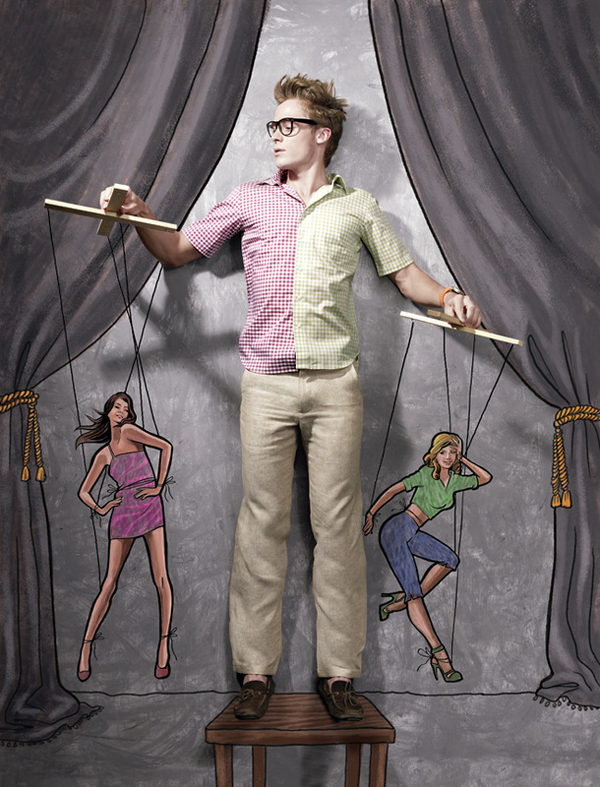
Nithin Rao Kumblekar builds pictures the way a set designer builds a stage: the props are drawn, the lighting is planned, and a real person walks into the scene as if it were already solid. Based in Mangaluru, India, and trained at Karnataka Chitrakala Parishat in Bangalore, he has spent years as an art director, game artist, and freelance illustrator for advertising and entertainment clients. The gallery here is a different register of his craft—less polished product art, more playful hybrid of photography and chalk-style drawing. Models lie or stand on a mottled gray surface while illustrated worlds bloom around them. Shot from the right angle, the floor becomes a wall, a road, or a desktop, and the joke lands before you notice how much planning it took.
What makes the work stick is not gimmick alone. Kumblekar treats every panel as a short story with a clear punchline: fame, music, speed, money, mornings, celebrity, digital clutter. The drawings are bold enough to read at a glance; the poses are precise enough to sell the illusion. Together they form a small museum of early-2010s conceptual photo-illustration—optimistic, graphic, and slyly comic.
The puppeteer and the stage
The series opens with theater. A young man in a split gingham shirt—pink checks on one side, green on the other—stands on a wooden stool and holds two marionette crosses. Drawn curtains frame him; gold cords tie them back; two illustrated women hang from his strings in pink and green outfits that echo his shirt. He looks down at his left-hand figure with the concentration of someone mid-rehearsal. The photograph is the body; the illustration is the fiction; the strings are the literal link between them. It is a neat manifesto for the whole set: the artist as controller, the drawing as obedient world.
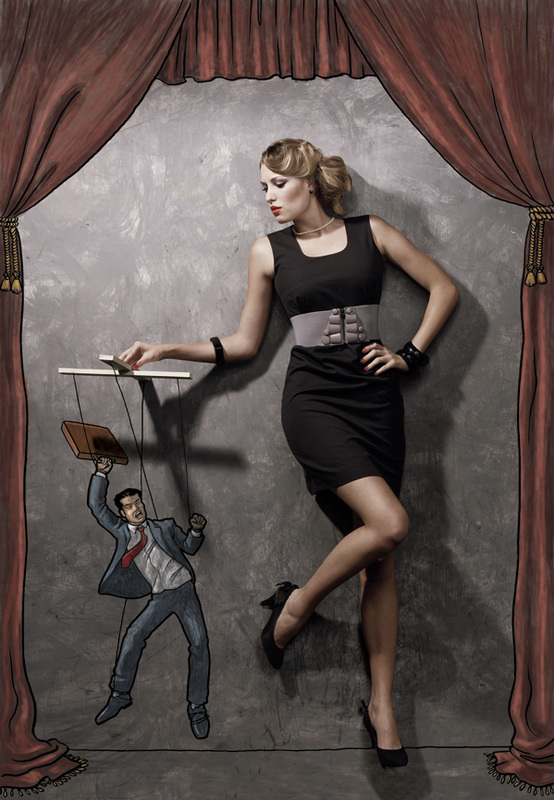
A companion piece flips the gender of the controller. A woman in a black dress, pearls, and red lipstick leans against a gray wall framed by sketched red curtains. From her hand hang the strings of a tiny illustrated businessman—gray suit, red tie, briefcase raised, mouth open in protest. An illustrated shadow of woman and puppet stretches behind them. Power dynamics become a cabaret bit: who pulls the strings, and who gets to look composed while doing it.
Music, motion, and the overhead club
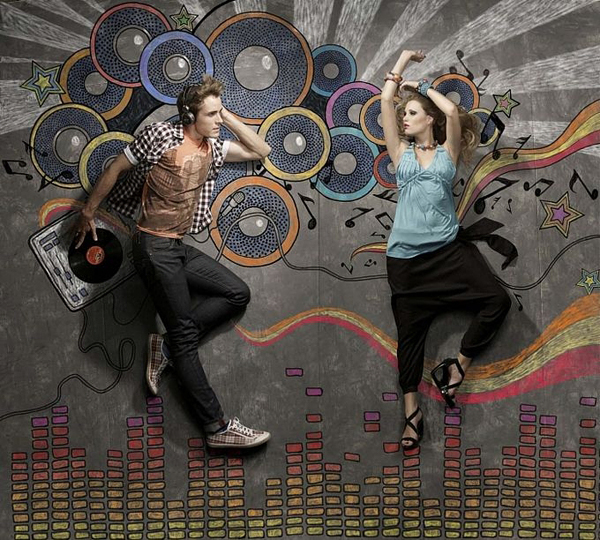
Several of Kumblekar’s strongest frames depend on a top-down camera. Subjects lie on the floor; chalk speakers, equalizers, and motion lines do the rest. In one, a man in headphones leans over a drawn DJ booth while a woman dances beside him, arms raised. Concentric speaker circles glow in blue, yellow, and orange; a colorful equalizer bar runs along the bottom; notes and stars scatter like confetti. The gray surface reads as nightclub darkness once the palette of the drawings takes over. Nothing about the pose is accidental—the DJ’s hand lands exactly on the drawn platter; the dancer’s body fills the space the speakers leave open.
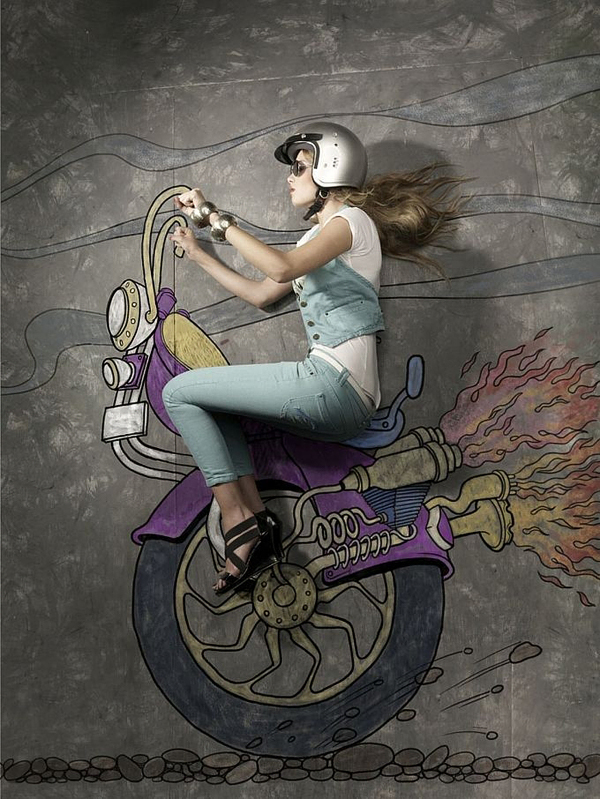
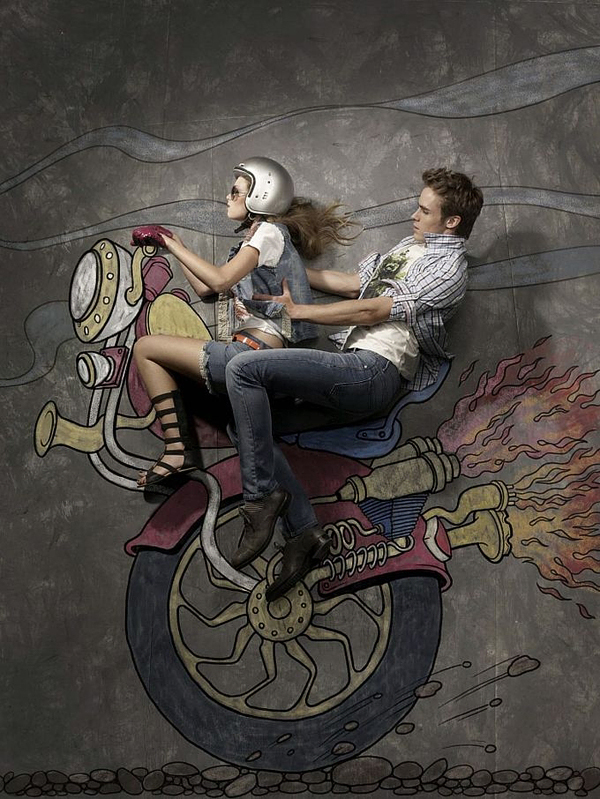
Speed gets the same treatment. A woman in a silver helmet, denim vest, and jeans lies along a purple illustrated motorcycle, hair flung back as if wind were real. Flames shoot from drawn exhausts; pebbles mark a road at the edge of the frame. A second motorcycle scene adds a passenger: the same rider grip, a man clinging behind her, red-and-yellow bike lines, more flame. The comedy is gentle. Nobody is in danger; everyone is in on the game. The drawings carry velocity so the models only have to hold still and look committed.
Action gags and everyday battles
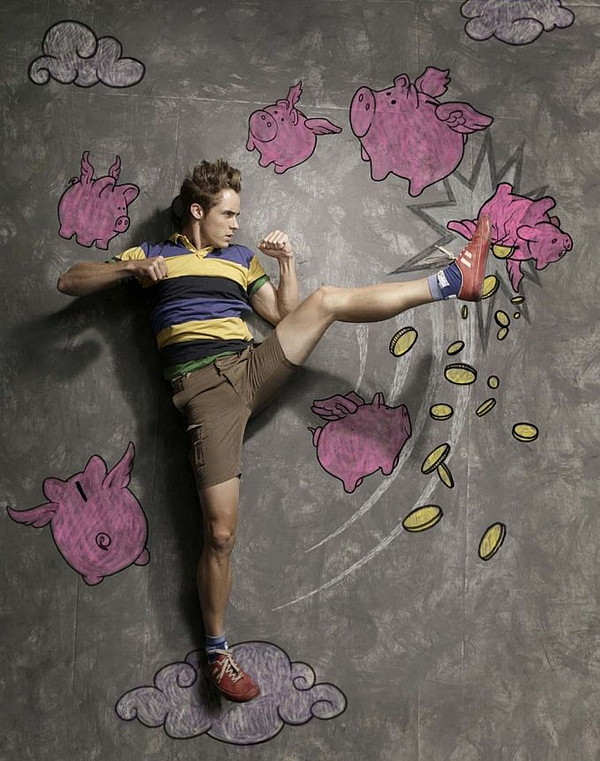
Not every scene is glamorous. One panel turns a kick into an economic joke: a man in a striped polo and red sneakers launches a side kick at pink winged piggy banks. One bank shatters into a chalk “POW” burst; yellow coins spill downward. Clouds underfoot and motion arcs sell the airborne fantasy. The phrase “when pigs fly” sits just offstage—you do not need the caption to feel it.
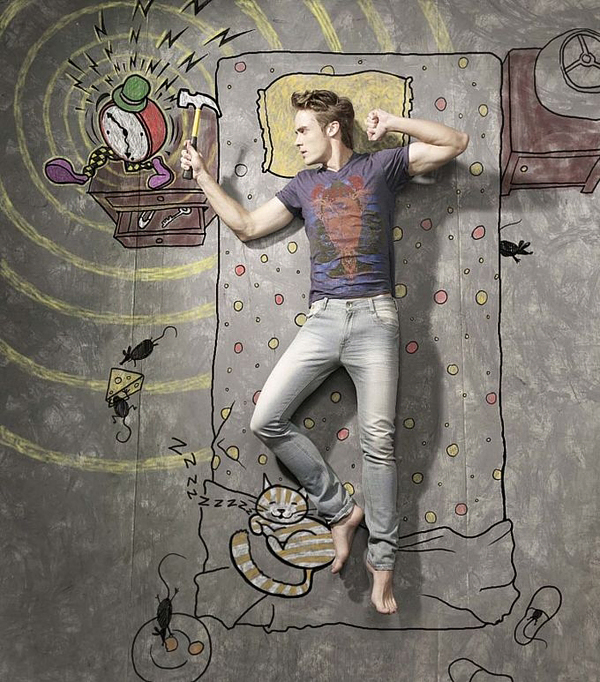
Morning warfare is quieter and meaner. A man in a lobster T-shirt lies on a drawn bed, real hammer raised toward an anthropomorphic alarm clock that rings with yellow concentric circles. A striped cat sleeps at his feet with “Zzz” marks; silhouetted mice scurry with cheese. Nightstands, lamp, and mattress are all line work. The only solid prop that matters is the hammer. Domestic irritation becomes a cartoon without losing the texture of a real body on a hard floor.
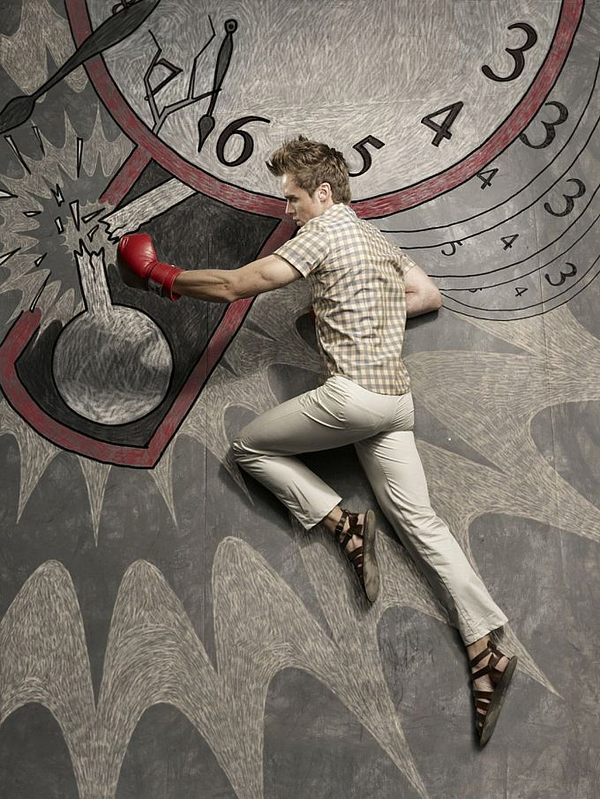
Another punchline is more abstract: a man in plaid and a red boxing glove lunges toward a shattering lightbulb. White impact lines radiate; warped clock numbers and curved arcs float nearby; hatched shapes pile under his legs. Time, light, and force share one collision. Compared with the piggy-bank gag, this piece is darker in palette and mood—still playful, but closer to a poster for a concept than a children’s book spread.
Ocean, celebrity, and the desktop self
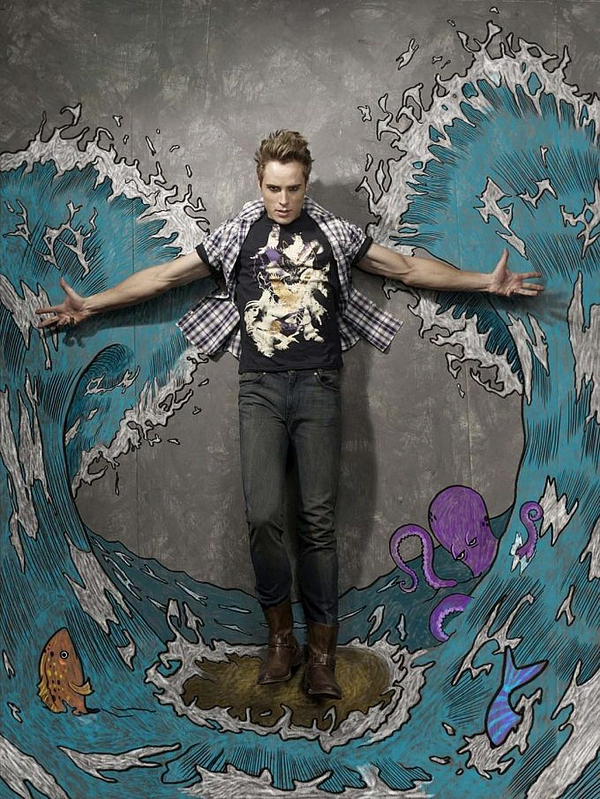
Scale shifts again when waves rise. A man in a checkered shirt stands on a small drawn island, arms outstretched, while blue-green breakers curl around him. A purple octopus peeks from the water; orange and blue fish mark the corners. The gray ground becomes sea spray through chalk alone. It is one of the most immersive compositions in the set because the drawing nearly closes over his head—the person is inside the illustration, not merely beside it.
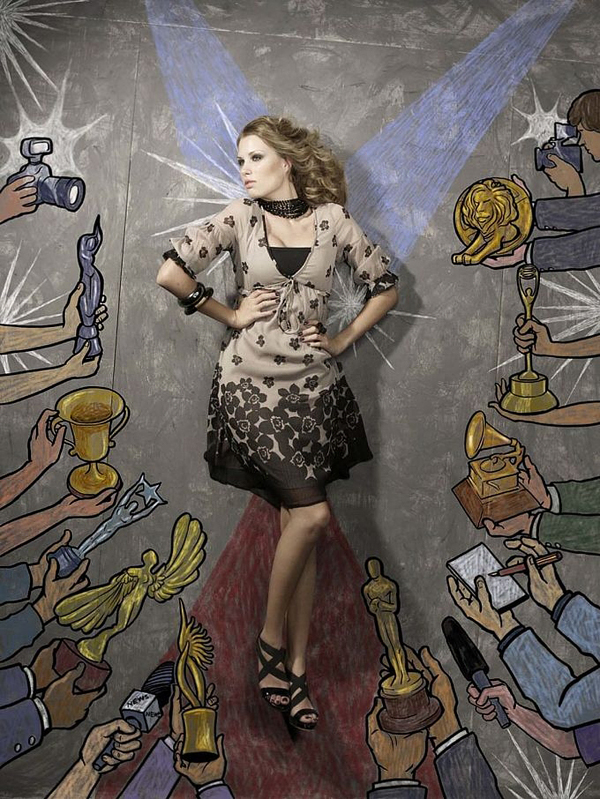
Fame gets a red-carpet treatment. A woman in a patterned dress and heels poses with hands on hips; chalk wings flare behind her; a red path runs to her feet. Drawn hands thrust trophies, cameras with flash bursts, a NEWS microphone, and an autograph book into the frame. Celebrity culture is reduced to props and reach—everyone wants something; she holds the center. The wings turn the satire soft: angel of the awards circuit, or fairy of attention, depending on how generous you feel.
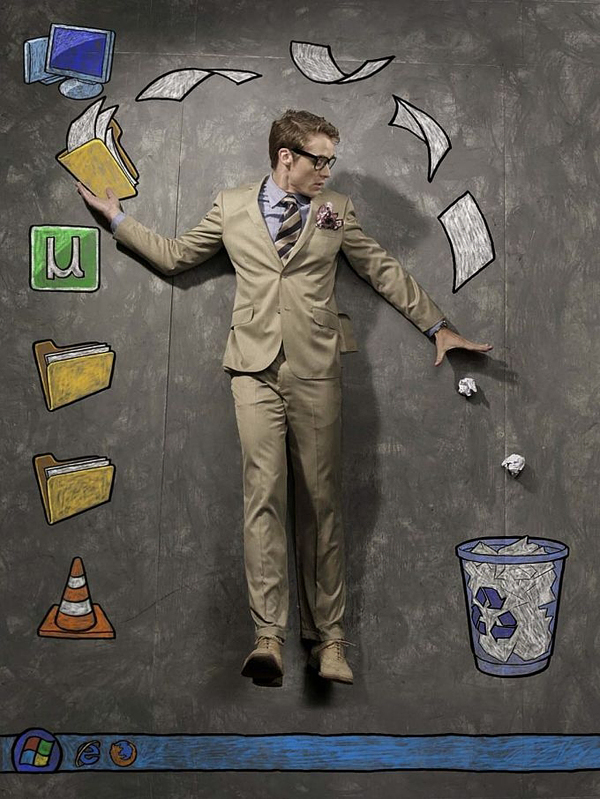
Digital life is treated with equal wit. A man in a tan suit floats among chalk desktop icons—monitor, folders, browser shortcuts, a VLC cone, a recycle bin. Papers arc from a yellow folder in his hand; real crumpled paper balls drop toward the bin. A blue taskbar runs along the bottom with familiar logo silhouettes. The joke ages in an interesting way: the icons are of their moment, but the feeling of sorting, deleting, and performing competence on a screen still lands.
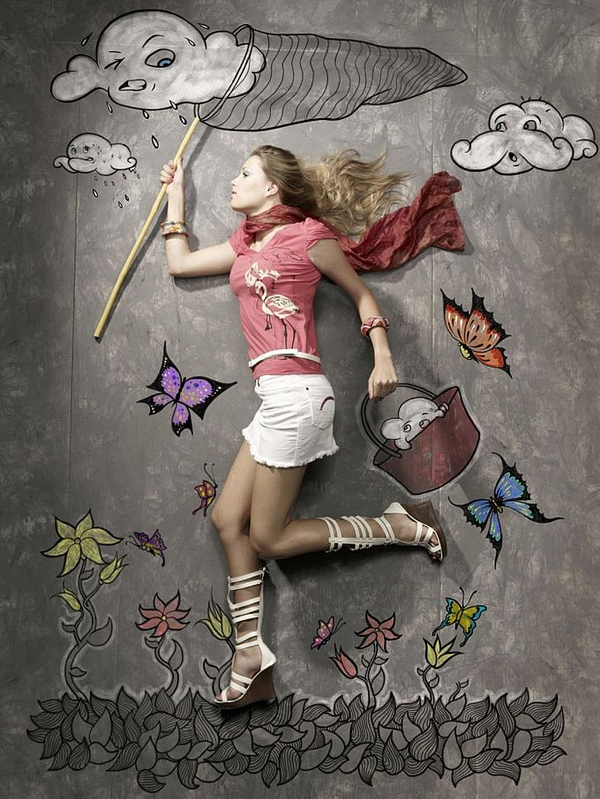
The gentlest panel may be the cloud chase. A woman in a flamingo shirt runs through chalk flowers and butterflies, wooden pole becoming a drawn net that catches a grumpy raincloud. A happy cloud peeks from a red bucket; other clouds look worried or surprised. Leaves and blooms pile at the bottom edge like a storybook ground. After the boxing glove and the piggy banks, this one feels like permission to stay silly.
How the craft works
Across the set, a few habits repeat. The surface is almost always a textured gray that can read as chalkboard, concrete, or studio floor. Color is reserved for the drawings and the models’ clothes, so the eye knows where the fiction lives. Poses are held long enough for chalk to meet fingertips, shoes, and hammers. Overhead shots sell depth without CGI; upright shots rely on curtains, islands, and carpets drawn to the body’s scale. Kumblekar’s commercial background shows in the clarity: each image has one idea, one climax, and almost no leftover noise.
For illustrators and photographers, the takeaway is practical. You do not need a green screen to invent a world. You need a flat plane, a decisive camera angle, drawings that respect the model’s silhouette, and a joke worth the setup time. For everyone else, the gallery is simply a reminder that imagination can be staged with chalk dust and patience—then photographed before anyone sneezes.
Which scene would you climb into first: the club, the motorcycle, or the quiet war with the alarm clock?

Comments
Continue reading
Fingerprint Art by Kevin Van Aelst: Autobiography in Ridges
Connecticut photographer Kevin Van Aelst rebuilds each of his ten fingerprints from mustard, wool, snacks, and other memory-laden materials—turning biometrics into still-life self-portraiture.
Cardboard Ladies (Dame di Cartone) by Christian Tagliavini
Christian Tagliavini’s Dame di Cartone portraits dress women in handmade cardboard couture—baroque, fifties, and cubist echoes built as craft photography.
Luzinterruptus: Plastic Garbage Bags Lighting Installation in Winterthur
Luzinterruptus’s 2012 Winterthur installation Plastic Garbage Guarding the Museum—5,000+ illuminated bags left outdoors for four months.