
Colourful Umbrellas Over Águeda: Portugal’s Floating Street Canopy
Águeda’s summer umbrella canopy—shade, festival colour, and the 2012 photographs by Patrícia Almeida and Diana Tavares that carried the scene worldwide.
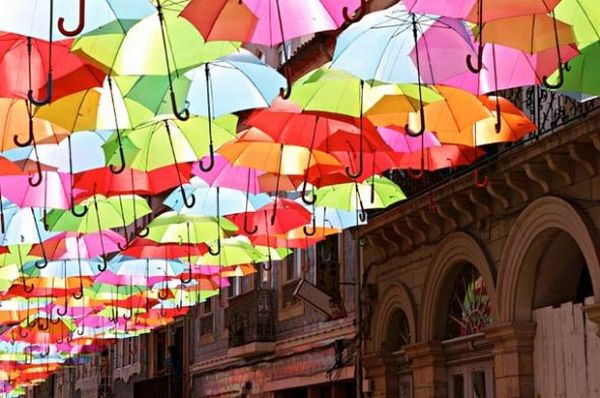
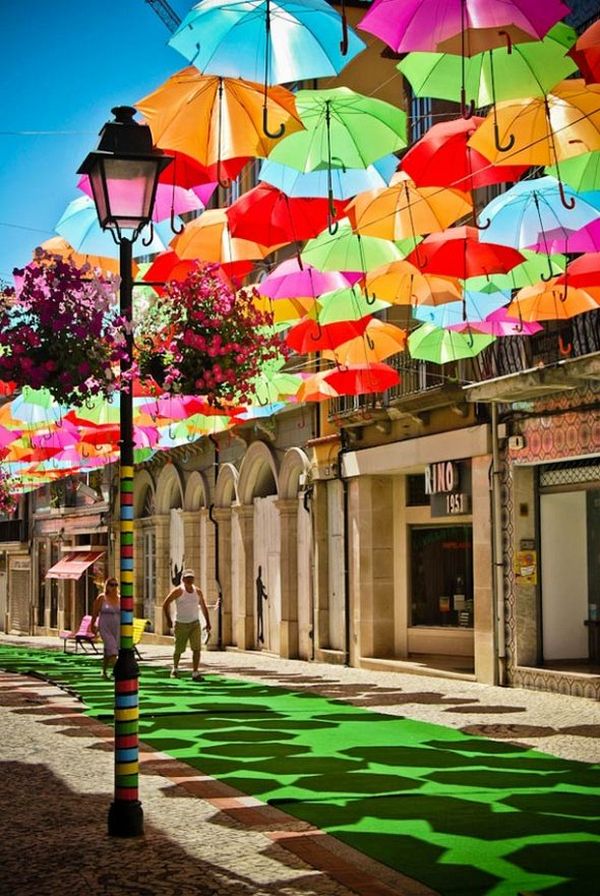
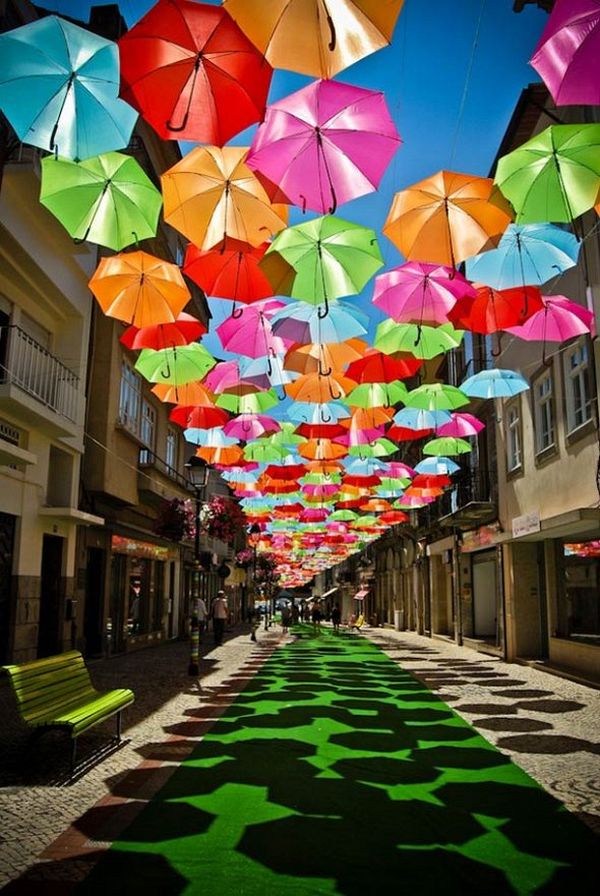
In July, certain streets in Águeda, a town in Portugal’s Aveiro district, turn into a corridor of colour. Hundreds of umbrellas hang above the pavement, fixed so they read as a floating canopy rather than a row of forgotten rain gear. Shade drops onto the street. Light filters through dyed fabric in overlapping discs. Pedestrians walk through a temporary sky that did not exist the week before, and the ordinary business of shops and doorways continues underneath as if bright weather gear had always been architecture.
The photographs that carried this image around the world in 2012 came from people who were there with cameras, including Patrícia Almeida and Diana Tavares. Their frames—umbrellas packed edge to edge, façades half-hidden, faces tipped upward—are why so many viewers first met Águeda as a place of suspended colour. The installation itself belongs to the town’s public art season, long associated with the AgitÁgueda festival and later widely known as the Umbrella Sky Project. The distinction matters: Almeida and Tavares helped the scene travel; the town and its festival built the reason to look up.
A canopy with a practical job
Águeda’s summers can be hard on open pavement. A dense field of umbrellas does more than decorate: it cuts glare, cools the walking lane, and gives shop fronts a shared ceiling. Public art that also works as climate relief tends to last in local memory because residents use it, not only photograph it. Visitors often feel the difference in their shoulders before they finish composing a shot—the body registers shade faster than the eye finishes counting hues.
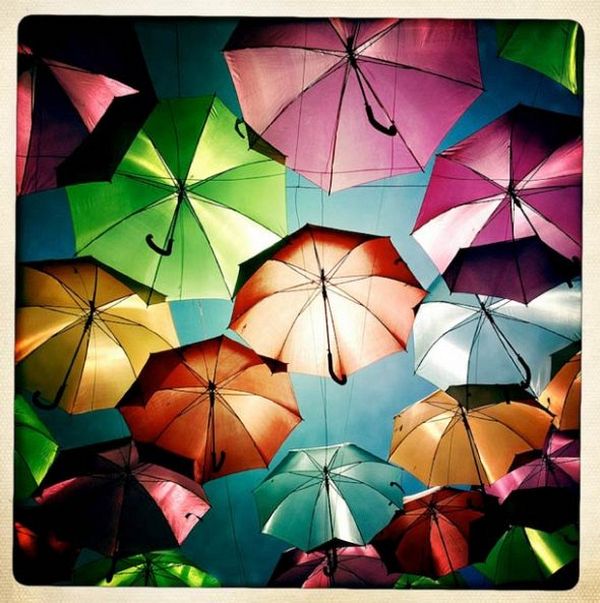
The visual trick is simple and strong. Umbrellas are familiar objects. Lift them off hands and into the air in volume, and familiarity flips into spectacle. Overlap matters. Gaps would look sparse; a continuous canopy looks intentional, almost textile. Colour blocks—reds beside yellows, blues cutting through oranges—create rhythm along the street’s length so the eye never settles on a single dull patch. From ground level the canopy becomes a tunnel of chroma; from an upper window it can look like a river of discs flowing between buildings.
That dual reading—comfort device and graphic field—is why the project photographs so well and still functions as civic furniture. Pretty alone would fade. Useful pretty returns each season.
How the pictures shaped the story
Almeida’s images from that July season captured the childlike surprise of standing under the field of colour. She described feeling amazed by the saturation, the sense of walking into a playful weather that was not weather at all. Tavares’s photographs added further angles on the same streets—closer façades, different approaches to depth, the relationship between hanging fabric and Portuguese street architecture with its balconies, signs, and pale walls. Together with other visitors’ cameras, those sets helped the installation travel far beyond Aveiro.
That circulation mattered. A local festival gesture became an international postcard almost overnight. Later seasons repeated and refined the idea; the umbrella sky became a recurring summer signature rather than a one-off stunt. Cities elsewhere borrowed the vocabulary—suspended umbrellas as temporary urban joy—but Águeda’s version remains tied to a specific place, calendar, and civic festival culture. Copying the prop is easy. Copying the fit between prop, climate, and town ritual is harder.
Looking back at the 2012 wave of shares, it is clear that photography did not invent the canopy, yet photography finished the story the canopy began. Without images that held both wonder and place, the umbrellas might have remained a pleasant regional note. With them, Águeda entered a global scrapbook of “places that look like joy.”
Reading the street as a designed space
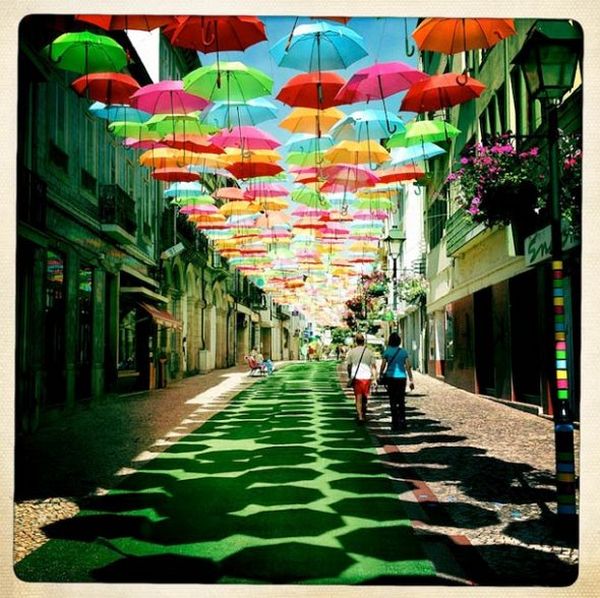
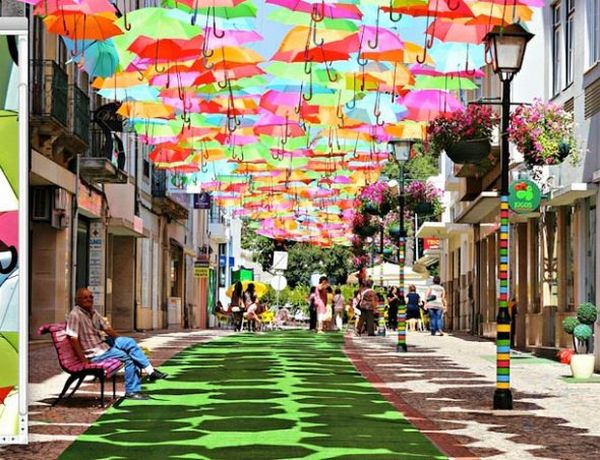
Hang enough umbrellas and ordinary elements change role. Balconies become frames. Shop signs become secondary colour notes. People become moving accents under a fixed ceiling. Photographers who linger notice that the best frames often include a human scale reference—someone walking, someone pointing up—so the canopy does not flatten into pure pattern. Without a figure, the image can tip into wallpaper; with one, it becomes a place you could enter.
Architecture under the umbrellas still counts. Pale walls bounce warm light downward and tint skin and clothing with reflected colour. Darker stone drinks light and deepens contrast. Narrow streets intensify the tunnel effect; slightly wider ones let side light sneak in and model the underside of each canopy, showing ribs, seams, and the slight tilt of fabric in wind. The installation is temporary architecture: cables, ties, and planning invisible in the pretty photographs but essential to keeping fabric aloft through gusts and foot traffic.
Designers studying the photographs can inventory those quiet decisions—density, height clearance, colour sequencing, attachment points—without needing a technical drawing. The street teaches by being walked.
Festival context, not a lone stunt
AgitÁgueda has long mixed street performance, installations, and summer programming. The umbrella canopy sits inside that broader energy—music, other artworks, evenings when the town stays outdoors after the heat eases. Seeing the umbrellas alone in a still photo is powerful; walking the town during festival weeks adds sound, crowd motion, and neighbouring pieces that explain why the canopy feels civic rather than commercial.
Businesses often join the mood, extending colour beyond the main hanging streets. That spillover is part of why visitors describe the town, not a single block. The sky of umbrellas is the icon; the festival is the reason the icon returns. A single viral image can freeze one perfect afternoon. A festival calendar turns that afternoon into a seasonal habit residents can plan around and guests can aim for.
Public art of this kind also negotiates risk: wind, maintenance, and the logistics of hanging and striking hundreds of objects. Those practicalities rarely appear in visitor photos, yet they are why the canopy can greet July again instead of becoming a one-summer legend.

What the photographs teach designers and travellers
Repetition with variation beats a single heroic object. Hundreds of similar forms, shifted in hue and slight angle, create a field stronger than one oversized sculpture would. Everyday material lowers the barrier to delight—viewers understand umbrellas instantly, so they can enjoy the transformation without a plaque explaining the concept.
Temporary does not mean trivial. A seasonal install can define a place’s identity for years if it is generous, photogenic, and useful. Shade is usefulness. Colour is invitation. Safety and maintenance are the unglamorous conditions that let generosity continue. Travellers who only chase the postcard angle miss half the lesson: the canopy works because people can walk, shop, and linger under it, not because it exists solely for cameras.
For anyone planning similar gestures elsewhere, Águeda suggests starting with climate and street width, then choosing a familiar object that multiplies cleanly. Novelty without comfort becomes a weekend stunt. Comfort without spectacle becomes awnings. The umbrella sky sits in the rare middle.
Visiting with open eyes
If you go for the canopy, give the town more than a drive-by frame. Walk the hanging streets at different hours. Midday emphasizes the shade function and saturated fabric pushing against hard sun. Late light softens edges and turns the underside into a warmer chamber where colours blend. Early evening can add café noise and cooler air while the discs still hold the day’s heat glow. Look sideways at how cables meet façades. Notice where the canopy ends and ordinary sky resumes—that threshold is part of the design, the moment the magic admits it is temporary.
Respect residents’ space. The photographs that made the scene famous were made by people moving carefully through a living town. Tripods in the middle of narrow lanes help no one. Ask before including shopkeepers or private balconies as main subjects. The umbrellas are public; people’s doorways are not props. Buy something small from a shop under the canopy if you can—participation is a better souvenir than another identical wide shot.
Colour as civic surplus
Urban design often rations colour to signage and seasonal lights. Águeda’s umbrella streets reverse the ration for a few months and let surplus become the default overhead. That surplus is democratic in a simple way: you do not need a ticket to walk under it, and you do not need art-historical training to enjoy it. Children understand it immediately. Adults remember it because it briefly reorders the hierarchy of the street—sky first, then walls, then errands.
Stand under the canopy long enough and the metaphor writes itself without slogans. Weather gear becomes shelter for a whole street. Private objects become a shared roof. The cameras of Almeida, Tavares, and everyone who followed made sure the rest of us could borrow that looking-up for a moment. The town kept building the reason to return when July comes around again.

Comments
Continue reading

Still-Life Photography by Margareth Perfoncio
São Paulo photographer Margareth Perfoncio’s still lifes of food and flowers—Old Master light, dark wood, and tables that feel inevitable.

Meaningful Love Quotes for Inspiration (and Ink)
Meaningful love quotes that still feel true — short lines for tattoos, gifts, and everyday reminders, with placement and wording tips.

Christina Hess’s Animals From History: Costumed Pets as Playful Portraits
Illustrator Christina Hess reimagines historical icons as ornate animal portraits—Elvis Petme and friends—mixing puns, costume detail, and soft history lessons.