
Children Illustrations by Melani Sie: Soft Magic, Companions, Quiet Light
A gallery of Melani Sie’s (darkmello) children’s illustrations—dragons on piers, flying turtles, beanstalks, and moonlit goodnights—from her Surabaya-era digital work.
Melani Sie’s children’s illustrations feel less like merchandise for a bedtime aisle and more like private weather reports from childhood. Working under the DeviantArt handle darkmello and based in Surabaya, East Java, Indonesia, she built an early reputation on soft digital paintings in which ordinary rooms, attics, and piers open onto companions that adults have usually forgotten how to see: gentle dragons, flying turtles, beanstalks tall enough for a wheelchair, moons with closed eyes.
The set gathered here belongs to that period when design and illustration blogs circulated her work widely—around the early 2010s—not as a career retrospective, but as a gallery of mood. Look long enough and a method emerges: warm lamps against cool atmospheres, oversized creatures that never threaten, children who are allowed to be quiet rather than cute on command.
Companions in a larger world
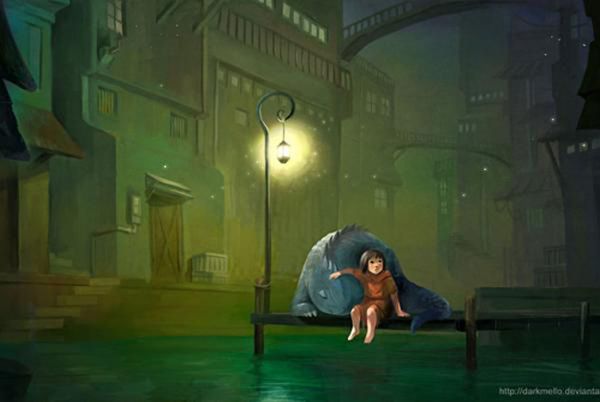
On the misted pier, a child in a simple dress sits beside a bulky blue creature under a single curved streetlamp. The city behind them is industrial and vertical—bridges, stacked windows, green haze over water—yet the emotional center is tiny: an arm around a scaled shoulder, two figures sharing one pool of gold light. Sie often stages friendship as shelter. The monster is not a plot twist; it is company.
That choice matters in children’s illustration. Many commercial images sell adventure as conquest. These pictures sell companionship as permission—permission to linger, to lean, to need someone larger than yourself without shame. The brushwork stays soft; edges dissolve into mist; the lamp’s sparks behave like fireflies. Atmosphere does the storytelling that captions would only flatten.
Imagination as a practical tool
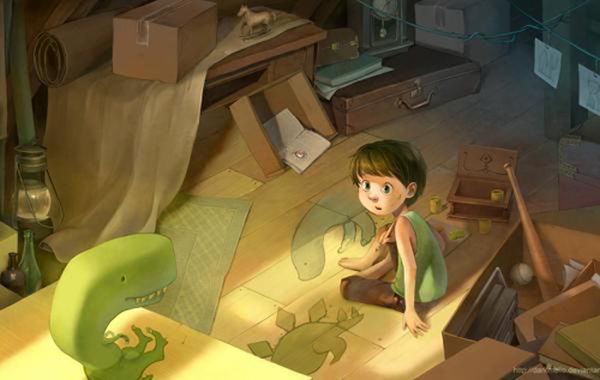
In the attic scene, toys and shadows conspire. A boy sits among suitcases, a baseball bat, a lantern, and papers strung on wire, while dinosaur silhouettes stretch across the floorboards from a low, theatrical light. The prehistoric shapes are not “real” in the room; they are real in the child’s attention. Sie treats play as architecture. The clutter of storage becomes a stage, and the light source becomes a collaborator.
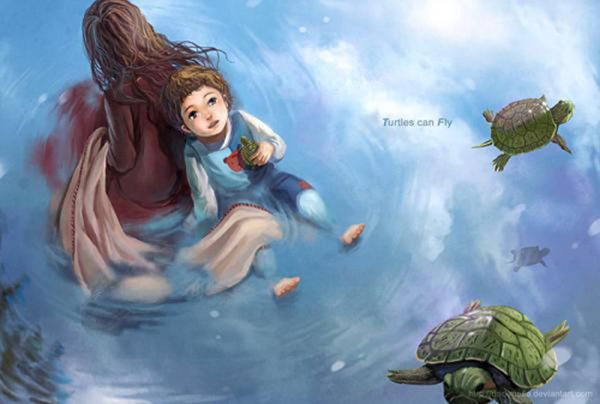
Turtles can Fly makes the same claim with gentler physics. A woman and child sit in water that behaves like sky. Shells float at different depths; the boy cradles a small turtle while larger ones drift past. The title is printed lightly into the picture, almost as if the illustration were already thinking of itself as a page. Soft blues and whites erase the border between swimming and dreaming. For young readers, that border was never firm anyway.
Both works show Sie’s instinct for scale shifts. Dinosaur shadows can be bigger than furniture. Turtles can occupy the same air as clouds. Children in her pictures are rarely the tallest things in the frame, yet they remain the emotional authorities—the ones whose wonder decides what counts as true.
Height, mobility, and reaching
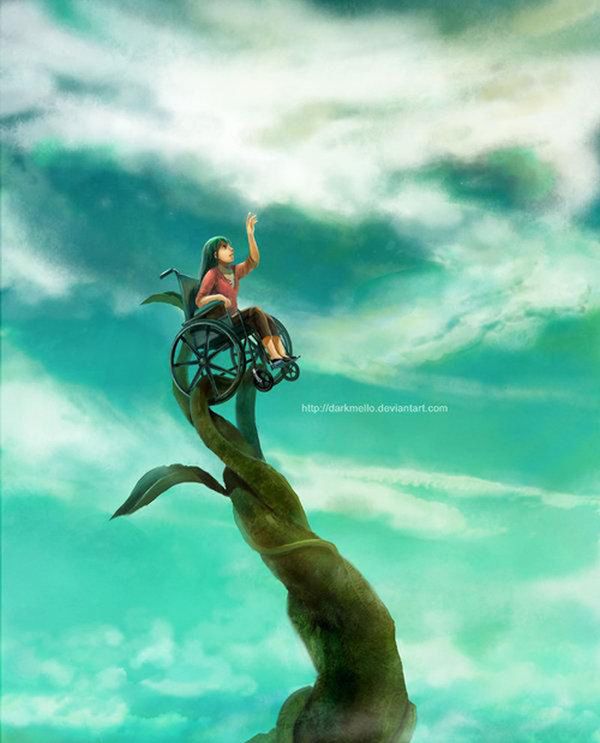
One of the strongest images places a girl in a wheelchair at the tip of a curling green beanstalk, reaching toward a turquoise sky. Contrails or light streaks cut the distance behind her. The composition is literally aspirational without turning disability into a slogan. The chair is drawn as part of the character’s body language, not as a prop for pity. Height becomes metaphor and also simply height: she is up there, looking, wanting.
Inclusive children’s art often fails by either erasing difference or over-explaining it. Sie’s beanstalk picture does neither. It trusts the viewer to feel the lift. Leaves along the stalk, soft cloud swirls, and the girl’s upward gaze do the editorial work. Aspiration here is not a lecture; it is a vantage point.
Rest, clutter, and everyday magic
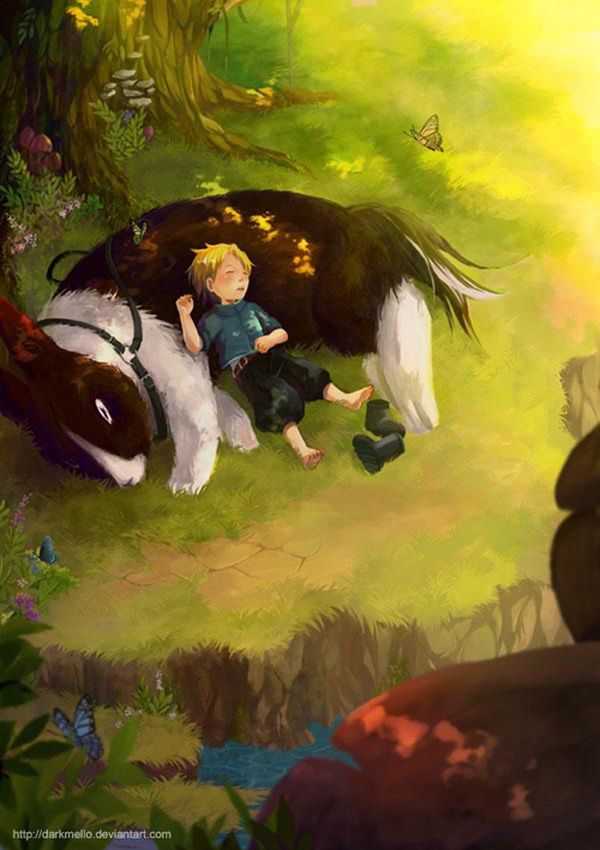
Afternoon sleep under trees may be Sie’s clearest statement of safety. A blond boy dozes against a huge rabbit-like companion while butterflies cross sunlit grass and discarded boots wait nearby. The creature’s harness and soft fur read as trustworthy rather than wild. Golden light arrives from above like a blessing that does not need a sermon. Children’s illustration frequently confuses excitement with value; this picture values rest.
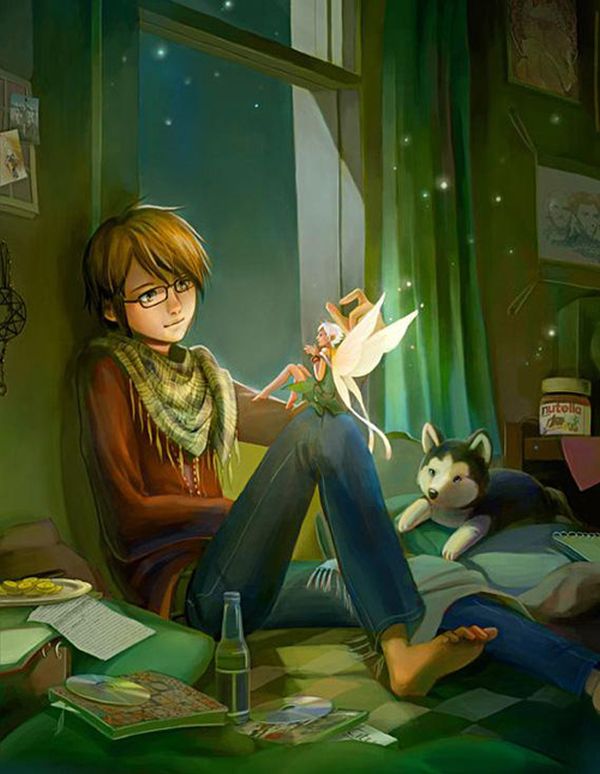
Elsewhere, magic visits a lived-in bedroom: CDs, fruit, notebooks, a husky puppy, a jar on a shelf, sketches pinned to walls. A young person in glasses and a scarf sits on the bed while a tiny fairy glows on one knee. The fantasy creature does not clean the room or rearrange the props into tasteful minimalism. Sparkles coexist with mess. That honesty is why the scene feels intimate instead of branded. Sie understands that wonder usually arrives in rooms that already have laundry and leftovers.
Scale games and shared weather
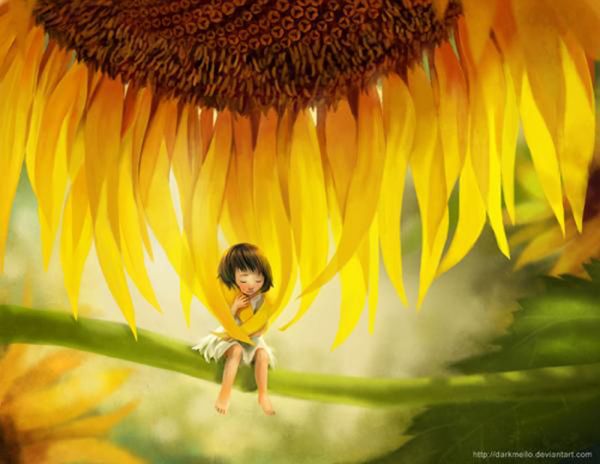
Under a giant sunflower, a barefoot girl in white becomes almost insect-sized, sheltered by drooping yellow petals. Bokeh leaves soften the distance. The picture is quiet enough to be a lullaby without text. Sie’s sunflower child is not performing for a camera; she is inhabiting a plant the way children inhabit cardboard boxes—completely, temporarily, as if the world had been redesigned for one afternoon.
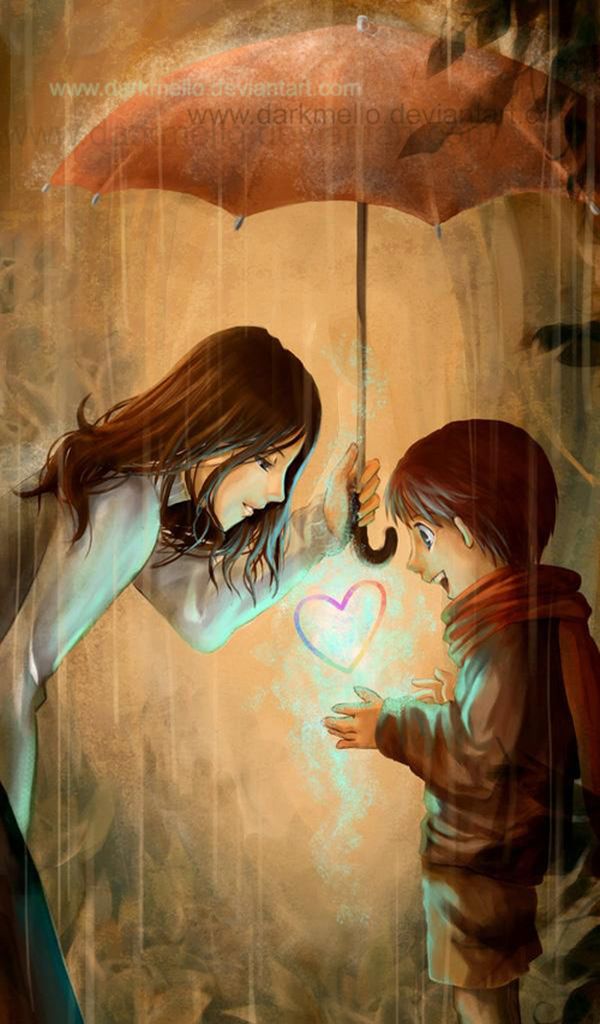
Rain becomes another kind of shelter when a woman tips an orange umbrella toward a small boy and a luminous heart floats between their hands. Vertical rain streaks cross warm autumn washes. Care is drawn as gesture: lean, cover, share. Magical light particles do not replace human attention; they underline it. In picture-book terms, this is the classic “adult as weather protection” theme, rendered with enough softness that it never becomes sentimental syrup.
Story inside the story
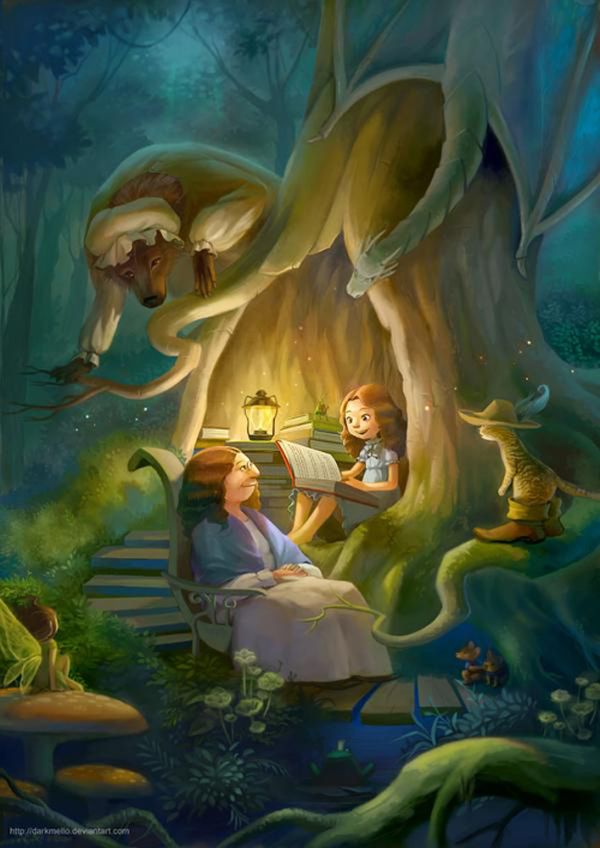
Sie also builds nested narrative scenes: a child reading inside a hollow tree while an older woman listens from a chair, a wolf in nightclothes perched above, a dragon coiled on bark, Puss in Boots on a root, a fairy on a glowing mushroom, mice on a walkway. Lantern light turns the hollow into a tiny library. The joke is affectionate—fairytale villains and helpers become an audience for story time—but the craft is serious. Warm interior gold against cool forest blues creates a readable hierarchy: first the book, then the listeners, then the woodland architecture.
These denser compositions reward slow looking in a way blog-era galleries sometimes discouraged. Thumbnails flatten detail; full frames restore it. Stacks of books, carved steps, feathered hats, and mushroom light are not decoration for empty cuteness. They are evidence that Sie thinks like a storyteller even when the “story” is a single still.
Good night, Mrs. Moon
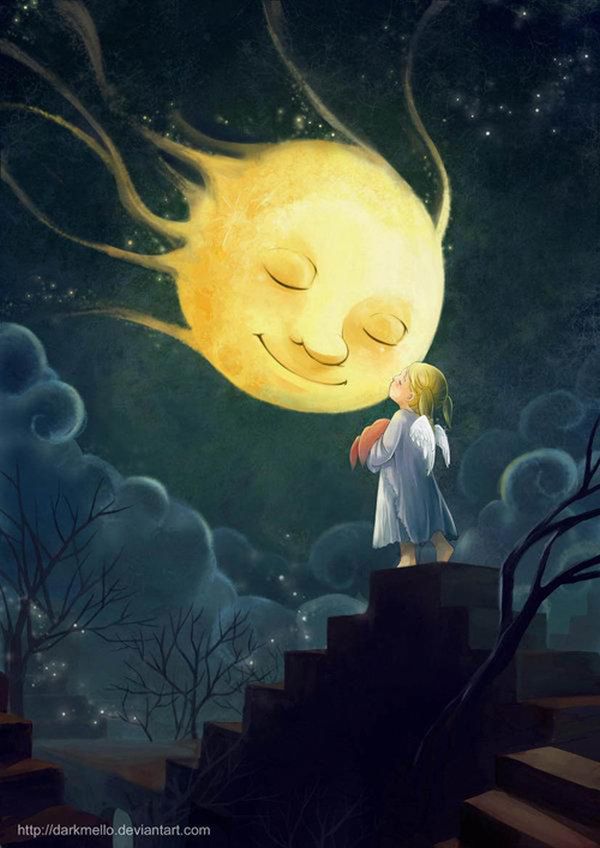
Among the best-known images associated with this body of work is the meeting between a small winged child and a vast, smiling moon. Golden tendrils stream from the lunar face into a teal night; firefly lights scatter; leafless trees frame a distant town. The child holds a soft red heart. Titles circulating with the piece—Good Night Mrs. Moon—match the tenderness of the exchange: gratitude toward light that makes darkness less frightening.
Personifying the moon is an old children’s-book move. Sie’s version works because the moon’s closed eyes make the giant feel restful rather than all-seeing. Authority softens into caretaking. The child’s small wings and nightgown place the scene in the borderland between bedtime and dream, where many of her strongest pictures live.
What to notice in the brush
Across the gallery, certain habits repeat. Faces carry large, readable eyes without tipping fully into empty kawaii. Color temperature usually splits the frame: cool environments, warm emotional cores. Texture suggests paint even when the file is digital. Watermarks from the darkmello era remind you these images traveled first through online portfolios, where illustrators learned to protect and share work in the same breath.
Sie’s Surabaya base sits inside a wider Indonesian illustration culture that, by the early internet years, was already fluent in global anime-adjacent character language while keeping local habits of atmosphere and narrative patience. You do not need a biography lecture to feel that patience here. The pictures refuse haste. They give children permission to sit with a creature, a book, a moon, or a shadow until the feeling finishes arriving.
If you are studying them as an illustrator, track three decisions: where the warmest light sits, who is allowed to be larger than the child, and what ordinary object remains in the frame after the magic enters. Those three answers—lamp or fairy glow; dragon, rabbit, or moon; Nutella jar, boots, or baseball bat—explain why the work feels inhabited rather than merely pretty. Pretty fades. Inhabited rooms stay.

Comments
Continue reading
Still-Life Photography by Margareth Perfoncio
São Paulo photographer Margareth Perfoncio’s still lifes of food and flowers—Old Master light, dark wood, and tables that feel inevitable.

Meaningful Love Quotes for Inspiration (and Ink)
Meaningful love quotes that still feel true — short lines for tattoos, gifts, and everyday reminders, with placement and wording tips.

Christina Hess’s Animals From History: Costumed Pets as Playful Portraits
Illustrator Christina Hess reimagines historical icons as ornate animal portraits—Elvis Petme and friends—mixing puns, costume detail, and soft history lessons.