
Celebrity Selfies by Dan Rubin: Street Portraits as Phonies
Dan Rubin’s phonies series lines up strangers with celebrity selfies on phone screens—a sharp, funny take on selfie-era identity.
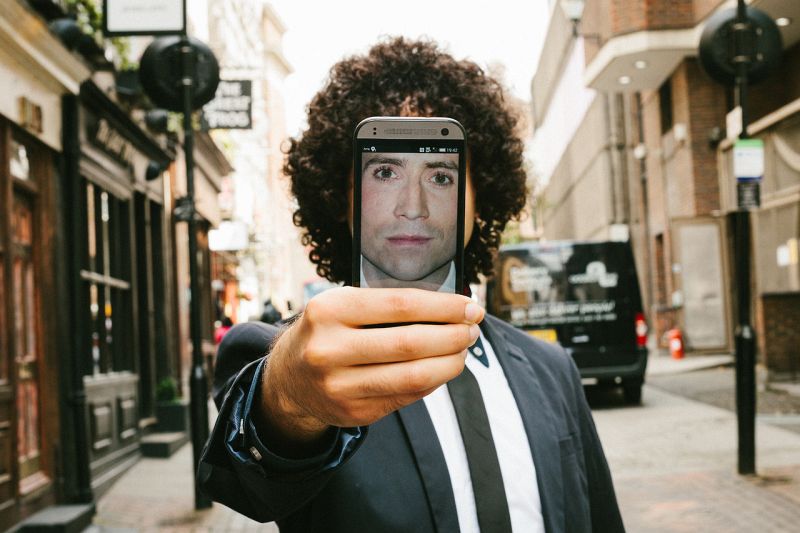
In 2014, the selfie had already moved from bathroom mirror habit to cultural weather. Celebrities posted curated faces; everyone else practiced looking famous into a front camera. London-based designer and photographer Dan Rubin—born in Miami Beach—answered that weather with a street series nicknamed phonies: ordinary passers-by holding phones whose screens showed celebrity selfies, aligned so famous eyes and mouths seemed to replace their own.
The gag is immediate. The aftertaste is sharper. Who is the subject—the stranger, the star, or the phone? Rubin’s photographs make that question visible without a lecture. A hand, a handset, a pavement, and a face that is not quite the face you think you are seeing.
How a phonie is made
The method sounds simple and is logistically fussy. Rubin prepared phones with images of celebrities known for selfie culture—Kim Kardashian among the most cited examples, alongside other famous faces circulating in coverage of the series such as James Franco, Harry Styles, Lily Allen, and similar high-visibility posters. On the street, often in busy London spots associated with the project’s press (Carnaby Street turns up in contemporary reports), he looked for passers-by whose bone structure, hair, or vibe could roughly accept the overlay.
Then came consent and alignment. The volunteer held the phone in front of their face. Rubin adjusted height and angle until the celebrity features sat where the person’s features would be—an apple-of-discord trick related, in spirit, to Magritte’s face-hiding fruit, except the obstruction is a glowing identity. The camera records both layers at once: real clothing, real city light, borrowed visage.
Matching took time. Rubin noted that finding the right stranger for each famous face was a slow hunt. The series depends on that near-miss precision. If the neck, ears, or hairline fight the screen too hard, the illusion collapses into a person holding a phone. When it works, the brain accepts a hybrid for a beat longer than it should.
Satire without a megaphone
Rubin described the project as a way to push the selfie sideways—merging celebrities known for self-shooting with street-portrait energy. The humor is candid and lightly teasing rather than cruel. It pokes at selfie-obsessed fame and at the audience that consumes it, including the viewer now looking at the phonie.
What makes the satire land is collaboration. These are not stolen candids of people mocked without permission. Volunteers play along, which means the joke includes a shared willingness to wear someone else’s face for a frame. That willingness is itself data about the culture: many of us will try on celebrity identity if the prop is handy and the photographer is charming.
There is also a class of mirror logic. Celebrities perform approachability through selfies—“stars, they’re just like us”—while remaining unreachable. Rubin’s strangers perform celebrity through the same device and remain anonymous. The phone is the elevator between those floors. Hold it up, and status flickers.
Street photography meets interface design
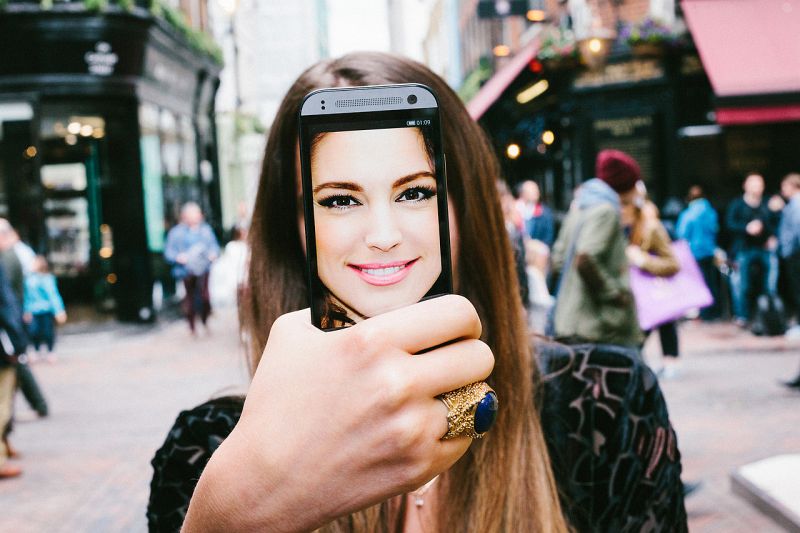
Rubin’s background bridges design and photography, which helps explain why the series feels tidy rather than chaotic. The phone is treated as a designed object with a job: display a face at the correct scale. Framing stays readable. Backgrounds are urban enough to prove the encounter, spare enough not to steal the composite.
In the mid-2010s, phone screens were still thick with bezels and specific aspect ratios. Those physical details date the pictures in a useful way. They remind you that selfies are hardware stories as much as social ones. A different generation of devices would change the crop, the brightness, even the way fingers grip the prop.
Compare a phonie with a conventional street portrait. In the conventional image, identity belongs to the person. In the phonie, identity is temporarily leased from a JPEG. That lease is the subject. Clothing, posture, and location become supporting evidence that a real body is underwriting the fantasy.
Reading the three frames here
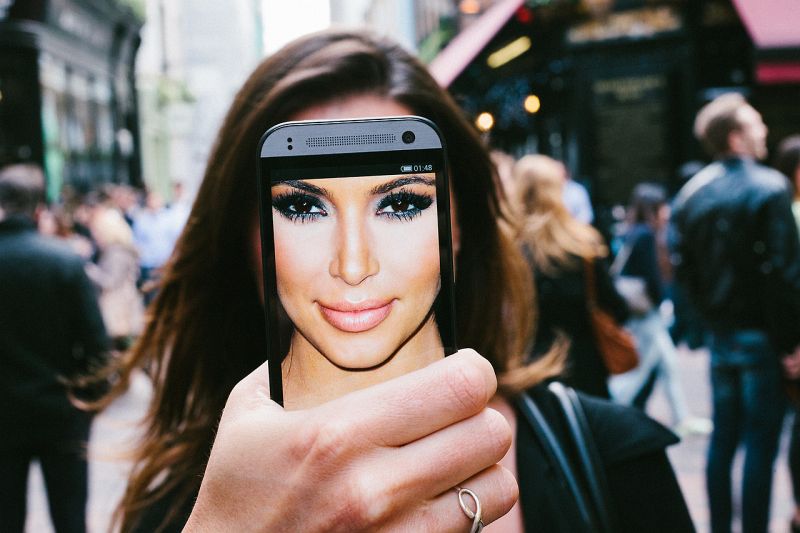
Even a small selection shows the series’ range of tone. Some phonies feel glamorous and seamless, as if a magazine cover briefly possessed a sidewalk. Others keep a seam visible—the ear that does not match, the smile that belongs to two people at once. Both outcomes are informative. Perfect alignment flatters the illusion; imperfect alignment exposes the construction, which may be the more honest selfie critique.
Ask, with each image: whose gaze are you meeting? The celebrity’s photographed eyes, or the implication of the stranger behind the glass? The series keeps flipping that answer. It is hard to feel simple about “connection” through a screen after you have watched connection staged as prop comedy.
Also notice bodies. Hands tense differently when holding a phone as mask rather than as camera. Shoulders rise. People present themselves for a portrait while erasing their own face—an odd, telling posture for a culture that claims to celebrate individuality.
Why the series still reads clearly
Selfie culture did not cool off after 2014; it industrialized. Filters, stories, front-camera defaults, and influencer economies only thickened the air Rubin was sampling. Looking back at phonies now, the project feels less like a novelty stunt and more like an early diagram of something we normalized: identity as a layer you can hold in one hand.
The photographs also preserve a specific platform moment—when Instagram fame and celebrity posting habits were consolidating into a shared visual dialect. Rubin, widely followed online in that period, was working from inside the same attention system he was teasing. That insider-outsider position keeps the series from smelling like pure scold. It feels like a participant’s joke.
Try the thought experiment
You do not need a prep’d handset to borrow the lesson. Next time you see a public selfie being taken, imagine swapping the faces—tourist for actress, cashier for pop star—and ask what changes in your level of interest. If the answer is “almost everything,” Rubin’s phonies have already explained your feed better than another think piece.
Or reverse it: open a celebrity selfie and cover everything but the eyes. How much fame remains? Then imagine those eyes floating over a stranger’s coat on a London pavement. The discomfort or delight you feel is the series’ real medium. The phone is only the easel.
Rubin’s phonies end where they begin—on the street, with people willing to play. The lasting craft is timing and alignment, but the lasting idea is plainer: we keep trying on other faces, and the camera keeps pretending not to notice.

Comments
Continue reading

Dramatic Photo Art by Sukron Ma’mun (Ipoenk Graphic)
Cirebon, Indonesia photographer Sukron Ma’mun uses theatrical natural light to frame village life, play, and place in lyrical photo art.

Bird’s-Eye Views: Florian Beaudenon’s Instant Life
Paris photographer Florian Beaudenon’s Instant Life series captures people in their rooms from above—intimate, collaborative overhead portraits of everyday joy.

Abandoned Cars Reclaimed by Nature: Rust, Growth, and Quiet Ruin
When neglected vehicles are left outdoors long enough, rust, moss, and trees rewrite them into strange still lifes—sad, photogenic, and slowly returning to the ground.