
Christmas Lights Around the World: Ten City Displays
From Vienna’s markets to Medellín’s river canopy and Singapore’s Orchard Road—ten cities where public Christmas lights turn night into a destination.
Public Christmas lighting is civic theatre: cities borrow darkness, then spend electricity and craftsmanship to prove winter can still feel generous. Some programs wrap historic squares in warm white. Others build tunnels of color over rivers. Theme parks treat December as a production schedule. The places below—drawn from a long-circulating list that once traveled the design blogs—are not ranked. They are different answers to the same question: how do you make night feel like a destination?
Vienna, Austria
Vienna’s December glow is inseparable from its markets and classical façades. Advent lights along pedestrian streets, Rathausplatz’s Christmas market silhouette, and shop windows on Graben and Kohlmarkt create a layered field rather than a single spectacle. The city’s strength is proportion: architecture already ornate enough that lighting can stay elegant—garlands, trees, and soft washes—without needing neon shock. Walk slowly. Vienna rewards looking up at cornices and across plazas more than racing for one Instagram tunnel.
Practical note for visitors: evenings get crowded near the biggest markets; side streets often hold quieter strings of lights and equally good hot drinks. Dress for wind; the Danube basin can make the same temperature feel sharper after sunset.
Baltimore, Maryland
Baltimore’s holiday lighting has long mixed neighborhood enthusiasm with downtown and harbor-area displays. Rowhouses, harbor reflections, and community contests give the season a local texture—less imperial boulevard, more blocks that compete with creativity. Harbor lights bouncing off water recall why port cities photograph so well in December: every bulb doubles in the dark surface.
If you go for lights specifically, check current municipal and harbor schedules; installations change year to year. The memorable Baltimore nights are often a combination of official trees and the residential streets where families have been refining their rooflines for decades.
Toronto, Canada
Toronto’s winter lights lean on public parks, Distillery District’s brick lanes, and downtown towers that already glitter. Cold is part of the show: breath in the air, skates nearby, and installations designed to be walked rather than driven. Canadian cities tend to treat outdoor light festivals as endurance events—warm layers, short loops, hot chocolate between blocks.
Seek contrast. A dense historic district strung with warm bulbs feels different from a contemporary light art piece in a park. Toronto can offer both in one evening if you plan transit instead of circling for parking.
Disney, California
Disneyland and the broader Southern California Disney footprint turn Christmas into choreography: Main Street façades, castle projections, parade routes, and timed shows where lighting is inseparable from music and crowd flow. It is commercial by design, and that is the point—holiday fantasy as a managed experience. Arrive with patience for queues and a willingness to see the same façade perform differently after dark than at noon.
For photographers, the challenge is scale and people. Shoot details of wreaths and windows early, then accept that wide night shots will include strangers. The spectacle is communal; framing it as empty magic usually means waiting longer than the cocoa stays hot.
Berlin, Germany
Berlin’s Christmas markets and street lighting sit against a city of sharp edges and reinvention. Lights here often feel contemporary beside historic—glass, steel, and temporary market structures glowing in plazas. Neighborhood markets each carry a mood: some cozy and wooden, others louder and more cosmopolitan. The city’s size means you sample rather than complete.
Transit makes multi-market nights possible. Choose two or three, walk between nearby ones, and leave room for a quieter residential street where balconies and courtyards do their own smaller versions of the season.
Kobe, Japan
Kobe’s Luminarie tradition—born from recovery after the 1995 earthquake—gave the city an international reputation for luminous corridors and archways of colored light. Even as editions, venues, and schedules evolve, the idea remains: light as civic remembrance and celebration, not only decoration. Japanese winter illuminations more broadly favor tunnels, allées, and carefully timed LED programs that feel closer to installation art than to a single civic tree.
Expect crowds and ticketed or timed entry for major illuminations when they run. The reward is immersion—walking inside a volume of light rather than looking at a distant tree from a sidewalk.
Vilnius, Lithuania
Vilnius wraps a compact Old Town in December atmosphere: cathedral square trees, street garlands, and markets that feel human-scaled. Baltic winters are serious; lights read brighter against early darkness. The pleasure is density—you can cover a lot of historic fabric on foot without a car.
Warm interiors matter as much as outdoor bulbs. Plan café stops. The best light walks alternate cold air and brief thawing so you stay long enough to see reflections on wet cobblestones after a flurry.
Medellín, Colombia
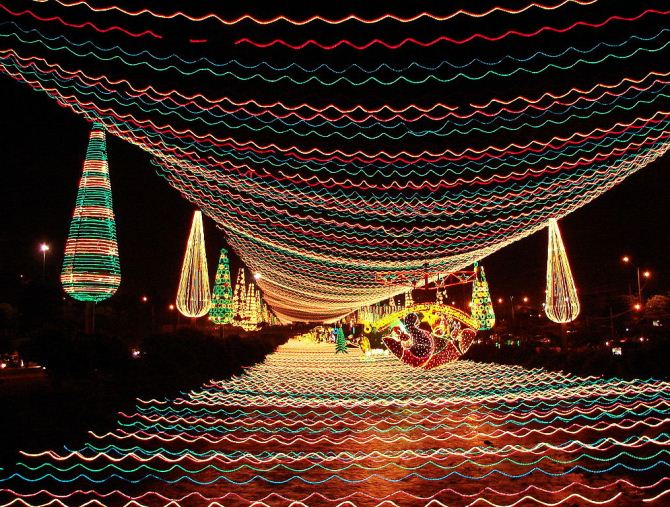
Medellín’s Alumbrados turn the holiday into a river of color. The photograph above captures the signature move: a long canopy of multi-colored lights arched over water, with wavy lines mirrored on the surface and teardrop or tree-like forms glowing along the banks. Warm nights replace snow; the spectacle is tropical density—thousands of points of light forming tunnels you walk or float beside rather than a single frozen square.
That contrast is why Medellín belongs on worldwide lists. European markets sell atmosphere through cold and wood smoke; Medellín sells atmosphere through volume, reflection, and civic pride in a public art of electricity. Go prepared for crowds at peak evenings, follow local guidance on best viewing stretches along the river parks, and give the reflections equal attention—the water is half the design.
Paris, France
Paris does not need permission to look cinematic in December. Avenue des Champs-Élysées trees, boutique windows, and bridge lights on the Seine build a city-scale constellation. The Louvre and department-store vitrines compete with street décor; the Seine doubles everything after rain. Parisian Christmas lighting is less about one branded “show” and more about the metropolis performing elegance at night.
Walk a planned axis—say from a lit avenue toward the river—rather than hopping randomly between arrondissements. Fatigue and transit time will otherwise steal the evening. A single well-chosen loop beats a checklist of famous corners seen only from a taxi window.
Singapore
Singapore’s Orchard Road and other holiday corridors treat Christmas lights as tropical boulevard theatre: synchronized LEDs, commercial façades, and humid night air that keeps crowds outdoors late. The aesthetic is polished and vertical—lights climbing buildings and canopies rather than clinging to snow-laden eaves. It is shopping-district spectacle done with high production values.
Heat and humidity shape the visit. Light clothing, water, and patience for pedestrian density matter as much as camera settings. Reflections in glass storefronts and wet pavement after a shower can be as interesting as the official arches overhead.
How to see lights without only collecting them
Across these cities, the same craft advice applies. Arrive after civil twilight but before the absolute peak crush when you can. Look for reflections—rivers, rain, harbor water, glass. Alternate wide establishing views with close studies of a single wreath, arch, or market stall. Respect residential streets; not every glowing balcony wants a tour group. Confirm current year dates; light festivals move, shrink, or relocate after the blog posts that made them famous.
Vienna’s restraint, Medellín’s river canopy, Kobe’s luminous corridors, and Disney’s staged Main Street are different instruments in one seasonal orchestra. Pick the climate and culture you want to stand inside, then let the darkness do half the composition work. The best displays are not only bright. They are places where a city agrees, for a few weeks, that night is worth dressing up for.

Comments
Continue reading

DIY Christmas Ornaments with Paint, Glitter, Crystals, and Filled Balls
Turn plain ornament blanks into a cohesive handmade tree with painted swirls, sealed glitter, crystal accents, filled scenes, and ribbon hangers that store cleanly for next year.
Simple Christmas Home Decoration That Actually Work
Entry, mantel, table, tree, lights, paper crafts, and textiles—practical holiday styling paired with the original decoration gallery.
40 String Light Home Décor Ideas: Curtains, DIY Chandeliers, and Everyday Glow
Reuse Christmas and LED string lights year-round—twinkle curtains, hula-hoop chandeliers, shelves, jars, and outdoor installs—with practical, inexpensive décor ideas.