
Elena Eremina’s Still Lifes with Adventurous Hamsters
After the household sleeps, Elena Eremina opens the cages—hamsters raid pasta pots and rewrite the kitchen still life as comic tabletop theater.
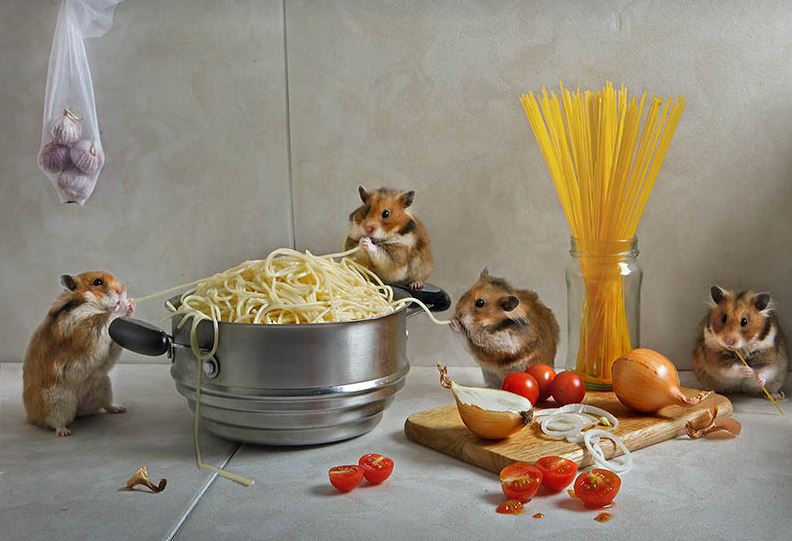
Russian photographer Elena Eremina built a late-night practice around her hamsters. After her husband and son went to sleep, she opened the cages and let the animals “run around everywhere and organize riots,” then turned those riots into still lifes that feel closer to comic theater than solemn fine art. The series often circulated under titles like “Still Life with Hamsters”—a wink at classical tabletop photography that usually features fruit, glassware, and skulls, not Syrian hamsters mid-heist.
Where many pet portraits chase cuteness alone, Eremina’s best frames stage narrative: ingredients arranged, scale jokes locked in, animals caught in gestures that read as cooking, tasting, or chaos. The kitchen pasta scene preserved here is a clear sample of that method—warm light, careful prop craft, and four light-brown-and-white hamsters treating spaghetti like treasure.
Pasta pot raid
A silver pot sits center-left, mounded with cooked spaghetti. One hamster stands left of the pot, hauling a single strand away with both paws. Another perches on the rim, nestled in noodles, nibbling. A third stands to the right of the pot, pulling pasta toward its mouth. On the far right, a fourth sits apart, holding a straight strand like a trophy and facing the camera. The spread of poses turns one prop into four story beats: theft, immersion, tasting, and portrait pause.
Around them, Eremina builds a cook’s still life at hamster scale. A wooden board holds a halved onion and translucent rings; whole cherry tomatoes sit nearby; cut tomatoes spill seeds on the counter. Behind, a clear jar bristles with dry yellow spaghetti—raw twin to the cooked mound. Upper left, a white mesh bag of garlic bulbs hangs against a soft neutral wall. Nothing in the background shouts. Warm, even light keeps fur and food equally readable.
The humor is architectural. Hamsters are small; pasta strands are long; a full pot is a landscape. By letting animals climb the rim and grip noodles, Eremina makes scale the punchline without captions. Viewers invent dialogue—chefs, thieves, critics—because the staging invites it. That invitation is why the work felt “entertaining in an exceptional way” when blogs shared it in the mid-2010s: it rewarded a longer look than a plain cage portrait.
Night sessions and willing chaos
Eremina’s own description of the process matters. She photographed after the household quieted, when her husband and son were asleep and the hamsters could be let out. The quote about happiness and “riots” is not marketing fluff; it names the practical truth of small-pet photography. Hamsters are crepuscular and curious. Forced stillness under bright lights produces stress faces. Short, supervised free-roam sessions on a cleared counter—with edible or safe props—produce the gestures that look like narrative.
“Organize riots” is affectionate exaggeration, but it points to directing without crushing spontaneity. Props are placed; animals explore; the shutter waits for coincidence that looks intentional. One hamster on the rim, another posing with a strand—those alignments are partly luck, partly patience, partly knowing how food motivates. Cooked pasta is risky as a regular diet item; as an occasional photo prop in a controlled set, it becomes temporary theater. Responsible reading of the image includes that caveat: charming stills are not feeding guides.
Working at night also shapes the light. Soft, warm illumination without harsh noon window glare suits fur texture and keeps shadows gentle under the pot and board. The neutral wall behaves like a studio cyc in a home kitchen. Eremina’s craft sits between domestic documentary and constructed set—closer to advertising tabletop than to snapshot, but powered by living subjects that refuse perfect obedience.
Still life, rewritten for rodents
Classical still life taught painters to arrange objects for symbolism and light. Eremina borrows the arrangement and swaps vanitas for comedy. Garlic, onion, tomato, and pasta already suggest an Italian kitchen; hamsters rewrite the scene as invasion. The dry spaghetti jar is a vertical counterweight to the horizontal pot; red tomatoes punch color against brown-white coats; onion rings echo the circular pasta nests. Compositionally, the frame reads left-to-right like a comic strip: climb, feast, pull, present.
Calling the broader body of work “Still Life with Hamsters” signals that she knew the art-historical joke. Fine-art stills of the period sometimes used animals as surreal intrusions; Eremina keeps the tone light rather than dark. No melancholy. No heavy metaphor required. The pleasure is watching prey animals given a stage usually reserved for porcelain and wine. That lightness helped the photos travel on Flickr and through lifestyle blogs that wanted shareable joy without academic framing.
Yet the photographs are not careless. Focus holds on faces and nearest pasta. Depth of field softens only enough to separate subjects from wall. Color balance favors food warmth. These are decisions. Entertaining work can still be precise; Eremina’s kitchen raid proves the combination.
Why Syrian hamsters suit the genre
Syrian (golden) hamsters have rounded bodies, expressive cheek pouches, and paws that grip like tiny hands—perfect for “holding” props in a way that reads as human activity. Their size relative to cookware creates instant fantasy. Four animals in one frame multiply personality: loner with a strand, crowd at the pot, climber in the noodles. Group staging is harder than a single pet on a blanket; Eremina accepts the difficulty because the riot is the brand.
Compared with guinea-pig fashion sets or dog costume blogs popular in the same years, her approach leans culinary and tabletop. The animals are not dressed. The world around them is dressed instead—ingredients as costume. That choice keeps dignity closer to the surface. Viewers can laugh at the situation without feeling the animals are masked into caricature. The far-right hamster looking toward camera even breaks the fourth wall, as if checking whether the audience is watching the heist succeed.
Home studio ethics and craft notes
Anyone inspired by Elena Eremina’s night shoots should separate admiration from imitation hazards. Clear the counter of toxins, cords, and fall risks. Stay present for the entire free-roam. Limit novel foods; prefer safe chew items when possible. Keep sessions short. Never leave hamsters unsupervised with water pots they could fall into. The charming photograph is the end of a careful process, not a license for chaos.
On the craft side, study how much empty wall she leaves above the garlic bag and how little clutter fights the pot. Negative space keeps the joke readable. Repeat colors—yellow pasta dry and cooked—so the eye links raw and finished. Place one animal apart from the cluster so the frame has a portrait anchor. Those are transferable still-life lessons even if your subject is ceramic, not rodent.
Eremina’s work also sits in a lineage of Russian and international pet photographers who treated small animals as recurring characters rather than one-off cute hits. Consistency of cast—her hamsters, revisited—builds audience attachment. Viewers return for the next adventure: another kitchen, another toy set, another riot after bedtime. The pasta frame is one chapter in that serial storytelling.
What remains on the counter
Look again at the four positions. Left puller, rim climber, right taster, far portraitist. Together they turn a pot of spaghetti into a complete scene without a human hand in frame. That absence is part of the magic. Elena Eremina’s presence is upstream—in the timing after her family slept, in the prop layout, in the decision to open the cages and wait. The photograph shows only the riot’s prettier second.
If classical still life whispered about time and appetite, this one laughs about appetite alone. Hamsters will always choose the noodle. The photographer’s job was to make that choice look like a feast worth remembering—and she did, one late night at a time, while the rest of the house dreamed through the quiet clatter of tiny paws on a kitchen counter.

Comments
Continue reading

Dramatic Photo Art by Sukron Ma’mun (Ipoenk Graphic)
Cirebon, Indonesia photographer Sukron Ma’mun uses theatrical natural light to frame village life, play, and place in lyrical photo art.
Bird’s-Eye Views: Florian Beaudenon’s Instant Life
Paris photographer Florian Beaudenon’s Instant Life series captures people in their rooms from above—intimate, collaborative overhead portraits of everyday joy.
Abandoned Cars Reclaimed by Nature: Rust, Growth, and Quiet Ruin
When neglected vehicles are left outdoors long enough, rust, moss, and trees rewrite them into strange still lifes—sad, photogenic, and slowly returning to the ground.