
Above the Clouds: Alpine and Aerial Cloud Photography
From Catalin Marin to Luís Riafoge—cloud-sea landscapes where mountains, light, and altitude turn weather into the main subject.
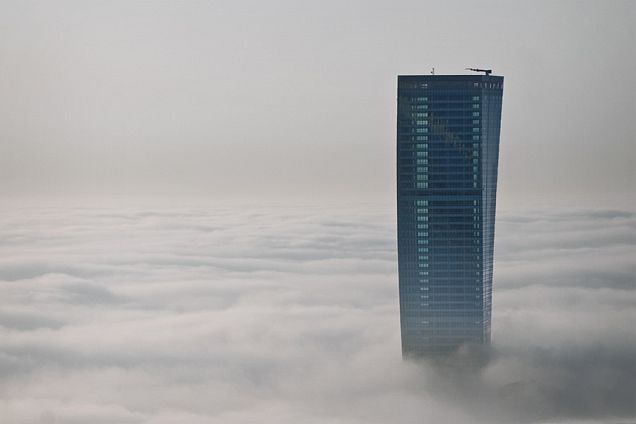
Cloud photography sits at an odd intersection of weather forecast and fine art. The subject is temporary, bright one minute and erased the next, yet the finished frame can feel monumental—as if the sky had always been arranged that way. The images gathered here work in that register: mountains, ridges, and open air above a soft floor of white, where the usual ground disappears and scale has to be reinvented.
Photographers who chase views above the clouds are not only hunting beauty. They are hunting altitude, timing, and a kind of quiet that street-level weather rarely offers. Below the layer, a city can be gray and damp. Above it, the same afternoon may open into hard light and a horizon that looks painted. That contrast is why these pictures stay memorable long after a standard sunset fades from memory.
A cloud deck also changes storytelling. Ordinary landscape photos depend on foreground rocks, paths, or trees to lead the eye. Above the clouds, the “foreground” may be vapor itself—or a thin ridge that behaves like a pier over an unreal ocean. The viewer has to accept a new physics of place. Once that happens, every peak that pierces the white becomes an island nation with its own weather.
Catalin Marin
Catalin Marin’s frame opens the set with that classic reveal: landforms or structure rising through a cloud sea, edges softened, distance stacked in pale bands. The photograph depends on separation—dark or textured subject against luminous weather—so the eye knows where to stand even when the floor is vapor.
What makes Marin’s kind of image work is restraint. Too much sky detail can compete with the subject; too little turns the cloud into a blank studio backdrop. The sweet spot is a layer that still holds texture—subtle waves, faint shadows, a sense that wind is moving something vast just beneath the camera’s calm.
Jason Hummel
Jason Hummel’s work often lives where adventure and landscape photography overlap. Above the clouds, that means earning the viewpoint: ridgelines, ski tours, alpine approaches where the marine or valley layer sits below like a second ocean. The drama is not only the white field; it is the knowledge that someone climbed or traversed into the clear air to make the picture.
Adventure cloud photography carries a different emotional temperature than aerial work from a plane. The camera is still tied to legs, lungs, and route-finding. When Hummel’s frames succeed, they feel inhabited—proof that a person stood in cold wind with a finite window before the layer rose or the light died.
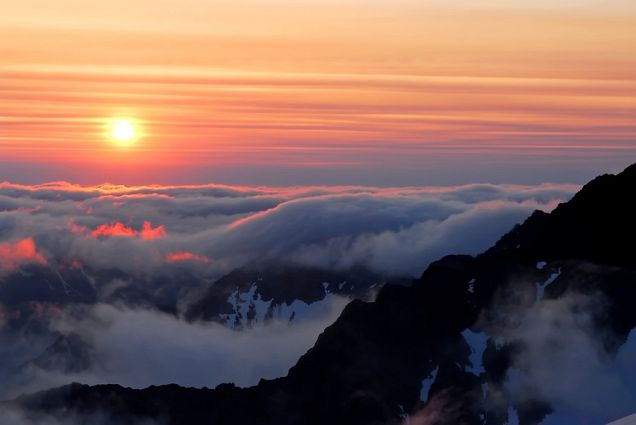
Edgar Moskopp
Edgar Moskopp appears twice in this collection, which suits a photographer attentive to sky structure. Cloud decks are not blank. They hold waves, breaks, and thin places where light punches through. Moskopp’s frames treat those variations as composition—using the cloud plane the way another landscape shooter might use a lake: reflective calm interrupted by form.
Repeating a photographer in a gallery is useful when the subject itself is variable. One Moskopp image may emphasize vastness; another may emphasize rupture—a hole in the layer, a tilted plane, a harder edge of shadow. Together they argue that “above the clouds” is a category with dialects, not a single postcard pose.
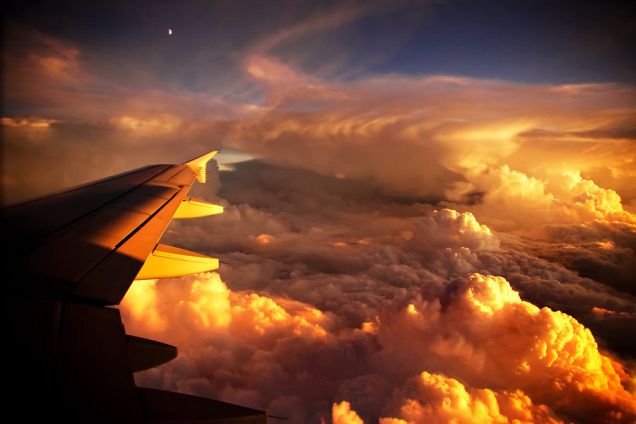
Gilles Monney
Gilles Monney’s contribution keeps the series from feeling like one repeated summit trick. Different lenses and distances change how “above” reads. A wider view makes the cloud field continental. A tighter crop turns a single break in the layer into a spotlight. Monney’s image holds that balance between weather as environment and weather as subject.
Color temperature matters here as much as geometry. Cool blue hour can make a cloud sea feel lunar. Warm sidelight can turn the same vapor into gold leaf. Monney’s eye for that shift is part of why the frame holds attention: you are not only looking at altitude, you are looking at a specific hour’s light negotiating moisture.
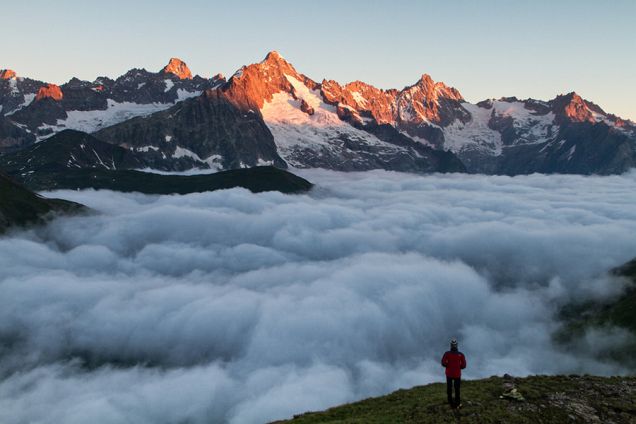
Edgar Moskopp, again
Returning to Moskopp underlines how changeable the same idea can be. One day the layer is smooth and endless. Another day it frays into strips and pockets. Photographers who specialize in sky work learn to wait for those moods rather than forcing a single formula. The second frame here rewards that patience: familiar theme, different weather personality.
It is also a lesson in editing. A strong cloud series needs sequence, not sameness. By placing two Moskopp images apart in the set, the gallery mirrors how real weather repeats with variation—same grammar, new sentence.
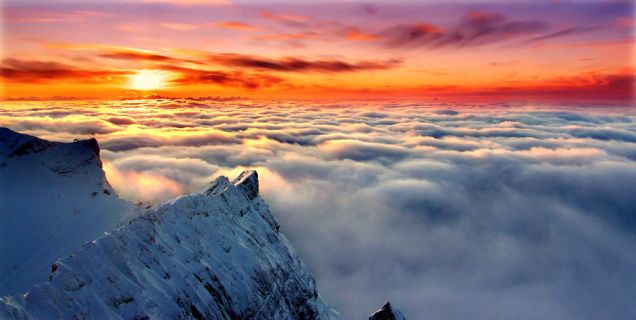
Evgeni Dinev
Evgeni Dinev’s photograph leans into luminous atmosphere—light scattered through moisture until edges dissolve. Above-the-clouds images can be high-contrast and graphic, or they can be soft almost to the point of abstraction. Dinev’s contribution tips toward the latter: less about a labeled peak, more about tone, glow, and the sensation of floating in brightness.
Abstraction is risky in landscape work because it can slide into vagueness. Dinev avoids that by keeping enough structure for the eye to travel—gradients, implied depth, a horizon that still behaves like a horizon. The result feels dreamlike without abandoning photography’s tether to a real hour and place.
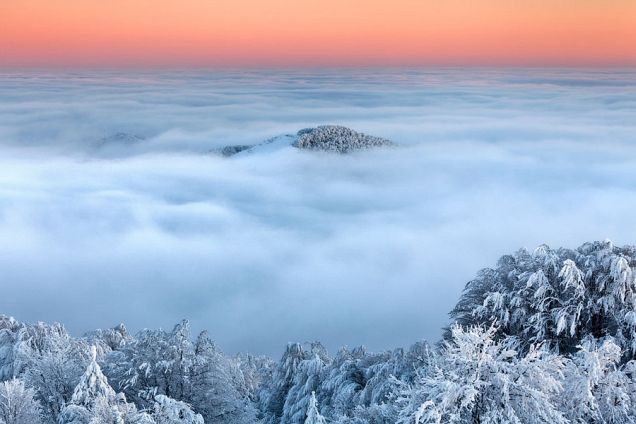
Eric Kraus
Eric Kraus brings another reading of altitude. Sometimes the strongest cloud photographs include a human-scale hint—a ridge walk, a wingtip, a thin trail—so the white expanse does not float free of reality. Even without an obvious figure, Kraus’s framing can imply position: you are somewhere specific, looking out over weather that most people only meet as a ceiling.
That implied position is what separates “pretty sky” from “above the clouds” as a genre. The camera must convince you that ordinary life continues under the layer while you briefly occupy the clear. Kraus’s contribution keeps that double awareness alive.
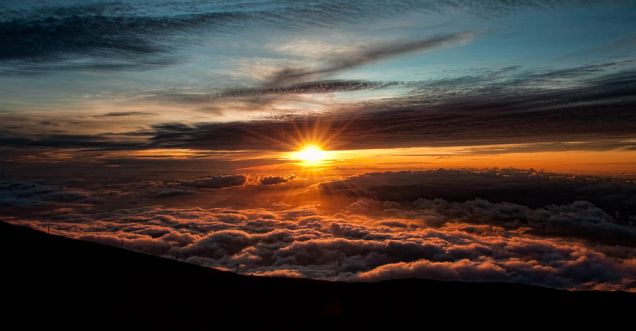
Glenn Harper
Glenn Harper’s image continues the conversation between solid ground and soft weather. Mountains that pierce a cloud deck become islands. Valleys disappear. The map in your head fails, and that failure is the point. Cloud photography at altitude is partly about disorientation made beautiful—proof that landscape includes volumes of air, not only rock and trees.
Harper’s kind of frame also rewards long looking. First you register the spectacle. Then you start counting tones in the white, noticing how distance cools, how a ridge line softens, how the cloud surface is not perfectly flat. Those secondary discoveries are where the photograph stops being a novelty and becomes a study.
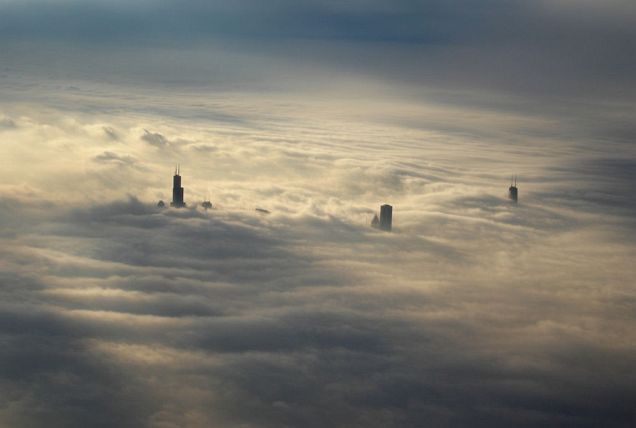
Michi
Michi’s vertical frame uses height in the picture plane as well as in the real world. A tall composition can stack cloud layers, emphasize drop-away space, or let a single shaft of light travel farther down the image. In a set dominated by wide horizontals, a vertical cut feels like a deep breath—more sky, more fall, more sense that the camera is suspended.
Verticals also change how we remember weather. A wide shot can feel like a panorama postcard. A tall shot can feel like standing at a railing and looking out, then up, then down again. Michi’s image gives the gallery that bodily reminder.
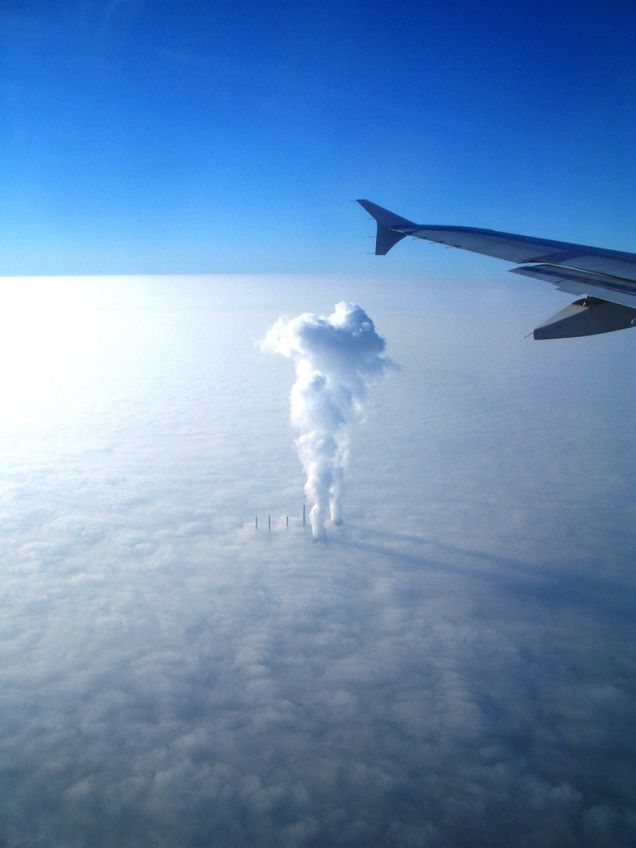
Luís Riafoge
Luís Riafoge closes the gallery with another reminder that cloud seas are global. The same optical conditions appear over different continents: temperature inversions, marine layers, post-storm clearing, dawn light raking a deck that overnight filled a valley. What changes is the foreground culture of place—local peaks, local color temperature, local habits of getting high enough to see.
Ending on Riafoge leaves the set open rather than concluded. There is always another ridge, another morning inversion, another photographer willing to wake early enough to meet the layer before it lifts.
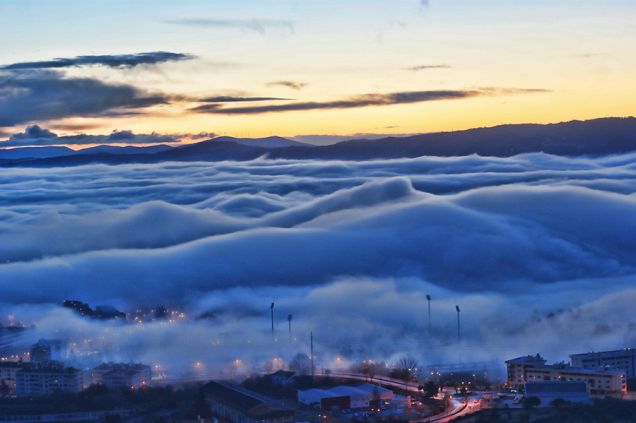
Working above a moving floor
Technically, these photographs punish complacency. Exposure for bright cloud can underexpose rock; exposure for rock can blow out the layer into featureless white. Graduated filters, careful histograms, and bracketed frames help, but so does accepting that some days the sky simply will not cooperate. Wind at ridge level, cold that drains batteries, and sudden fog that climbs to meet you are part of the craft, not interruptions of it.
Ethically and practically, altitude has costs. Not every viewpoint is a roadside pullout. Some of the most striking above-the-clouds images come from routes that demand experience, navigation, and respect for avalanche, weather, and land access. The romance of floating over white should not obscure the fieldwork underneath. The best of these pictures carry that seriousness quietly: stable horizons, deliberate compositions, and light that feels waited for rather than snatched.
What unites Marin, Hummel, Moskopp, Monney, Dinev, Kraus, Harper, Michi, and Riafoge here is not a shared brand. It is a shared elevation of attention. They treat clouds as terrain—something you can be above, beside, or briefly inside—rather than as background decoration for a sunset cliché.
Keep that habit when you close the gallery. The next low ceiling over your own town is not only dull weather. Somewhere above it, for a short window, the world may open into clean air and long sightlines—the same conditions these photographers climbed, flew, or waited into, and then fixed in frames that still feel like standing on the edge of a white sea.

Comments
Continue reading
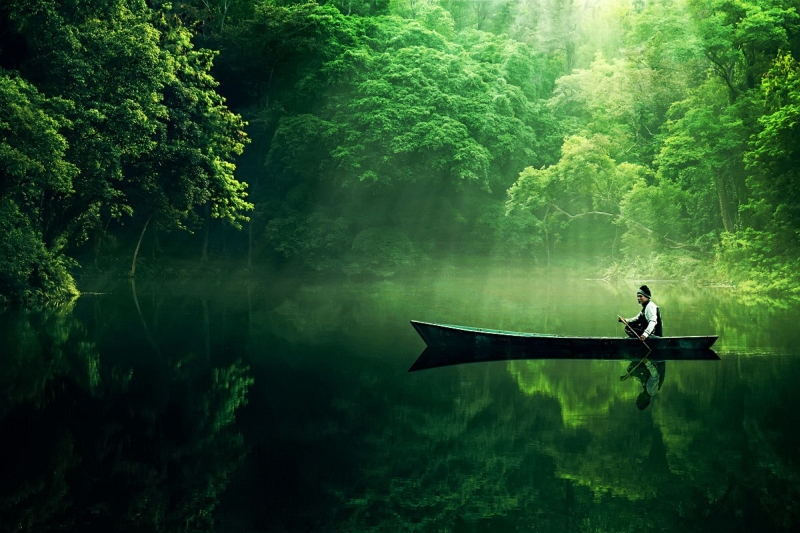
Dramatic Photo Art by Sukron Ma’mun (Ipoenk Graphic)
Cirebon, Indonesia photographer Sukron Ma’mun uses theatrical natural light to frame village life, play, and place in lyrical photo art.

Bird’s-Eye Views: Florian Beaudenon’s Instant Life
Paris photographer Florian Beaudenon’s Instant Life series captures people in their rooms from above—intimate, collaborative overhead portraits of everyday joy.
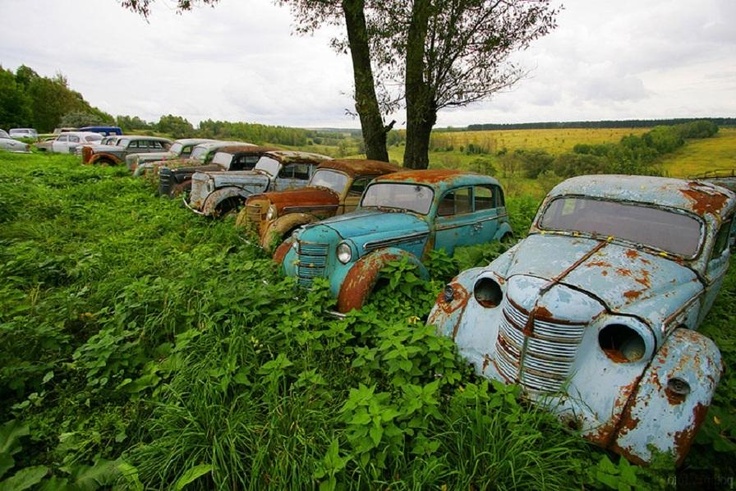
Abandoned Cars Reclaimed by Nature: Rust, Growth, and Quiet Ruin
When neglected vehicles are left outdoors long enough, rust, moss, and trees rewrite them into strange still lifes—sad, photogenic, and slowly returning to the ground.