
5 Ways Understanding Locks Changes How You See Physical Security
High-level lessons about lock limits, door systems, and layered home security—awareness for lawful protection, not bypass instructions.
In a digital age, conversations about security often start with passwords, phishing, and network breaches. That focus is rational: cybercrime scales quickly and can reach people who never leave home. Physical security still matters. As long as theft, unauthorized entry, and violence remain real risks, doors, windows, and locks continue to shape daily safety—even when property-crime trends and cyber threats shift from year to year.
Understanding locks at a high level can change how you evaluate “secure enough.” It does not require becoming a locksmith, and it should never mean practicing on property you do not own or lack explicit permission to test. In many places, possessing lock-bypass tools or attempting entry without authorization can be illegal. The useful public lesson is awareness: what locks are for, where consumer hardware is limited, and why layered defenses beat faith in a single cylinder.
Security researchers, locksmiths, and ethical hobbyists who study locks with consent and within the law often describe the same pattern: once you see that locks are engineered compromises—not magic barriers—you start protecting homes and workplaces differently. Below are five perception shifts that tend to follow that awareness, framed for lawful, defensive use only.
1. Locks are access-control tools, not force fields
A lock’s job is straightforward in purpose if not always in engineering: it restricts who can open a door, gate, cabinet, or container under normal conditions. It gives authorized people a convenient way in and raises the cost of casual or opportunistic entry for everyone else. That is valuable. It is also narrower than the cultural idea of a lock as an absolute seal.
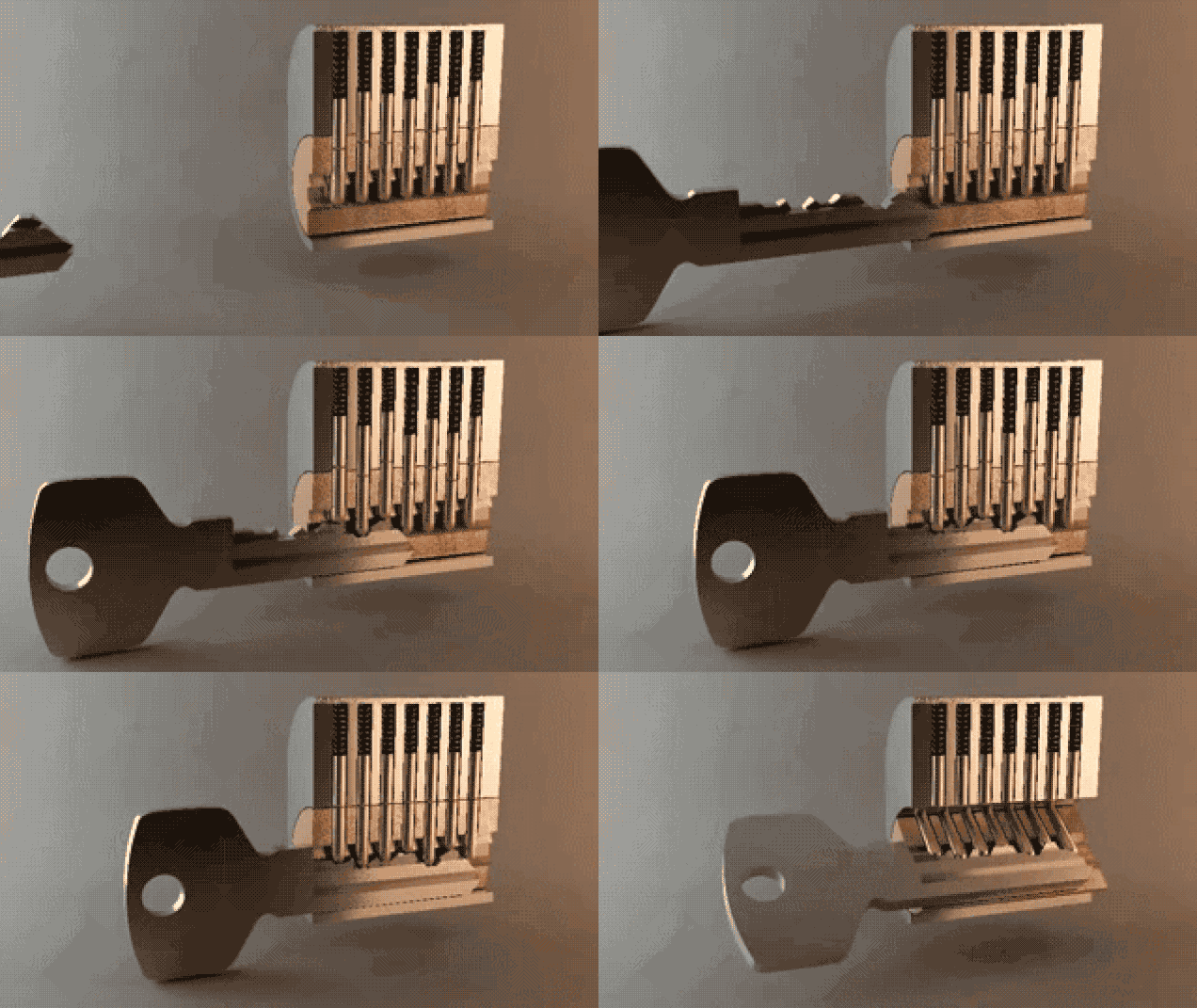
Locks are among the oldest security technologies still in everyday use. Common pin-tumbler designs descend from ancient mechanisms and were widely popularized in modern form in the nineteenth century, including work associated with Linus Yale Jr. A simplified cutaway helps many people grasp the concept: springs and pins inside a cylinder must align before the plug can turn.
What matters for homeowners is not memorizing internal parts. It is recognizing that a key is a carefully shaped authorization token for a mechanical system. If the system is cheap, worn, poorly installed, or unmatched to the door and frame, the “locked” label can overstate protection. Perception shift: treat locks as one control among several, not as proof that a building is hard to enter.
2. Consumer lock quality varies more than the “locked” sticker suggests
In theory, more complexity inside a lock should mean stronger resistance to tampering. In practice, manufacturing quality, materials, installation, and age matter enormously. Budget hardware may meet a price point while offering limited resistance to known classes of attack. Older locks may still look solid while no longer matching modern expectations. Even decent locks can be undermined by a loose strike plate, a weak door, or a sidelight that bypasses the lock entirely.
Security-aware people stop asking only “Is there a lock?” and start asking “Is this lock appropriate for the asset and the threat?” A closet inside a locked office is not the same problem as a street-facing apartment door. Retail padlocks on a garden shed are not the same problem as a pharmacy cabinet. Matching hardware grade, certification marks where relevant, and professional installation to the real risk is more useful than collecting impressive-looking keys.
This article will not describe bypass methods, tools, or practice drills. Those details belong in licensed training, manufacturer documentation for owners, or authorized security assessments. For everyone else, the defensive takeaway is enough: assume many everyday locks were designed for convenience and cost as much as for determined adversaries. Perception shift: “It locks” is not the same as “it resists a motivated intruder.”
3. Door systems matter as much as the cylinder brand
Travelers and security professionals often notice that multi-point locking—where a door secures at several points along the frame rather than only at a single latch—is more common in some regions than others. Multi-point systems can raise the difficulty of forcing a door open because load is distributed. They can also be more demanding to install and operate, which is one reason simpler single-point setups remain widespread in many U.S. homes.
The perception shift is architectural, not nationalistic. A strong cylinder in a flimsy door with a short screw in the strike plate is still a weak system. Hinges, frame reinforcement, glass near the lock, mail slots, and garage-entry doors often determine outcomes more than the brand stamped on the key head. When you evaluate physical security, look at the whole opening: door, frame, hardware, and adjacent weak panes.
If you upgrade, prioritize the envelope. Reinforced strike plates with long screws into framing, solid-core or metal doors where appropriate, and locks rated for residential exterior use typically beat swapping only the pretty part of the knob. Ask a qualified locksmith or security consultant for options that fit your door type—especially for multi-point or high-security hardware that must be installed correctly to work as designed.
4. There is no permanently “unpickable” or unattackable lock
Manufacturers innovate. New keyways, better materials, and improved resistance features appear regularly. None of that creates a forever-proof device. Every design is a trade-off among cost, convenience, reliability, and resistance to specific threats. Features that stop one attack class may do little against another. Marketing language that implies perfection should be read skeptically.
Some products rearrange familiar internal ideas without addressing known weak points of a product family. Others improve one metric while remaining vulnerable to totally different approaches—destructive entry, key control failures, or social engineering. The mature view is probabilistic: better locks raise time, noise, skill, and chance of failure for an attacker. They do not grant immunity.
Perception shift: buy resistance and delay, not mythology. Combine improved hardware with key control (who has copies?), periodic inspection, and procedures for lost keys or employee turnover. For higher-risk sites, consider systems with better audit trails or electronic access—still imperfect, still useful when managed well.
5. Quiet bypass is only one threat; force and opportunism dominate many crimes
Popular culture fixates on silent, skilled entry. Real property crime frequently looks different: smashed glass, kicked doors, unlocked windows, open garages, and rushed theft when nobody appears home. If a lock seems time-consuming to defeat discreetly, a burglar may choose a louder, faster path—or move to an easier target. That reality does not make locks useless. It means lock quality must sit beside other controls.
Layered physical security is the practical response: exterior lighting, alarms or monitored sensors, cameras used ethically and legally, window locks, landscaping that preserves sight lines, neighborhood vigilance, and habits like locking up even for short absences. Safes should be anchored; valuables should not advertise themselves through street-facing windows. Insurance and inventory records help after an incident, but prevention starts with denying easy wins.
Perception shift: design against the likely path, not only the cinematic one. Ask what an opportunistic thief would try in thirty seconds. Fix that first. Then improve delay and detection for more determined attempts. Understanding that locks have limits is not an invitation to defeat them; it is a reason to stop relying on a single point of failure.
Use knowledge defensively and lawfully
Learning how physical security fails can feel unsettling. That discomfort is useful if it drives better doors, better habits, and honest risk assessment. It is harmful if it becomes curiosity aimed at other people’s property. Keep study ethical: your own locks, permissioned training, or professional assessments only. Do not treat online challenge culture as a substitute for legality or consent.
Physical and digital security increasingly overlap—smart locks, cameras, and apps introduce new failure modes alongside old mechanical ones—but the core lesson remains human. Barriers buy time. Awareness buys better choices. When you stop imagining a locked door as absolute and start seeing it as one layer in a system, you are already thinking more like someone who protects people and places, not like someone who merely owns a key.

Comments
Continue reading
Funny Animal Signs That Warn People (While Animals Ignore Them)
From a seagull on a no-birds disc to classic zoo and park ironies—why animal warning signs get funny, and what the rules are still for.
How to Find Local Amenities on Vacation: Mechanics, Haircuts & More
Locate trustworthy local services and everyday spots while traveling or settling in—using publications, reviews, map apps, neighbor tips, and low-pressure exploration.

Kristen Stewart for V Magazine, Spring Preview 2013
V81’s Wild at Heart cover story—Kristen Stewart shot by Inez & Vinoodh, styled by Joe McKenna, in pale minimal spring glamour.