
Wonderland by Kirsty Mitchell
English photographer Kirsty Mitchell’s Wonderland series builds handmade fairy-tale worlds in real woodland—costume, colour, and grief shaped into staged photographs.
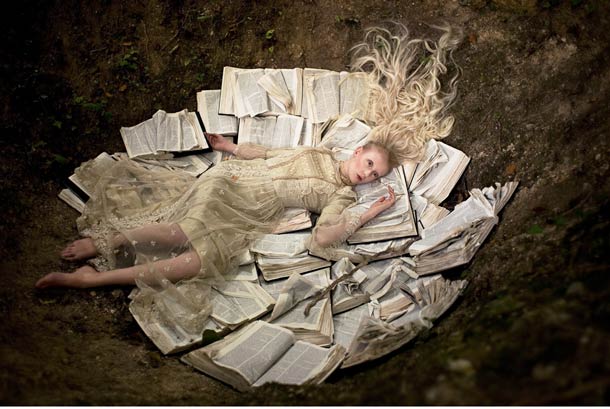
English photographer Kirsty Mitchell builds worlds before she photographs them. In her long-running series Wonderland, colour, costume, and woodland become a single staged dream: figures in handmade dress, props assembled by hand, scenes that look like pages torn from a storybook and left overnight in the English countryside. First glances often leap to Alice—and the kinship is real—but the deeper current is personal. Mitchell began the work after the death of her mother, Maureen, and the project grew into a tribute, a therapy, and a body of fine-art photographs that treat grief as something you can sew, paint, and light.
That double identity matters. Mitchell trained and worked as a fashion and costume designer, including time around the London studios of Alexander McQueen and Hussein Chalayan, before photography claimed the centre of her practice. The dresses, headpieces, and set pieces in Wonderland are not rented catalogue props. They are crafted objects—often months in the making—then carried into real landscape and photographed at true scale. What you see is theatre without a stage house: a miniature film set that happens to be a forest floor, a riverbank, a clearing after rain.
A series born from loss and storytelling
Maureen Mitchell was an English teacher who loved stories. When she died in 2008, her daughter faced the familiar collapse that follows such a loss: work still demanded focus, while ordinary days felt hollow. Mitchell turned to the woodlands near her home in Surrey and to the camera. Early pictures filled with fantasy, colour, sadness, and longing. Over time those experiments hardened into a deliberate series. Fairy-tale fragments her mother had once read aloud mixed with adult grief and a spiritual pull toward nature. The resulting images read like chapters without captions—open enough for viewers to project their own narratives, yet specific enough that you sense a private autobiography under the glitter.
Calling the work “escapist” is only half true. Escape is there, yes: saturated palettes, impossible silhouettes, characters who seem to belong to another century. But the craft keeps the pictures grounded. Fabric has weight. Leaves catch real light. Weather and season interrupt the fantasy. That friction—dream costume against damp English ground—is part of why the series resists looking like digital collage. Mitchell has been clear that the scenes are physical constructions, not composite shortcuts. The labour is the point as much as the final frame.
Across years of production, Wonderland expanded into dozens of photographs. Individual images could take months of preparation; the wider project stretched over roughly five years. Friends and volunteers appear in production stories as helpers rather than a commercial crew. Materials were scavenged, customised, and funded from ordinary wages at the start. The mythology of the big fashion team does not apply here. What applies is patience, thrift, and an obsessive attention to surface—beading, embroidery, painted detail—skills Mitchell had already practised as a designer specialising in fabric manipulation.
Costume, set, and the designer’s eye
Fashion training shows in how garments sit on bodies and how colour blocks against foliage. Headpieces become architecture. Skirts become landscape features. A character can dominate a clearing the way a couture look dominates a runway—except the “audience” is bark, moss, and sky. Mitchell’s past internships and studio years matter less as name-dropping than as evidence of hand skills: how to make something look inevitable once it is worn, how to control silhouette, how to let a single prop carry narrative weight.
Look for construction, not only mood. Seams, layers, and texture reward slow viewing. What appears ethereal at thumbnail size often reveals glue, stitch, and scavenged material up close. That honesty is part of the series’ charm and its seriousness. Fantasy built from humble stock still has to hold under daylight. The photographs succeed when the handmade object survives contact with weather and still looks like it belongs to myth.
Models in these pictures are collaborators in stillness. Poses tend toward tableau: a figure halted mid-story rather than caught mid-stride. Faces may be serene, masked, or turned toward some off-frame wonder. The camera treats them as inhabitants of a finished world, not as lifestyle influencers visiting a location. That theatrical distance is why comparisons to film stills feel apt. You are watching a scene that already knows its own rules.
How to read a Wonderland picture
Start with hierarchy. Where does the eye land first—colour flare, facial expression, a prop that breaks the natural palette? Mitchell often uses high-chroma costume against greens and browns so the human figure becomes a signal fire in the woods. Next, notice scale. Are we close enough to read embroidery, or far enough that the figure becomes a fairy-tale silhouette against trees? Distance changes the genre feeling: intimate frames lean toward portrait; wider frames lean toward storybook illustration.
Then ask what the picture withholds. Many strong frames refuse neat plot. There is arrival without destination, mourning without epitaph, celebration without party. That openness is deliberate. A tribute to a storyteller does not need to flatten into a single moral. It needs room for memory—hers, and yours. Viewers who come only for “pretty fantasy” still get beauty; viewers who stay longer often feel the ache underneath the satin.
Colour behaves like emotion in this work. Soft pastels can read as childhood; deep reds and blacks can tip toward ritual or warning; sudden whites can feel spectral. Because Mitchell designs the palette as carefully as a collection lookbook, chromatic choices are rarely accidental. Treat hue as narrative punctuation.
Finally, remember the English landscape itself. These are not generic stock forests. Local woodland, weather, and season are co-authors. Mud, mist, and low light keep the magic from floating into pure CGI softness. The land insists on time of day and time of year. Grief, too, has seasons; the pictures seem to know that.
Between Alice and something more private
Alice comparisons are inevitable and useful up to a point. Both traditions traffic in portals, odd companions, and the sense that ordinary rules have been suspended. Mitchell’s work, though, is less pastiche of Carroll than a personal mythology assembled from childhood reading, adult loss, and design craft. The title Wonderland names a place of astonishment and also a place of disorientation—the kind that follows when a central person in your life is gone. Wonder and bewilderment share a root.
That is why reducing the series to “fashion photography in the woods” misses its centre. Fashion is the toolkit. The subject is remembrance made visible: a daughter using every skill she has to keep a mother’s gift of imagination in circulation. Prints, books, and exhibitions later widened the audience, but the emotional contract was set early. Make something beautiful enough that strangers will look—and personal enough that the looking feels like witness.
If you collect or study staged photography, Wonderland sits with other practitioners who build worlds rather than wait for decisive street moments. The difference is how nakedly the build is tied to mourning. Many staged series are coolly conceptual. Mitchell’s is hot with feeling even when the faces stay calm. Colour does the crying that the models refuse.
Why the handmade still matters
In an era when fantasy imagery can be generated in minutes, spending months on a costume can look quaint. Mitchell’s practice argues the opposite: duration changes the picture. Time spent sewing is time spent thinking with the hands. Mistakes get corrected in fabric before the shutter opens. The photograph inherits that labour as density—an almost tactile thickness you can sense even on a screen.
There is also an ethics of attention. Handmaking slows production and limits quantity. Each frame costs more care. Viewers often respond with matching care: lingering, zooming, returning. Viral circulation of individual images does not cancel that; it only proves that handmade density travels. People share what feels scarce.
For designers, the series is a reminder that fashion skills can migrate into fine art without becoming mere costume illustration. For photographers, it is a reminder that pre-production can be the real authorship. For anyone carrying grief, it offers a quieter lesson: making can be a way through, not only a way out.
Visit Mitchell’s site for the wider set and the story she tells in her own words. Then come back to a single frame—like the one above—and stay with it longer than a scroll allows. Ask what was cut, glued, carried into the woods, and held still long enough for the light to agree. The wonder is not only the dream you see. It is the work that made the dream stand up in real weather.

Comments
Continue reading

Dramatic Photo Art by Sukron Ma’mun (Ipoenk Graphic)
Cirebon, Indonesia photographer Sukron Ma’mun uses theatrical natural light to frame village life, play, and place in lyrical photo art.

Bird’s-Eye Views: Florian Beaudenon’s Instant Life
Paris photographer Florian Beaudenon’s Instant Life series captures people in their rooms from above—intimate, collaborative overhead portraits of everyday joy.
Abandoned Cars Reclaimed by Nature: Rust, Growth, and Quiet Ruin
When neglected vehicles are left outdoors long enough, rust, moss, and trees rewrite them into strange still lifes—sad, photogenic, and slowly returning to the ground.