
The Everyday Life of a Super Hero by Andreas Englund
Swedish painter Andreas Englund’s photorealistic oils follow an anonymous aging superhero through ordinary, imperfect hours—humor as the way into dignity.
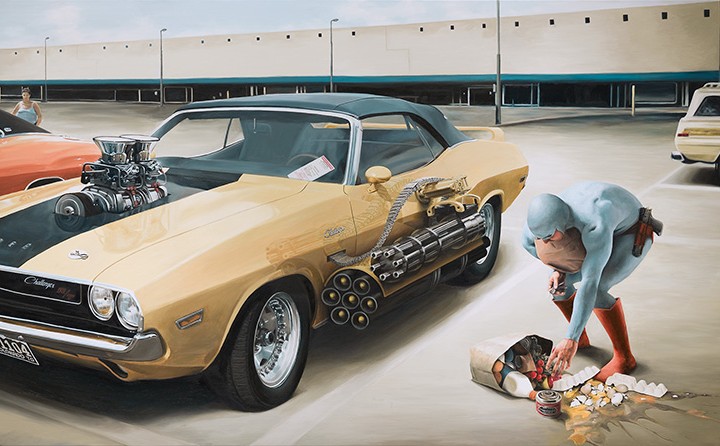
Superheroes are usually sold as forever young: jawlines that never soften, costumes that never wrinkle, bodies that treat gravity as optional. Swedish painter Andreas Englund flips that marketing promise inside out. In his best-known series—often framed as the everyday life of an aging, anonymous superhero—he paints a man who still wears the suit, still carries the myth, and still has to live inside an ordinary body that gets tired, embarrassed, and older.
Englund (born 1974, based in Stockholm) came to painting with a background in advertising and art direction. That training shows. He knows how a costume reads at a glance, how a stereotype travels faster than a paragraph, and how humor can smuggle seriousness past a viewer’s defenses. The paintings look photorealistic—large surfaces, careful light, pores and wrinkles rendered with almost uncomfortable clarity—but the subject is fiction with a human pulse. The hero has no franchise name. He is a type, not a trademark, which lets Englund poke at perfection culture without arguing about continuity or licensing.
When the work traveled widely around 2013, the hook was simple enough to share: what happens when a superhero gets old? The answer Englund offers is neither parody alone nor tragedy alone. It is a tender comic. The cape stays on while the man peels fruit, sits through dental work, nurses a hangover, or otherwise fails to live up to the poster version of himself. Power remains visible as costume; frailty remains visible as flesh. The gap between those two signals is where the paintings breathe.
“Humour can be the carrier of messages that are otherwise hard to convey. For me, it liberates my thoughts and ideas from pretentiousness while at the same time it opens doors to new routes and angles.”
That line from Englund is a useful key. The jokes are not punchlines glued onto classical technique. Humor is the method. It keeps the work from becoming a sermon about aging, and it keeps the hero from becoming a joke at an elderly man’s expense. Viewers are invited to recognize themselves—not because they wear spandex, but because they know the distance between who they are supposed to be and who they are on a Tuesday morning.
Why the anonymous hero works
Named heroes arrive with decades of lore. An anonymous hero arrives with only the silhouette and the suit. Englund needs that emptiness. Without a branded origin story, every domestic scene becomes a character study rather than a crossover Easter egg. You do not ask which villain did this. You ask how dignity and absurdity share one canvas.
Writers covering the series have noted that Englund has used family likenesses as models—his father for the older figure, himself for younger chapters—so the fiction stays tethered to real aging faces. That choice matters. Photorealism without a living reference can tip into plastic fantasy. Here the skin carries history: soft jowls, tired eyes, the small collapses of posture that no gym montage erases. The suit still signals “hero.” The face signals “person who has been alive a long time.”
Englund has said, in later interviews around exhibitions of the work, that he wants to challenge the stereotype of the perfect life. The superhero is a useful vessel for that challenge because popular culture still treats the costume as a guarantee of competence. Put the same costume on a man who cannot live up to the guarantee, and the stereotype starts to look fragile. Respect remains. The paintings do not mock age; they insist age belongs inside the myth instead of outside it.
Scale, surface, and advertising instincts
Englund prefers large-scale surfaces for these oils. Size is not vanity; it is pacing. At mural or near-mural scale, a hanging belly or an awkward hand becomes monumental. The viewer cannot skim past the embarrassment the way they might on a phone thumbnail. Classical technique—careful modeling, convincing fabric, controlled highlights—makes the comic situations land harder. If the paint looked cartoonish, the joke would stay cartoonish. Because the paint looks almost photographic, the joke becomes uncanny: this could be a documentary still from a world that never existed.
His advertising past also explains the series’ shareability. The premise fits in one sentence. The images read in one second. Underneath that speed sits a slower idea about recognition and respect in later life: even when drive no longer “blusters out explosively,” achievement and presence still deserve attention. Humor opens the door; the painted flesh keeps you in the room.
Look at how Englund handles costume details. Logos and fabric folds are clear enough to trigger the superhero schema, yet never so glossy that they float free of the body. The suit ages with the man. Spandex that once advertised invulnerability now records strain, sag, and the comedy of maintenance. That is a visual argument about myths that outlast the bodies assigned to carry them.
Everyday scenes as moral theater
Across the wider series, Englund’s hero moves through private and semi-private rituals: medical vulnerability, hungover mornings, quiet outdoor errands, the small failures that never make a trailer. These are not battle scenes with collateral damage. They are scenes of continuity—life continuing after the applause, or without applause at all. The costume becomes a stubborn habit, a second skin the man will not remove, or cannot remove without losing a story he still needs.
That stubbornness is sympathetic. Many people keep performing a role—professional, parental, athletic, social—after the body and schedule have changed. Englund’s hero makes that performance visible without requiring a lecture. You can laugh at the mismatch and still feel protective of the person inside the Lycra. The paintings train a double response: amusement and care arriving together.
There is also a quiet critique of success culture. If the perfect life is a fantasy, then the aging hero is not a failed product; he is an honest one. He still tries. He still wears the uniform of trying. He still discovers that trying does not cancel dentistry, sleep debt, or the ordinary absurdity of being human. Englund’s own framing treats humor as liberation from pretentiousness. Pretentiousness would demand unbroken dignity. These paintings prefer broken dignity that still stands up.
How to look at the work
Start with the costume, then abandon it. Name what the suit promises—speed, strength, rescue—then inventory what the body is actually doing. Is the gesture heroic, hesitant, clinical, domestic? Notice the light: Englund’s realism depends on believable illumination falling across skin and fabric in the same climate. If the light feels photographic, ask what a camera would have caught that a comic panel would omit—fatigue, texture, an unflattering angle that still feels loving.
Then watch your own reaction. Do you laugh first? Do you flinch? Do you feel oddly tender? That sequence is part of the piece. Englund designs for the laugh to arrive early and the recognition to arrive late. By the time you leave the image, the anonymous hero has done what named heroes often cannot: he has made vulnerability look like part of the job description rather than a spoiler.
Collectors and exhibition audiences have kept the series alive for years because the premise renews itself with each new ordinary crisis. New canvases do not need new villains. They need new frictions between myth and maintenance. That is a durable engine for a painter who wants classical craft and contemporary satire in the same frame.
Stand again with the figure in the painting above. Forget the franchise shelf for a moment. Ask a smaller question: if your public costume—whatever role you wear for other people—had to follow you into the most unglamorous hour of the week, would it still look like power, or would it look like fabric clinging to a person who deserves rest? Englund’s aging superhero does not answer that for you. He simply refuses to take the costume off while the answer forms.

Comments
Continue reading

Dramatic Photo Art by Sukron Ma’mun (Ipoenk Graphic)
Cirebon, Indonesia photographer Sukron Ma’mun uses theatrical natural light to frame village life, play, and place in lyrical photo art.

Bird’s-Eye Views: Florian Beaudenon’s Instant Life
Paris photographer Florian Beaudenon’s Instant Life series captures people in their rooms from above—intimate, collaborative overhead portraits of everyday joy.
Abandoned Cars Reclaimed by Nature: Rust, Growth, and Quiet Ruin
When neglected vehicles are left outdoors long enough, rust, moss, and trees rewrite them into strange still lifes—sad, photogenic, and slowly returning to the ground.