
Stitchy, Itchy, Crafty Tattoos
From trompe-l’oeil needles to Singer machines and Make Do and Mend banners, craft tattoos turn sewing and knitting tools into permanent emblems of making.
Craft tattoos treat the body like a worktable that never has to be cleared. Spools, scissors, measuring tape, knitting needles, and Singer machines migrate from the sewing basket onto skin—tools of patience redrawn as permanent companions. The joke is gentle and precise: the same instruments that mend a hem can mark a person. What follows is a look at that motif as it appears across styles, placements, and temperaments—from trompe-l’oeil needles to neo-traditional declarations that craft itself is a way of living.
The appeal is not only decorative. Sewing and knitting are languages of care. A stitch holds fabric together; a tattoo holds a story in place. For makers, these designs are less costume and more résumé—proof that hours spent with yarn, pattern, and needle were not a hobby to apologize for, but a practice worth wearing.
When the needle becomes the tattoo
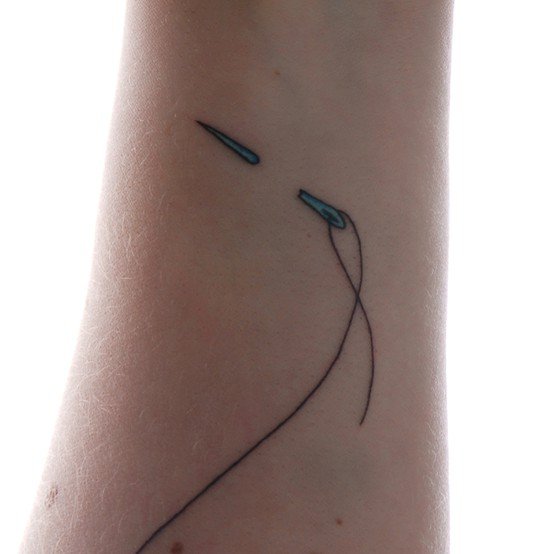
The most literal craft tattoo is also the cleverest: a sewing needle drawn as if it were threading the skin itself. Fine-line shading creates the illusion that the shaft disappears under the surface and reappears a few centimeters away, a tiny black thread looped through the eye. The body becomes both fabric and canvas. Viewers often reach out before they remember they should ask—proof that the illusion works.
That piece sets a tone for the whole category. Craft tattoos thrive on recognition. Anyone who has ever threaded a real needle knows the scale of the tool, the glint of metal, the thinness of thread. Translating those sensations into ink rewards artists who care about proportion. Too thick and the needle becomes a stake; too faint and it vanishes into freckles. The successful versions sit at the edge of trompe-l’oeil without tipping into novelty for its own sake.
Names written in thread
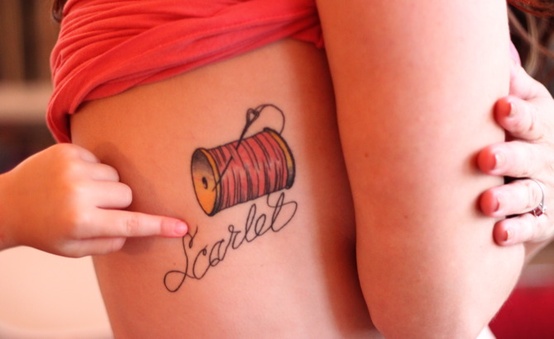
A spool of pink thread tilted on the ribs, a silver needle parked in the winding, and a cursive name pulled from the strand like embroidery: craft iconography doubles easily as memorial or dedication. The name is not stamped in block letters; it is drawn as if the thread itself learned to write. That choice matters. It suggests the person named was stitched into daily life—someone whose presence is felt in the handwork of ordinary days.
Personalization is where craft tattoos stop being a trend board and become private. Buttons, scissors, and yarn balls are shared symbols; the color of the thread, the exact script, the placement near the heart or along a forearm—these are the variables that turn a motif into a biography.
Measuring tape, dashed hearts, and the grammar of stitch
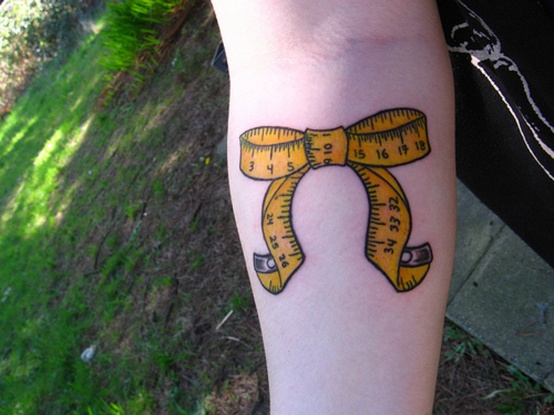
A yellow tailor’s tape tied into a bow is almost cartoonishly cheerful—numbers marching around loops and tails, metal tips rendered in grey—but it is also a manifesto of precision. Measuring is the quiet opposite of impulse. Tattooing a tape measure onto the forearm is a way of saying: I care about fit, about the millimeters between intention and result.
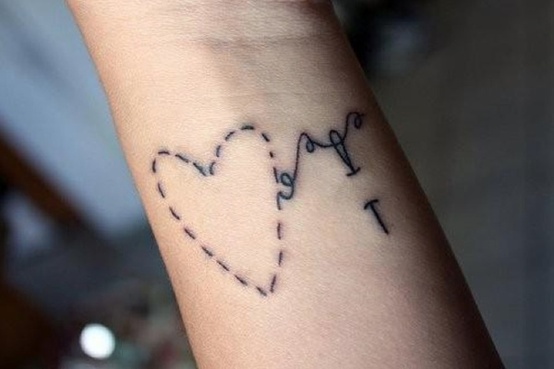
Elsewhere, a heart outlined in dashed “running stitch” lines trails a thread to a waiting needle. The design borrows the visual grammar of sewing patterns—those dotted paths that tell a hand where to go. On a wrist it reads as affection made technical: love as something you construct carefully, not only something you feel.
Craft tattoos often borrow that pattern language. Dashed outlines, cross-stitch grids, and banner ribbons echo the paper guides that once lived in envelopes on a cutting table. The body inherits the diagram.
Toolkits in a column, shears in full color
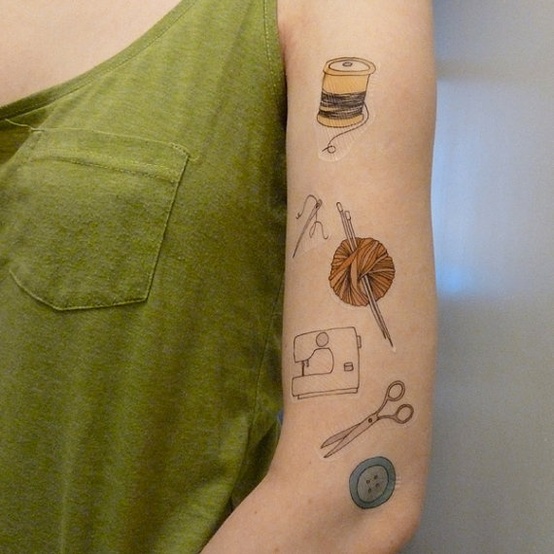
Some wearers collect craft icons the way a drawer collects notions: spool, needle, yarn with knitting needles, sewing machine, scissors, button—stacked like a vertical inventory. The effect is playful and encyclopedic. Each object is small enough to read as a stamp; together they form a syllabus of making.
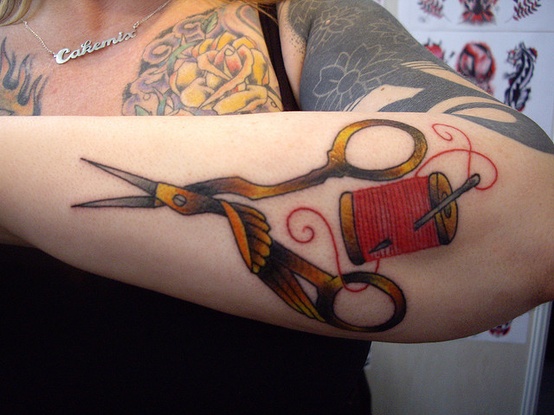
Others commit to a single bold composition. Open vintage shears in gold and bronze, a wooden spool wound in saturated red, thread looping through a handle—the neo-traditional palette turns domestic tools into flash-sheet royalty. Scissors in tattoo culture already carry double meaning: they cut, they protect, they sever. Paired with thread, they insist on repair as much as on separation. The studio wall of roses and hearts behind such a piece is no accident; craft motifs sit comfortably beside classic Americana because both traditions love clean outlines and objects you can name at a glance.
Quiet placements and unfinished knitting
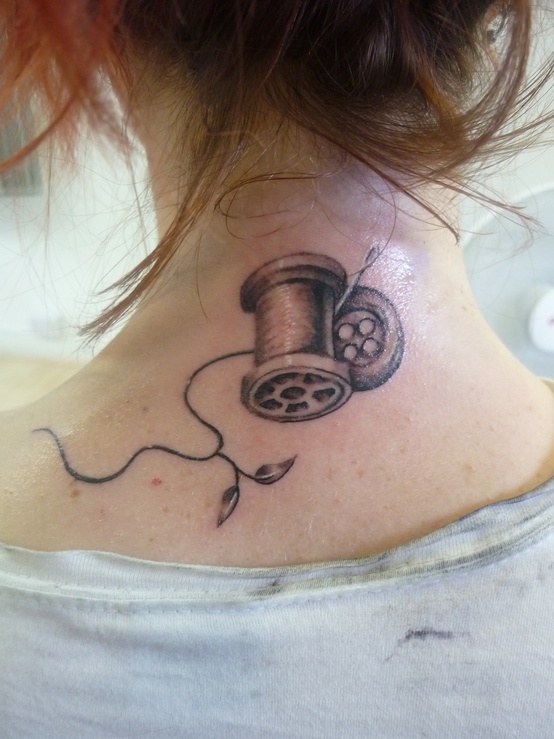
Black-and-grey work at the nape—a spool, a four-hole button, a needle, a thread that softens into a vine with leaves—shows how craft imagery can whisper. Placed where hair can cover or reveal it, the tattoo becomes a private workshop badge. The organic flourish at the end of the thread suggests that making is continuous with growing: what begins as a notion ends as a living line.
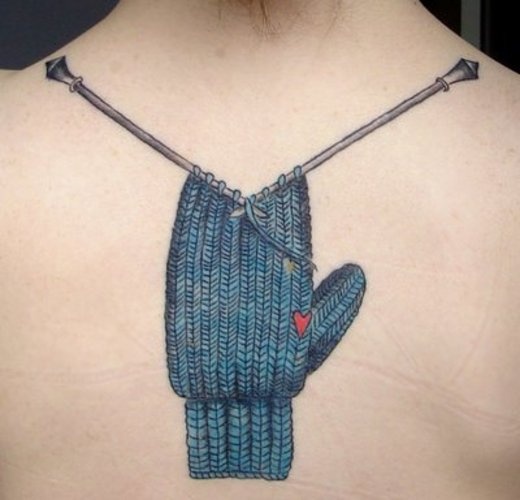
A light-blue mitten still on the needles, stockinette texture carefully rendered, a small red heart on the thumb side, needles angled like a V across the upper back: this is knitting mid-sentence. The unfinished object is the point. Craft is process. Permanently inking a work-in-progress is a refusal to treat hobbies as only finished products worthy of display.

Color stories, foot placements, and the word knit
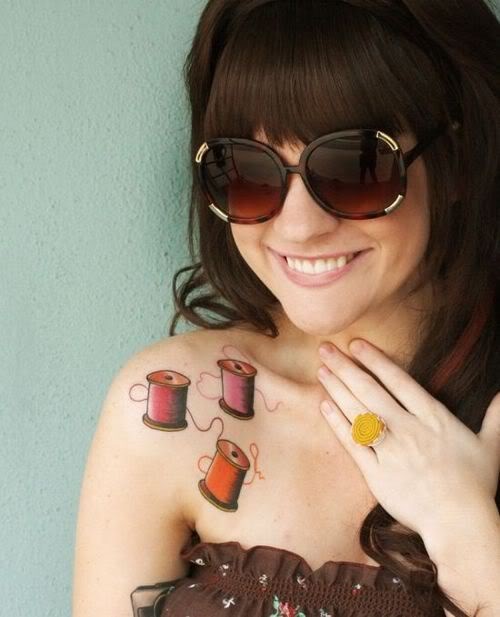
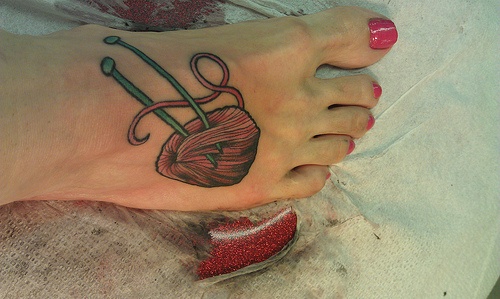
Three spools in orange, magenta, and deep red clustered on a shoulder turn thread into a bouquet. Matching a yarn-ball foot tattoo to pink nail polish is the kind of small coordination makers understand instinctively: palette is part of the pleasure. A bold black-line yarn ball framed by a stitch-edged heart and roses shows how craft symbols merge with traditional tattoo flora until the whole sleeve feels like one dialect.
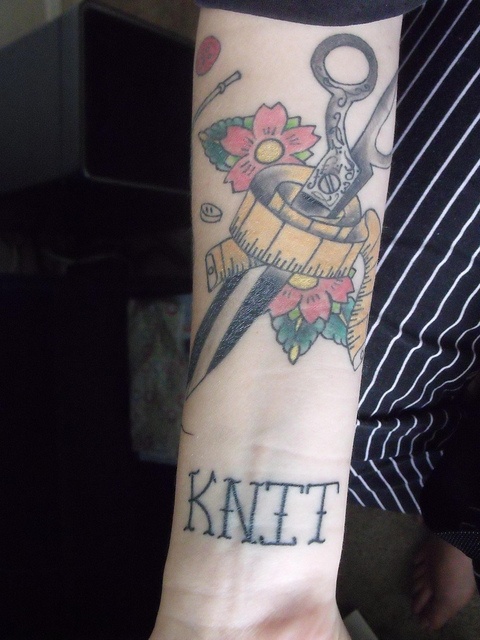
Ornate shears wrapped in yellow measuring tape, pink blossoms, stray buttons, and the blunt wrist word KNIT make the argument without metaphor. Some wearers want poetry; others want a noun. Both approaches belong in the same family. The tools are shared; the tone is personal.
Singer roses, wartime mottos, and craft or die
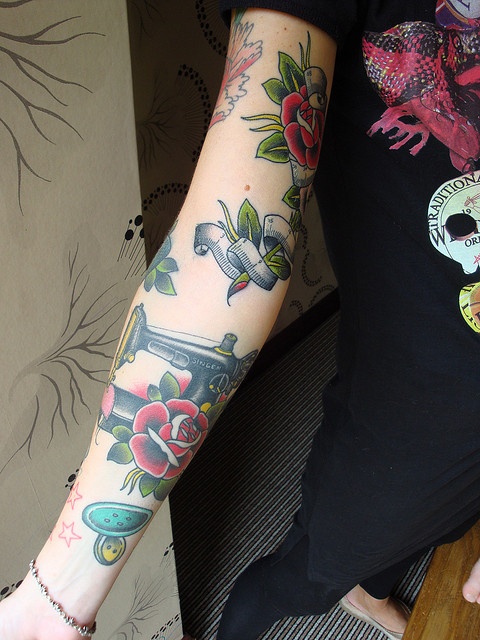
An American traditional Singer machine framed by red roses is industrial nostalgia wearing flash-sheet confidence. The brand lettering matters historically: for generations the home sewing machine was a household engine, not a boutique accessory. Tattooing it beside swallows and stars places garment work inside the same mythic catalog as anchors and daggers.
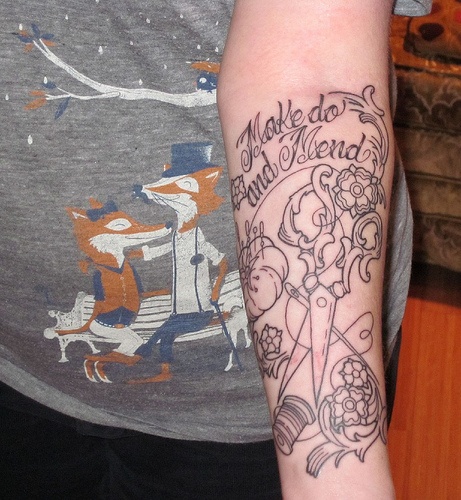
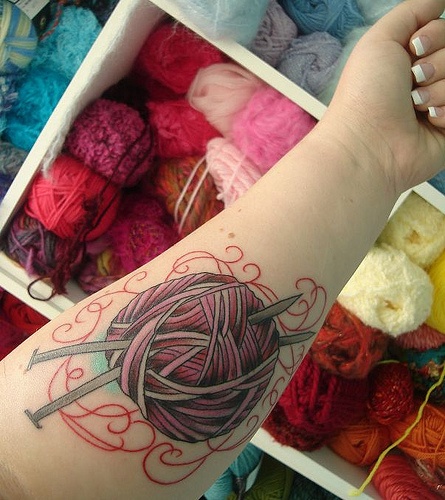
“Make do and mend,” arched over ornate scissors, a pincushion, and a spool, revives a wartime thrift slogan as permanent ethics. Repair becomes identity. Nearby, a yarn ball photographed over real bins of yarn collapses the distance between ink and practice: the tattoo is not a costume for Instagram; it is a mirror held up to the stash.
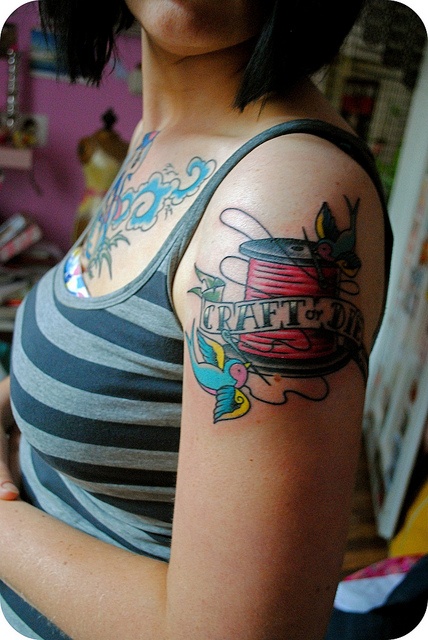
And then the banner that refuses understatement: CRAFT OR DIE across a red spool, flanked by small birds. Hyperbole, yes—but also a community password. In maker circles, craft is not filler for idle evenings. It is structure, income, therapy, inheritance, and sometimes survival. The slogan’s drama matches the seriousness with which many people treat their tables full of scissors and thread.
Why the motif keeps holding
Craft tattoos succeed because they translate labor into emblem without erasing the labor. A needle on skin remembers the needle in the hand. A mitten still on the needles refuses the fantasy that creativity arrives finished. A dashed-stitch heart admits that affection, like fabric, is assembled.
Styles range widely—fine-line illusion, blackwork inventory, neo-traditional saturation, old-school machines—but the family resemblance is clear. These are tattoos for people who understand that beauty is often a byproduct of usefulness, and that the most intimate tools are the ones that leave a mark only after long use. Look again at the gallery: every spool is a clock of hours wound tight, every pair of shears a decision about what stays and what goes. The itch in the title is temporary; the stitch, once healed, is the part that lasts.

Comments
Continue reading
Meaningful Love Quotes for Inspiration (and Ink)
Meaningful love quotes that still feel true — short lines for tattoos, gifts, and everyday reminders, with placement and wording tips.
40 One-Word Tattoo Ideas: Placement, Type, and Meaning
A gallery of single-word tattoos—love, faith, strength, wanderlust, and more—with guidance on typography, body placement, and choosing a word that still fits years later.
16 Taurus Tattoo Ideas: Bulls, Glyphs, and Venus-Inspired Ink
Sixteen Taurus tattoo directions—from minimal glyphs and constellation maps to floral bulls and bold blackwork—plus placement and artist tips for lasting earth-sign ink.