
I Fought the Law by Olivia Locher
Olivia Locher’s I Fought the Law stages eccentric U.S. state “laws” as bright, satirical photographs—fifty images where humor meets legal myth and fact.
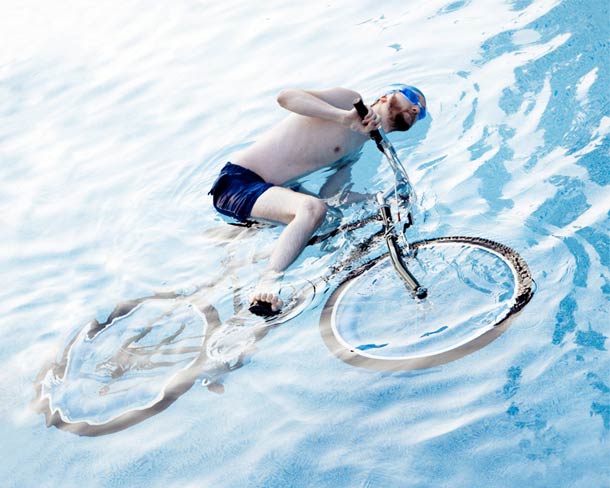
Olivia Locher builds jokes that look like evidence. In I Fought the Law, she stages one eccentric “law” after another—rules attributed to U.S. states, some stubbornly real, some repealed, some nearly passed, some closer to folklore—and photographs the violation with candy-bright studio clarity. A bicycle in a swimming pool. An ice cream cone where it should not be. Pickles asked to bounce. The pictures are funny first. Then they start asking harder questions about who writes rules, who repeats them, and how easily a rumor becomes a fact if the lighting is good enough.
Locher is a photographer; the series is hers. The project unfolded roughly from 2013 to 2016, with images made in her New York studio and in her hometown of Johnstown, Pennsylvania. It later anchored a New York solo exhibition at Steven Kasher Gallery and a 2017 Chronicle Books monograph, Olivia Locher: I Fought the Law. What began as a sharable curiosity gallery became a sharper meditation on legislation, myth, and “alternative facts” before that phrase was everywhere.
“In California nobody is allowed to ride a bicycle in a swimming pool.”
One state, one image, fifty small rebellions
The structure is elegantly simple: fifty photographs for fifty states, each paired with a single-sentence claim about an unusual prohibition or requirement. Locher’s camera does not illustrate the law in a dry, documentary way. It performs the breach. Bodies, props, and pastel-pop color turn statutes into surreal tableaus. The tone borrows from Pop’s appetite for bold surfaces and from a cinematic weirdness that keeps the scenes from feeling like courtroom exhibits.
That performance matters. Reading a list of “dumb laws” online is a passive smirk. Watching someone enact the forbidden act—carefully lit, carefully composed—makes the absurdity physical. You feel the logistics. You also feel the gap between the solemn language of legality and the silly logistics of obedience.
Among the claims circulating with the series:
- California: no riding a bicycle in a swimming pool.
- Alabama: ice cream cone in a back pocket treated as illegal.
- Hawaii: coins not to be placed in one’s ears.
- Connecticut: pickles must bounce to count as pickles.
- Delaware: restrictions aimed at form-fitting pants around the waist.
- Texas: children and “unusual” haircuts cast as a decency issue in at least one municipal telling.
- Wisconsin: apple pie in public restaurants tangled up with cheese service expectations.
Some of these sound like lobby fossils. Some sound like playground myths that grew a citation. Locher’s project thrives in that uncertainty.
“In Alabama it’s illegal to have an ice cream cone in your back pocket at all times”

Real statutes, dead letters, and complete myths
A crucial honesty in Locher’s own framing: the set mixes categories on purpose. Some rules remain on books. Many were removed. Others never fully became law. A few are myths. She has been clear that refusing to label which is which is part of the point. The laws themselves are often hard to trace; origins blur; viral lists launder rumor into authority. Drawing a bright line in a caption would tidy the project into a quiz. Leaving the line fuzzy recreates how Americans actually meet these stories—through forwardable lists, novelty books, and dinner-table certainty.
That approach aged into cultural relevance as public arguments about truth and fabrication intensified. The photographs do not lecture. They demonstrate how belief works: a crisp image plus a confident sentence can outrun footnotes. Humor becomes a research method. If you laugh and then wonder whether you should warn a friend traveling to Connecticut about pickle physics, the piece has you.
Civil disobedience with perfect styling
Gallery language around the exhibition called the photographs acts of civil disobedience with a satirical spin. The disobedience is theatrical rather than street-protest earnest, but the political question remains adult: who decides what is decent, safe, moral, or marketable enough to encode as law? Why does one community police haircuts while another polices teacups of wine or coins in ears? Which emergencies were real, and which anxieties got frozen into code because repeal costs time and money?
Locher’s palette keeps the critique from hardening into scold. Pastels, clean props, and studio control make the work inviting. You can enjoy the gag and still feel the aftertaste. That double register—cheer on the surface, skepticism underneath—is why the series works as both internet gallery bait and monograph material with critical essays and interviews attached.
“In Hawaii coins are not allowed to be placed in one’s ears.”
“In Connecticut pickles must bounce to officially be considered pickles.”
“In Delaware it is illegal to wear pants that are form-fitting around the waist.”
“In Texas it is illegal for children to have unusual haircuts.”
“In Wisconsin it is illegal to serve apple pie in public restaurants without cheese.”
How the pictures are built
Formally, the images favor clarity over chaos. Subjects are legible. Props read at thumbnail size—important for a project that lived partly through blogs and feeds. Color blocking and careful wardrobe choices push scenes toward advertising’s confidence while the action undermines that confidence. The result is closer to a deadpan commercial for nonsense than to gritty documentary of crime.
Look for recurring strategies:
- Literalism as comedy. The forbidden act is shown as plainly as a product demo.
- Scale jokes. Ordinary objects (coins, cones, pickles) become monumental problems.
- Body as ballot. People perform the rule-break with faces that range from solemn to sly.
- Caption partnership. The sentence is half the artwork; without it, some scenes are merely odd. With it, they become legal theater.
That caption partnership is why the California pool-bike image lands so hard. Without the line, you have a surreal sport. With the line, you have a jurisdiction, a prohibition, and a dare.
What to take from the series now
I Fought the Law is easy to misread as only a novelty list with better production design. The deeper pleasure is watching Locher turn bureaucracy’s leftovers into visual literature. Local lawmaking produces hundreds of small decisions yearly—some protective, some lobbied, some outdated, some imaginary in the public mind. Her photographs do not replace legal scholarship. They make the strangeness memorable enough that you might ask better questions the next time a “did you know it’s illegal…” factoid slides into your messages.
They also model a photographer’s answer to information overload: do not only screenshot the rumor. Stage it. Make the body responsible for the claim. See what remains funny when the lights are professional and the prop budget is real.
If you seek more of the fifty, Locher’s own presentation of the project and the Chronicle monograph gather the set with the context it deserves. Start with the images you can hold in your head after one glance—the pool cyclist, the pocket cone, the bouncing pickle logic—and notice how quickly delight turns into doubt. That turn is Olivia Locher’s specialty. The law, in her frames, is not only something you obey or break. It is something you can see—and something you should sometimes refuse to believe without a second look.

Comments
Continue reading

Dramatic Photo Art by Sukron Ma’mun (Ipoenk Graphic)
Cirebon, Indonesia photographer Sukron Ma’mun uses theatrical natural light to frame village life, play, and place in lyrical photo art.

Bird’s-Eye Views: Florian Beaudenon’s Instant Life
Paris photographer Florian Beaudenon’s Instant Life series captures people in their rooms from above—intimate, collaborative overhead portraits of everyday joy.
Abandoned Cars Reclaimed by Nature: Rust, Growth, and Quiet Ruin
When neglected vehicles are left outdoors long enough, rust, moss, and trees rewrite them into strange still lifes—sad, photogenic, and slowly returning to the ground.