
Extreme Close-ups of the Human Eye by Suren Manvelyan
Armenian photographer Suren Manvelyan’s Your Beautiful Eyes macros turn irises into planetary landscapes—crypts, fibers, and pigment under raking light.
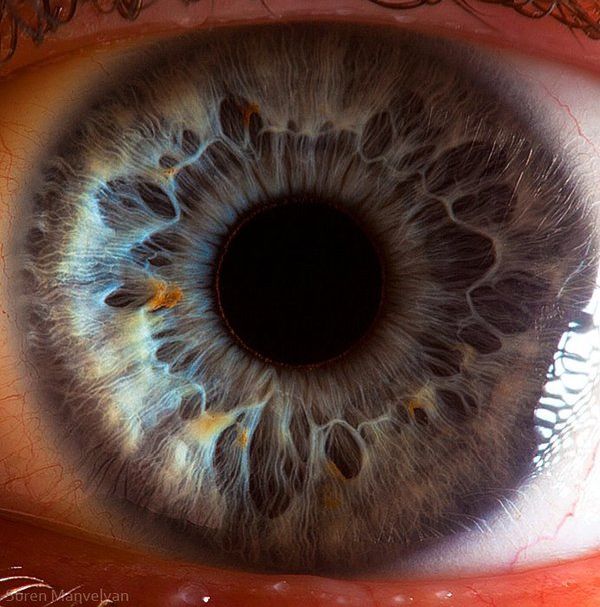
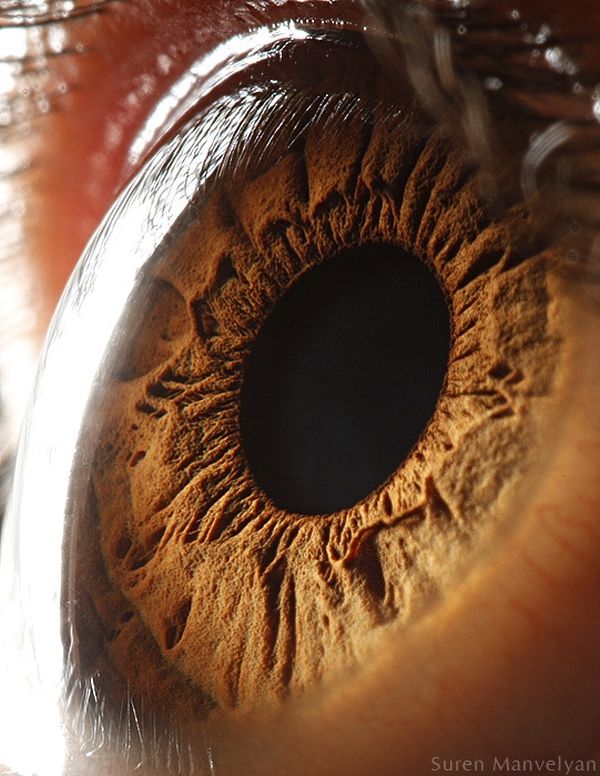
We look into human eyes every day and almost never see them. Conversation keeps us at social distance; makeup tutorials and phone cameras keep us at stylized distance. Armenian photographer Suren Manvelyan closes that gap until the iris stops behaving like a color label—“blue,” “brown,” “hazel”—and starts behaving like terrain. In the series widely known as Your Beautiful Eyes, extreme close-ups turn crypts, furrows, and pigment freckles into canyons, ridges, and weather systems around a black pupil.
The pictures went globally viral after Manvelyan posted them on Behance in 2010, climbing toward millions of views and becoming one of the platform’s most circulated photography projects. Virality can flatten craft into a one-line reaction. The series itself asks for something slower: comparative looking, almost geological patience. Every iris is a map. No two maps agree.
What the camera insists you notice
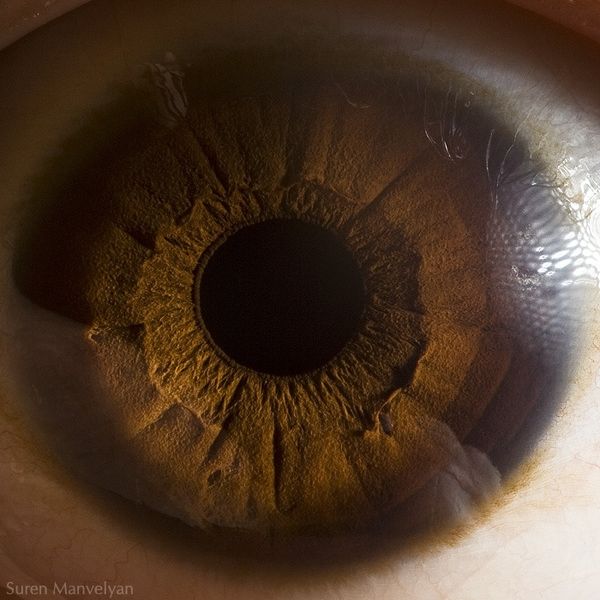
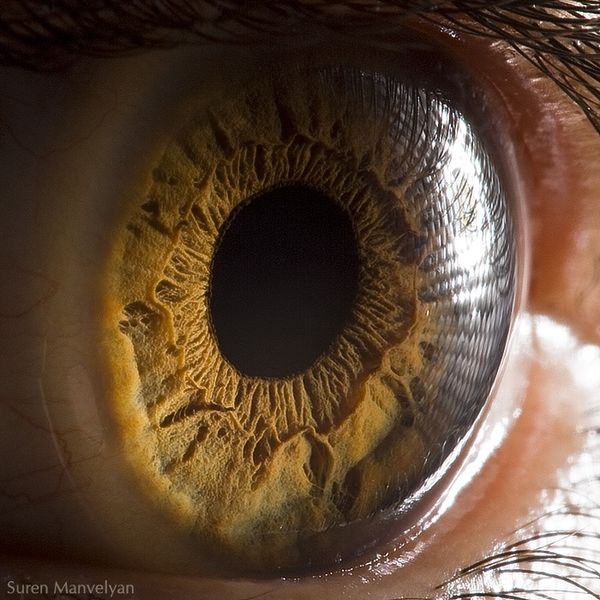
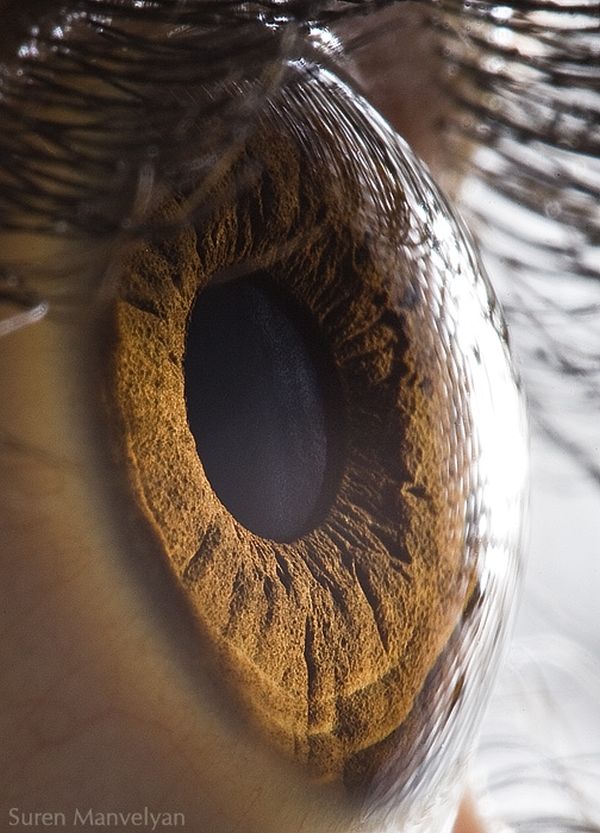
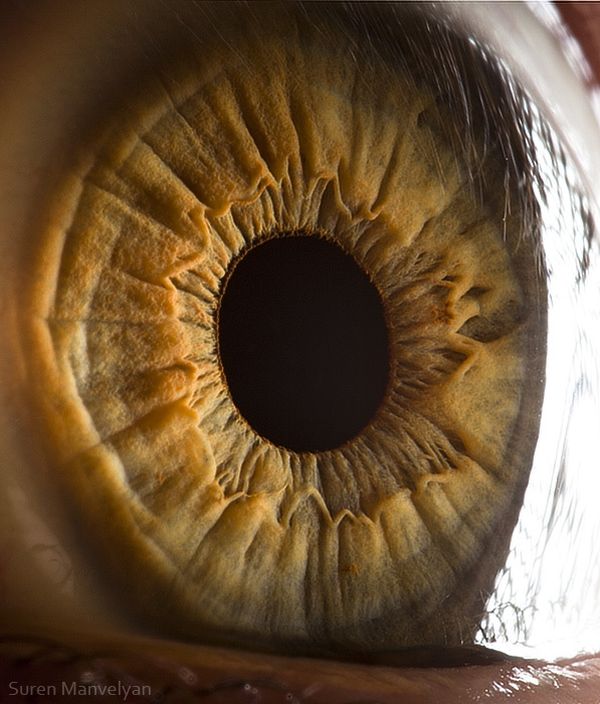
At conversational distance, an eye is a personality cue. At Manvelyan’s distance, color is only the first layer. Fibers radiate from the pupil like spokes under tension. Crypts open as dark pits. Collarettes form ragged rings where tissue densifies. A rectangular catchlight—evidence of the lighting setup—rides the cornea like a window reflected in wet glass. Capillaries invade the sclera at the frame’s edge. Lashes become ropes. The eyelid’s rim is a horizon line you rarely consider when you are busy reading someone’s mood.
Manvelyan, who holds a doctorate in theoretical physics, has said that we see thousands of eyes without suspecting the structure of the iris—that the surface can resemble other planets, with craters, rivers, and valleys. The metaphor is earned. Side light rakes across relief so that tiny height differences cast real shadows. Diffuse beauty lighting would flatten the same eye into a polite portrait disc. Directional light turns anatomy into topography, which is why these frames feel closer to landscape photography than to headshots.
He has kept some process details relatively guarded, an authorial choice that frustrates imitators and protects mystique. What matters for looking is already visible: sharp focus on the iris plane, controlled specular highlights, magnification high enough that individual fibrous bundles separate. Patient subjects help; micro-movements of a living eye are enemies of clarity. The resulting stillness feels almost unnatural—more specimen than blink—yet moisture and irregularity keep the images from tipping into plastic CGI orbs.
A gallery of differences, not a catalog of types
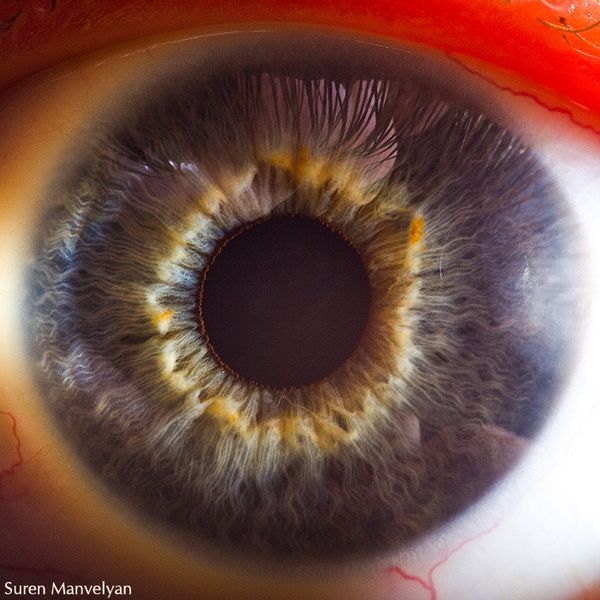
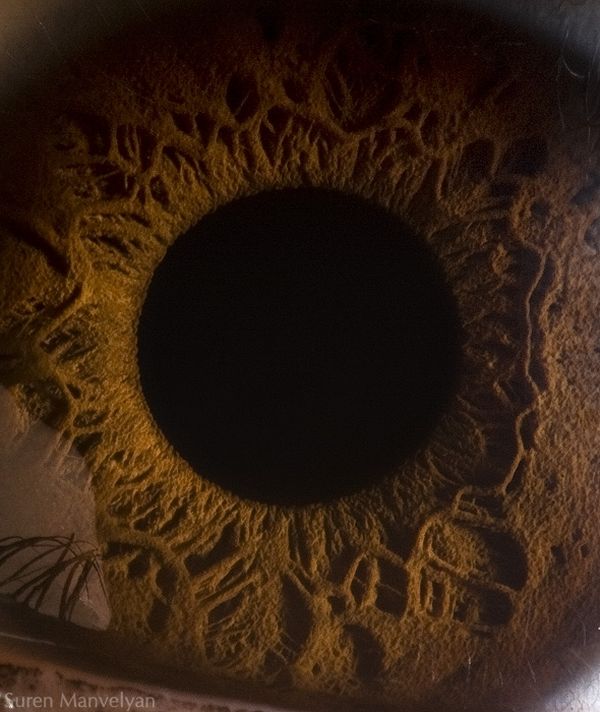
Part of the series’ pleasure is comparative. Move from a cool blue-gray iris freckled with amber to a deep brown disc where relief is carried more by sheen than by hue contrast. Some pupils sit in relatively calm fields; others are surrounded by storm systems of overlapping fibers. A few frames push so close that the pupil becomes a pure abstract center and the “eye” almost forgets to be an organ. That range is the point. Manvelyan is not hunting a single perfect specimen. He is demonstrating diversity of structure that everyday vision smooths away.
It helps to refuse medical overreading. These are not diagnostic plates, and spotting a crypt is not the same as understanding pathology. The project sits closer to portraiture of a body part we treat as symbolic—“windows of the soul”—while ignoring its physical peculiarity. By insisting on relief, Manvelyan flips the cliché. Soul talk can wait; the surface is already astonishing. Specificity replaces poetry until poetry returns on its own, through resemblance to river deltas and lava fields.
Later he extended related approaches to animal eyes, work that demands different logistics: permissions, handlers, shorter stillness, more portable lighting. The human series remains the core statement because recognition is immediate. You know you are looking at a person. That knowledge makes the alien-landscape feeling more destabilizing, not less. An insect macro is curious; a neighbor’s iris is intimate.
Beauty, discomfort, and the ethics of looking
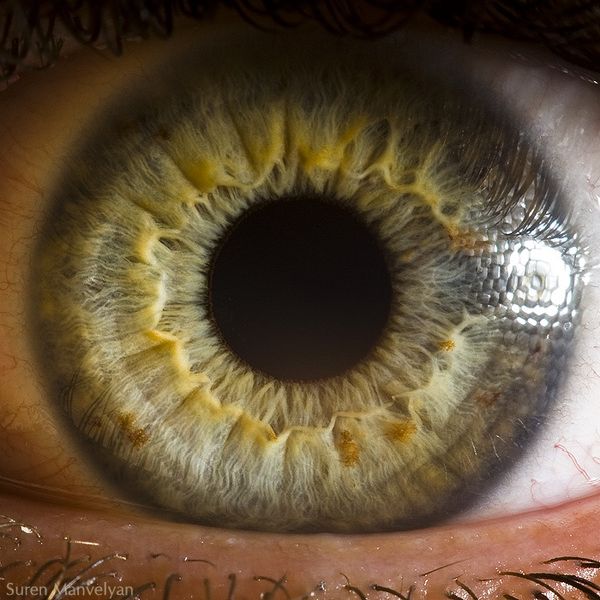
Extreme macros of bodies can tip into the clinical or the sensational. Manvelyan’s frames mostly stay on the side of wonder without sanding away reality. Wetness, veins, tiny asymmetries, and the soft intrusion of lids remain in play. That honesty matters in a culture where advertising eyes are retouched into frictionless gems. Idealized “perfect eyes” erase the irregularities that make these photographs specific—and human.
There is also a mild discomfort built into the genre. Seeing an eye this large can feel invasive, as if you have stepped inside someone else’s personal space without the social contract of mutual gaze. The subject cannot look back at you as a whole person; the camera has taken only the aperture. Holding that tension—beauty plus unease—is part of why the series stays memorable after the first viral hit fades. You are thrilled, then slightly ashamed of how greedily you stared, then thrilled again when the next iris invents a new topography.
For anyone tempted to imitate the look, ethics are not a footnote. Never force light into an eye in ways that cause pain or damage. Keep sessions short. Prioritize blink comfort over one more take. Magnification photography of living tissue is a collaboration, not a raid.
Physics mind, photographer’s patience
Knowing Manvelyan’s scientific background is optional, but it fits the pictures. They show a taste for structure, pattern, and forces made visible. Photography becomes another instrument for revealing hidden order—here biological rather than theoretical. He has spoken of feeling, while photographing an eye, as if traveling through the cosmos. Viewers report the same sensation: flying over a planet that happens to be a few centimeters wide.
By the early 2010s, when features and shares multiplied, the series also rode a broader appetite for extreme macros—insects, water drops, household objects made alien by scale. Manvelyan’s difference is emotional proximity. The technical thrill carries a human charge because the subject is the organ of meeting. We use eyes to recognize, flirt, warn, and trust. Seeing that organ as landscape briefly suspends those social uses and replaces them with awe.
A practical way through the set
Try not to scroll these frames as a color sampler. For each image:
- Ignore hue for ten seconds. Read only light and shadow on the relief.
- Find the deepest crypt and the highest ridge near the pupil.
- Notice where pigment concentrates—ring, freckles, or even wash.
- Locate the catchlight and infer the direction of the key light.
- Only then return to “what color are these eyes?” The first answer is usually incomplete.
When you step away from the screen, test the afterimage in ordinary life. Look at someone nearby—at polite distance—and see whether you can still invent the landscape you are not seeing. Suren Manvelyan’s extreme close-ups do not ask you to stare rudely at strangers. They ask you to remember that every casual glance lands on a structure as specific as a fingerprint, hidden in plain sight behind the simplest social act we have: meeting someone’s eyes and thinking, for a moment, that you already know what you are looking at.

Comments
Continue reading
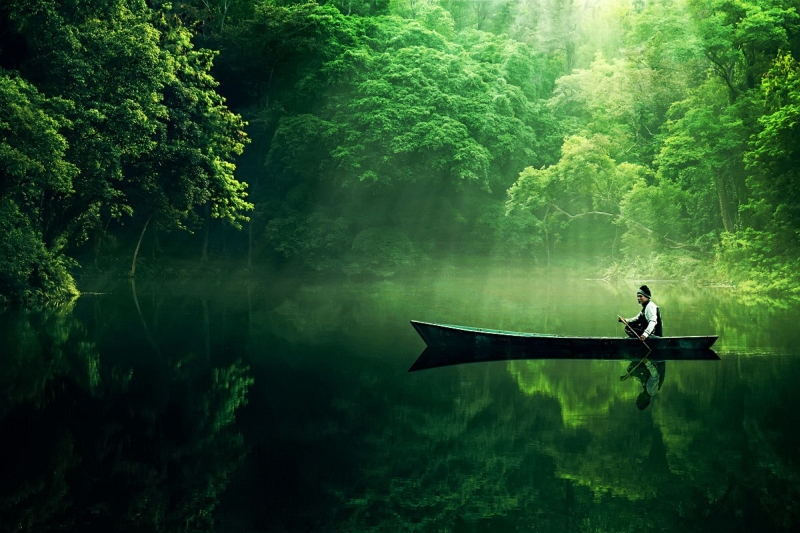
Dramatic Photo Art by Sukron Ma’mun (Ipoenk Graphic)
Cirebon, Indonesia photographer Sukron Ma’mun uses theatrical natural light to frame village life, play, and place in lyrical photo art.

Bird’s-Eye Views: Florian Beaudenon’s Instant Life
Paris photographer Florian Beaudenon’s Instant Life series captures people in their rooms from above—intimate, collaborative overhead portraits of everyday joy.

Abandoned Cars Reclaimed by Nature: Rust, Growth, and Quiet Ruin
When neglected vehicles are left outdoors long enough, rust, moss, and trees rewrite them into strange still lifes—sad, photogenic, and slowly returning to the ground.