
Bairon Rivera’s Conceptual Levitation Photography
Maryland-based photographer Bairon Rivera’s Levitation? work—fog, puddle mirrors, and bodies that hover just long enough to make physics negotiable.
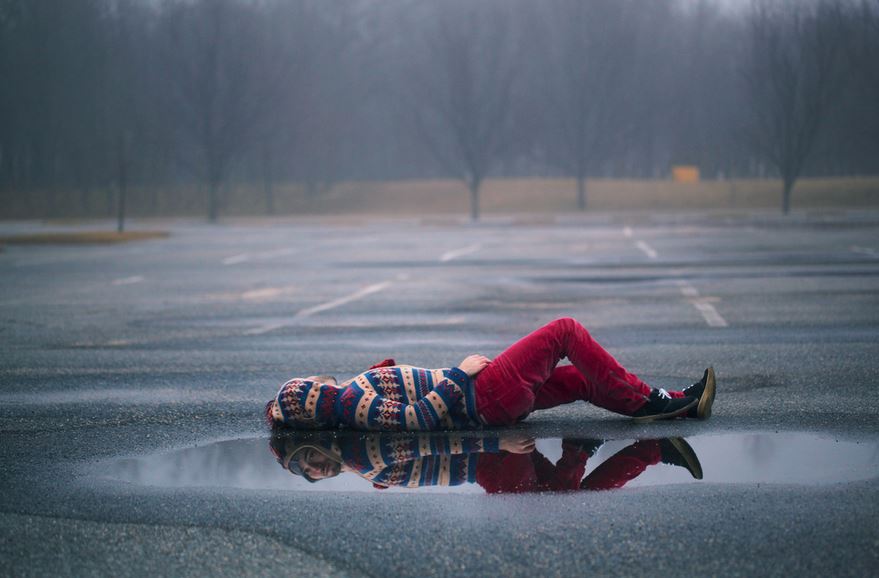
Bairon Rivera builds photographs the way some people build short stories: one impossible premise, then enough ordinary detail that the premise starts to feel documentary. Based in Maryland—and often associated with the wider Washington, D.C. orbit—he became widely shared in the early 2010s for conceptual work that mixes in-camera timing with careful editing. The series most often labeled Levitation? asks a simple counterfactual. What if gravity loosened its grip for a beat, and ordinary people kept their ordinary gestures while the ground forgot them?
That question sounds like pure fantasy until you notice how Rivera stages it. Clothes look worn. Parking lots stay parking lots. Fog behaves like real weather. The surreal arrives as a revision of a familiar scene, not as a pasted-on galaxy background. The frame below is a clear example of that method—and of the puddle reflections that made his portfolio stick in viewers’ minds.
A body held by water and fog
In this image, a figure floats horizontally a short distance above wet asphalt. Head and torso hover over a wide puddle; knees bend slightly; black sneakers hang just clear of the ground. A Fair Isle–patterned sweater in blue, red, and white meets bright red pants—the one loud color chord in a grey morning. Beneath him, the puddle returns a near-perfect mirror: face, knit, and sky inverted into the water’s skin. White parking lines cut across damp pavement. Bare trees dissolve into mist at the far edge of the lot. A small yellow blur waits in the distance like leftover infrastructure.
The reflection is not a gimmick layered on top of levitation. It is the argument for belief. Water proves the body has weight and form even while air denies it. If the puddle lies convincingly, the float becomes harder to dismiss as a cheap composite. Rivera’s best frames often work this way—pairing an impossible pose with a trustworthy surface: rainwater, stream, or wet ground that behaves optically as physics expects.
Conceptual photography as playful rigor
Conceptual photography can drift into illustration with a camera attached. Rivera’s appeal, as noted when his work circulated from Instagram and Flickr into design blogs, is that he still seems to be having fun with the apparatus. Fun here does not mean careless. It means curiosity: how far can a jump, a lean, or a midair pause be extended in post without breaking the weather, the shadows, or the social realism of the clothes?
Maryland’s suburban and semi-urban landscapes—lots, trees, overcast skies—become stage sets rather than tourist backdrops. Fog softens distance and hides the seams of production. Overcast light reduces harsh directionality, which helps composites and also helps a single exposure look dreamlike without heavy color grading. Rivera’s palette in this frame stays restrained: cool greys and blues, then the red trousers as a flare of human temperature in cold air.
Levitation without the usual clichés
Internet levitation photography often repeats the same recipe—subject jumping, arms out, horizon locked, shadow painted underneath. Rivera’s stronger images complicate the recipe. Bodies appear mid-fall, mid-ride, or oddly calm in positions that should panic a nervous system. Sometimes objects join the defiance: rocks, bicycles, debris that shares the same exemption from gravity. The unease comes from posture. People do not always look like they are performing “float.” They look interrupted.
That interruption is narrative. A horizontal hover over a puddle suggests sleep, surrender, or a paused fall more than a yoga pose. Red pants and patterned knit keep the figure contemporary and slightly playful, so the melancholy of fog does not tip into pure gothic. Conceptual work thrives on that balance—strange enough to stop the scroll, human enough that you invent a before-and-after for the person in the sweater.
Puddle reflections as craft
Puddles are small stages with ruthless rules. The water must be still enough to mirror. The camera angle must reconcile the real body with the inverted twin. Debris, ripples, and oil sheen can either ruin the illusion or make it local and believable. In Rivera’s puddle work, reflection often carries emotional information the airborne body withholds—an expression clearer in the water than in the profile above, or a symmetry that turns one person into a closed loop of self.
Photographers studying this approach can borrow the lesson without copying the composite: find water that already wants to be a mirror; shoot low; protect the reflection’s edge where asphalt meets liquid; let weather do atmosphere instead of forcing it in software. When editing enters—as it does in ambitious levitation—the puddle becomes a calibration tool. If the reflection’s perspective, softness, and color temperature match the scene, viewers forgive more of what happens in the air.
Editing as invisible theatre
Rivera’s reputation includes photo manipulation done with a light touch. The goal is not to advertise the clone stamp. The goal is continuity: matching grain, matching fog density, matching how red cloth would look under the same sky if the body truly hung there. Failures in conceptual composite work usually announce themselves at the feet, the contact shadow, or the horizon line. Successes make you argue with yourself about whether a trampoline, a wire, or a perfect jump could explain it—then decide you do not care, because the mood is the point.
That mood, in the parking-lot frame, is quiet. No crowd. No spectacle lighting. Just a person, a mirror of rainwater, and trees half-erased by mist. Conceptual photography sometimes chases maximal weirdness. Rivera often chases minimal stages where one violation of physics is enough.
Place, series, and why the work traveled
Working from Maryland with ties noted toward the Washington area placed Rivera in a corridor of blogs and social feeds hungry for shareable surrealism around 2012–2014. Levitation series travel well online because they read instantly and reward a second look. Titles that end in a question mark—as Levitation? does—fit the images’ tone: not a manifesto claiming magic, but an invitation to doubt what you are seeing.
Barnel Photography, the name attached to some of his professional identity, sits beside the art series as a reminder that many conceptual photographers also live in assignment work. The art frames, though, are where the voice is clearest. They treat neighborhood weather and infrastructure as worthy of myth. A strip-mall lot becomes a temporary otherworld because fog arrived and someone agreed to hang in the air long enough for the shutter—and the edit—to finish the sentence.
Looking longer
Spend another minute with the floating figure. Notice how the puddle crops the world into a second sky. Notice how the sneakers’ white soles punctuate the hover. Notice how little the background needs to do once the reflection locks the premise. Bairon Rivera’s conceptual photographs succeed when they refuse to explain themselves. They offer a body, a surface, and a soft contradiction—and leave you in the parking lot fog, deciding whether the person is rising, falling, or simply resting on a law that stopped applying for one frame.
If you come away wanting to try the genre, start smaller than full levitation. Master a puddle’s honesty first. When water tells the truth, the lie in the air has somewhere solid to stand.

Comments
Continue reading
Dramatic Photo Art by Sukron Ma’mun (Ipoenk Graphic)
Cirebon, Indonesia photographer Sukron Ma’mun uses theatrical natural light to frame village life, play, and place in lyrical photo art.

Bird’s-Eye Views: Florian Beaudenon’s Instant Life
Paris photographer Florian Beaudenon’s Instant Life series captures people in their rooms from above—intimate, collaborative overhead portraits of everyday joy.
Abandoned Cars Reclaimed by Nature: Rust, Growth, and Quiet Ruin
When neglected vehicles are left outdoors long enough, rust, moss, and trees rewrite them into strange still lifes—sad, photogenic, and slowly returning to the ground.