
15 Unique Shoe Designs That Treat Footwear Like Sculpture
Fifteen experimental shoes—from origami heels and slingshot wood to keyboard-key boots and continuous-band mules—where concept outruns convention.
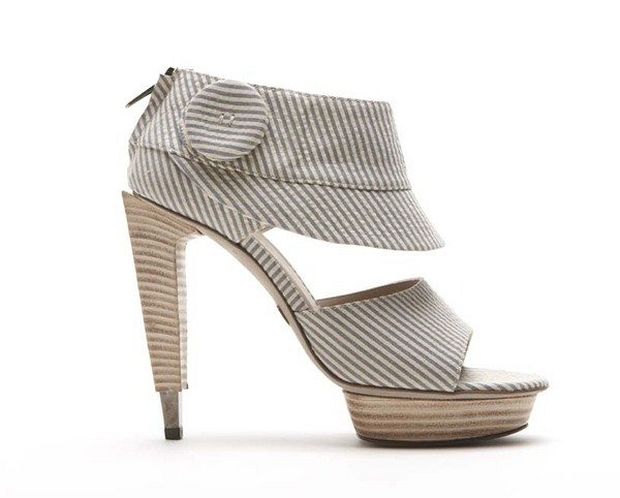
Unique shoe design lives where footwear stops behaving like a default accessory and starts arguing with gravity, material, or habit. The fifteen pieces below favor sculpture, joke, and experiment over office-safe polish. Some look walkable; others look like gallery objects that happen to remember a foot. All of them push the silhouette—heel as architecture, upper as origami, surface as collage—until “shoe” becomes a question again.
Read the set as a design brief: strip decoration until structure speaks, then add only what changes the idea. Tailoring details, industrial metal, keyboard keys, and low-poly color spikes each answer differently. Wearability is optional; clarity of concept is not.
1. Seersucker cuff platform sandal
Grey-and-white horizontal stripes wrap an open-toe platform sandal whose ankle rises into a wide fabric “cuff” closed with a matching covered button. Stacked light wood textures the platform and slim heel. The joke is sartorial: shirt-collar logic transplanted onto footwear. Preppy pattern meets architectural height, so the shoe reads as tailored rather than merely striped. Midfoot openness keeps the cuff from feeling like a bootie accident.
2. Continuous-band sculptural mule
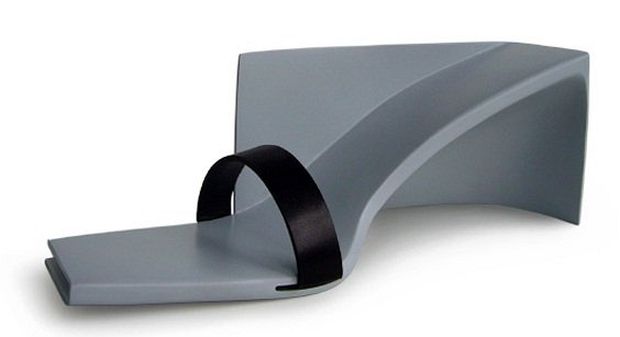
A matte light-gray band forms toe plate, arch, and a broad flat heel support in one continuous sweep—closer to furniture than to a traditional last. A thin black strap alone softens the rigidity. Designs in this family (often associated with Rem D. Koolhaas / United Nude Möbius thinking) treat the shoe as a loop of material rather than upper-plus-sole. Side light reveals how little ornament the idea needs when the silhouette already argues.
3. Origami-fold gray stilettos
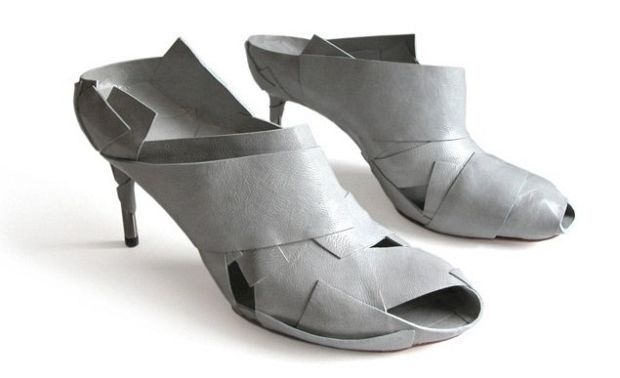
Pale gray peep-toe mules look folded from stiff panels: overlapping strips, diamond cutouts, and crisp upward creases at the ankle edge. The stiletto stays slim and faceted in the same tone. Without stitching theater, the pair leans on paper-fold geometry. Fashion often borrows “origami” as a metaphor; here the metaphor is literal enough that the shoes feel drawn before they feel worn.
4. Teal trough-toe architectural heels
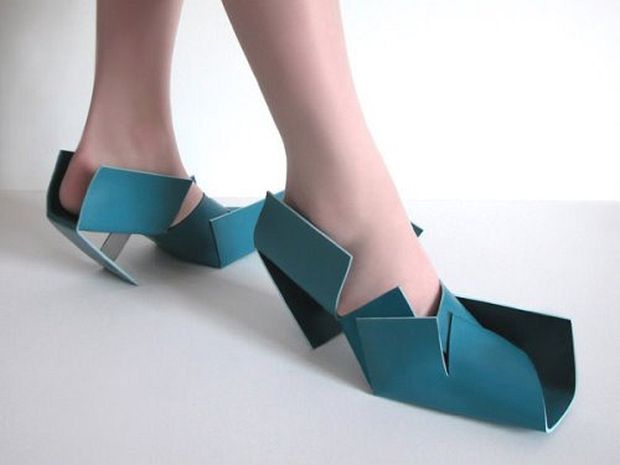
Deep teal panels fold into open U-shaped toe troughs that extend past the wearer’s toes, with angular block heels and tall rear plates that stand away from the heel cup. Dark edge lining emphasizes cut-and-fold construction. Negative space becomes the luxury—more chute than shoe tip. On a white studio floor, the color and sharp planes read as product sculpture first, footwear second.
5. Wooden slingshot thong heel
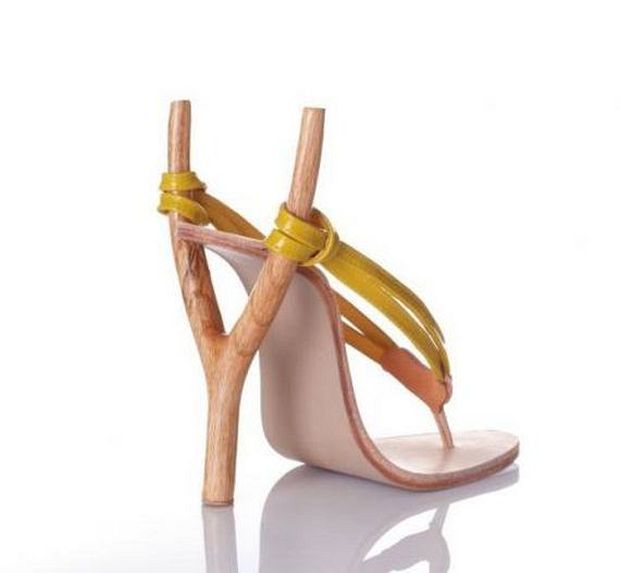
A Y-shaped light wood piece serves as heel and rear support while bright yellow tubular straps knot around the prongs and run forward into a thong sole. The object joke lands because the structure still works as a heel diagram. High arch and polished reflection underline fashion photography’s love of the absurd-but-buildable. It is wit with joinery, not a costume prop glued onto a pump.
6. Low-poly crystal pumps
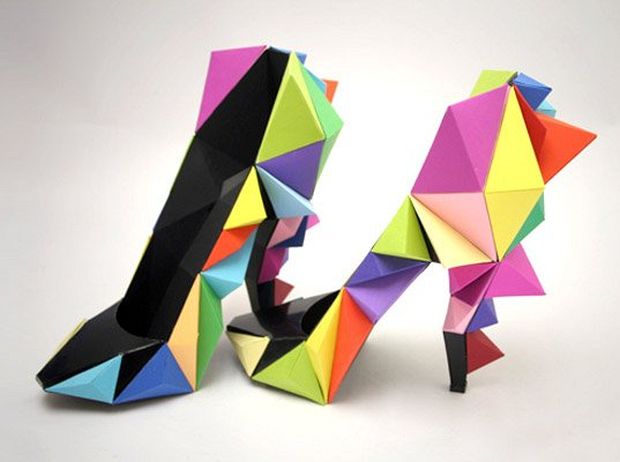
Black pointed pumps erupt with matte pyramids and prisms in pink, lavender, yellow, orange, lime, and blues—densest at heel and toe tip. The effect is low-poly digital mesh made physical. Color noise sits on a classic silhouette so the experiment stays legible: you still know it is a pump; the geometry is the interruption. Wearable art often fails by hiding the shoe; this one keeps the black body as a canvas edge.
7. Perforated white shell slip-on
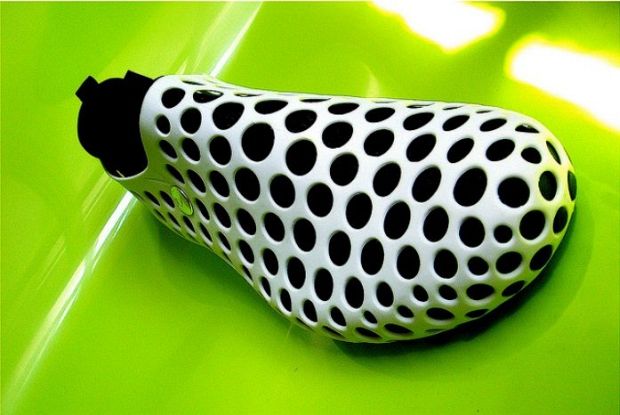
On neon green gloss, a rounded slip-on shows a thick white outer shell punched with circles and ovals, black sock visible through every hole. Laceless, molded, almost biomorphic—Swiss-cheese graphic without cartoon softness. Pattern is structure: remove the perforations and the shoe loses its idea. Concept footwear often chases complexity; this one chases one bold negative-space move.
8. Perforated brace-heel sculpture
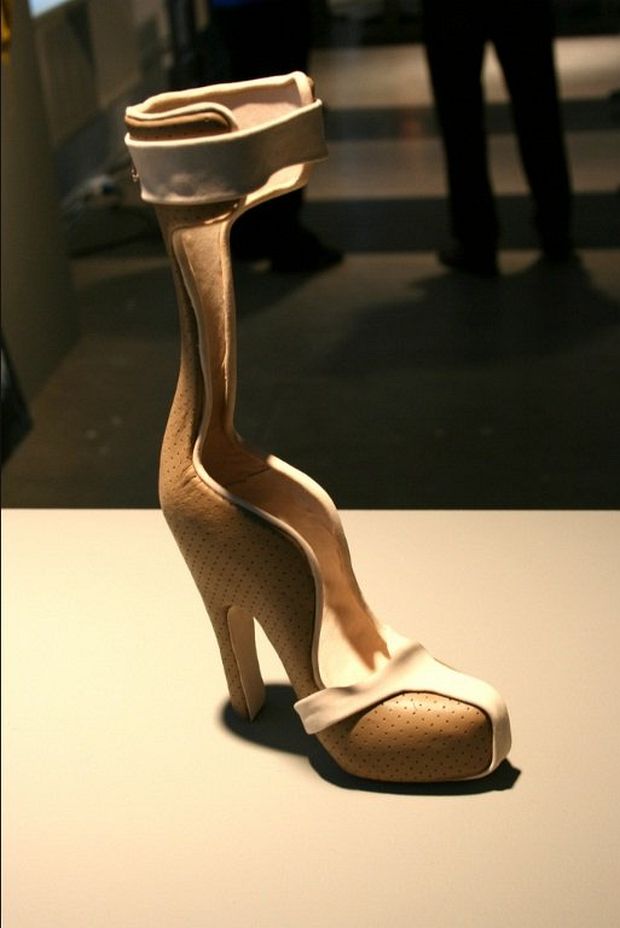
Tan perforated leather-like panels rise from a platform pump into a tall rear pillar ending in a thick cream calf cuff—halfway between heel and orthopedic brace. Open back means the cuff, not a heel counter, anchors the upper leg. Dramatic gallery lighting and a hard shadow sell the silhouette as installation. Medical-chic fashion borrows support language; here the borrow becomes the whole drama.
9. Gloss terracotta toe shells
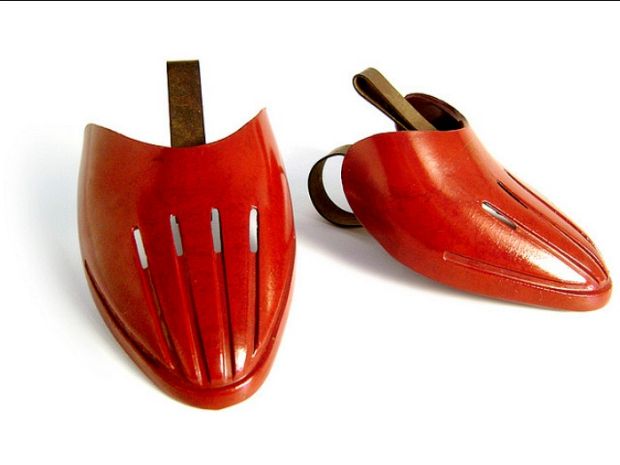
Glossy burnt-orange pointed shells cover only the forefoot, with four parallel vents on top, side ridges, and dark rear loops. They read as industrial toe armor or conceptual half-shoes—closer to mid-century metal forms than to sneakers. Whether worn, displayed, or descended from shoe-tree logic, they belong in a uniqueness roundup because they refuse the full-foot contract. Minimal coverage, maximal object presence.
10. Crystal-block heel sketch
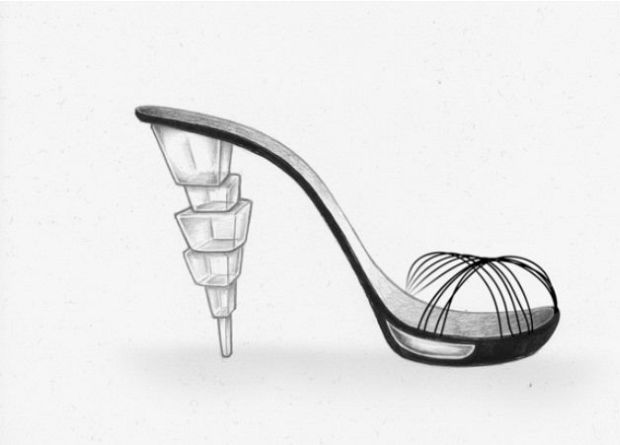
A graphite side view shows a steep sandal whose heel is a stack of translucent geometric blocks tapering to a slim base, while thin arched wires cage the toe. Illustration belongs in design collections because many radical shoes begin as drawings that dare factories later. Offset crystal cubes suggest precarious architecture; the wire fan keeps the forefoot airy. Concept first, sample second.
11. Chrome ankle brace sandal
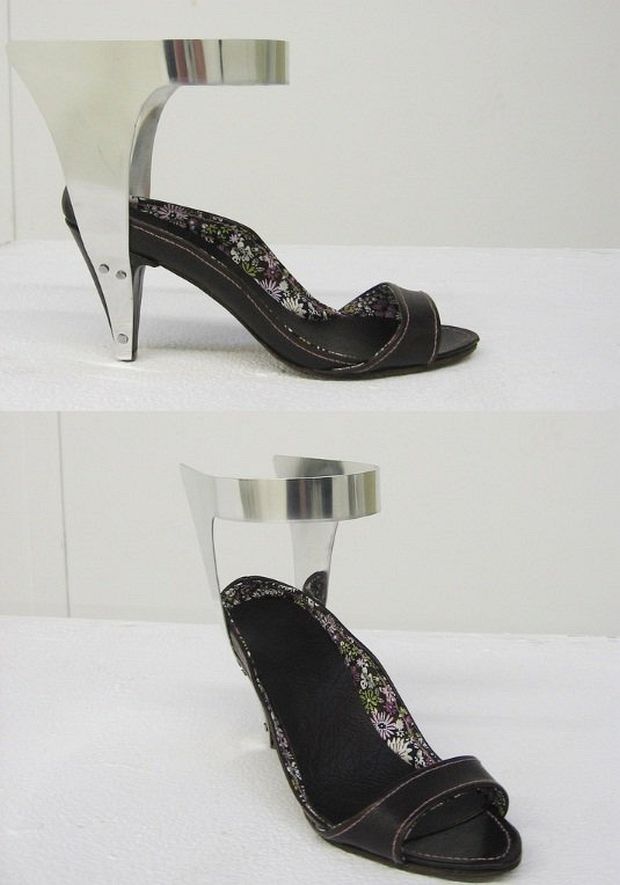
Two studio angles show a dark open-toe sandal with floral interior lining and a polished silver metal structure riveted at the heel that flares into a rigid C-cuff around the ankle. Soft floral against hard chrome is the contrast engine. Industrial jewelry logic replaces a flexible strap. Profile view sells the silhouette; three-quarter view sells the lining surprise—proof that uniqueness can live in material clash, not only in wild outlines.
12. Fluid nude ribbon heels
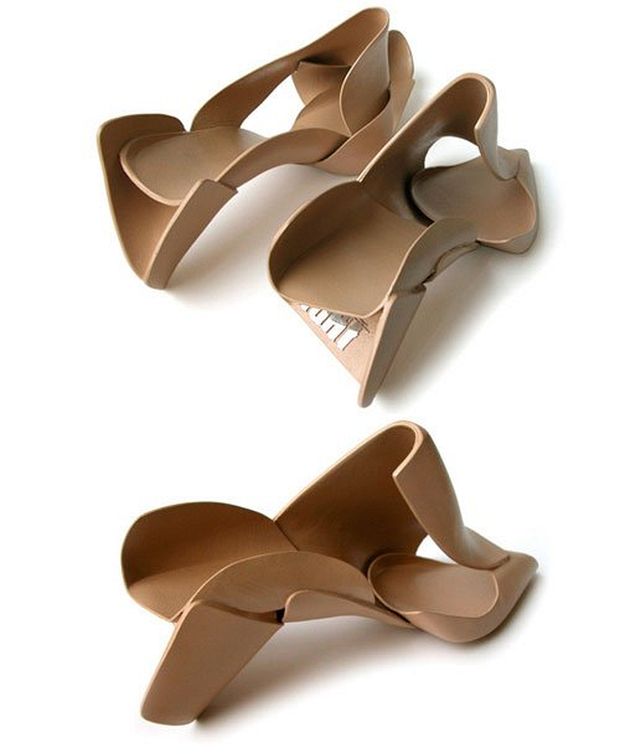
Three views of matte tan shoes built from wide undulating strips: triangular flat heel panel, petal footbed, and wave cutouts with almost no traditional seam language. The look echoes fluid architecture more than cobbler craft. Hollow heel structure and floating footbed make the pair feel like a continuous ribbon frozen mid-motion. Experimental footwear often looks aggressive; this one looks calm and still alien.
13. Chartreuse wood platform with sphere accents
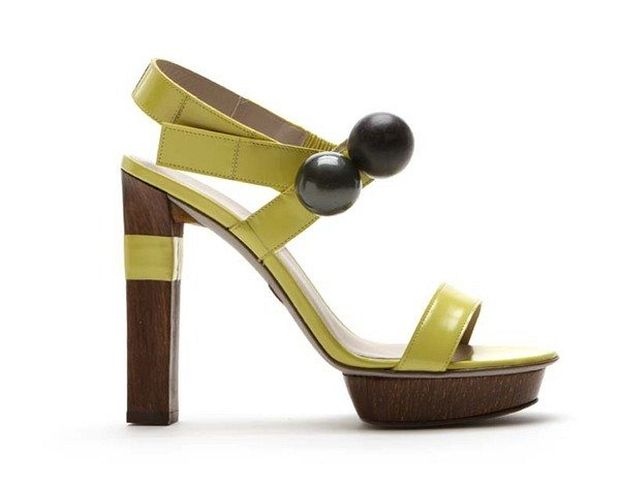
Dark wood-grain block heel and platform meet lime straps and two oversized glossy charcoal spheres on the ankle strap. Cream lining softens the citrus punch. Spheres do the unique work—jewelry scale gone wrong in the best way. Organic wood texture against glossy orbs keeps the shoe from reading as a single-material stunt. Platform mass makes the spheres feel intentional, not glued-on afterthoughts.
14. Rainbow dotted-stripe ankle boot
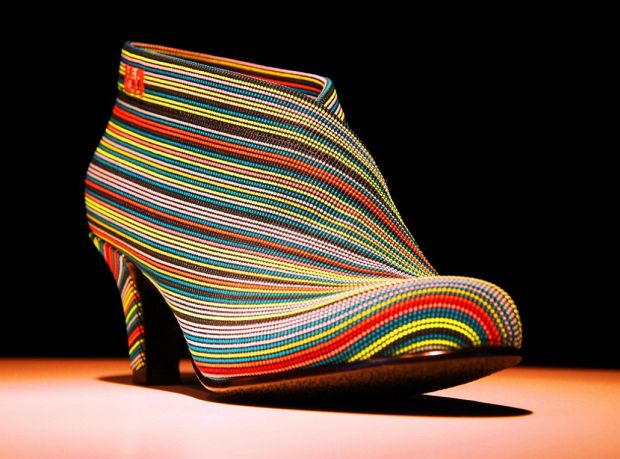
Against black and peach, a low ankle bootie wears thin horizontal stripes built from tiny color dots—yellow, green, turquoise, coral, red, white, black—wrapping upper and heel. Black outsole grounds the optical buzz. Silhouette stays almost conventional so pattern can scream. Op-art footwear proves uniqueness is not only weird last shapes; surface systems can carry the entire thesis.
15. Keyboard-key museum boot
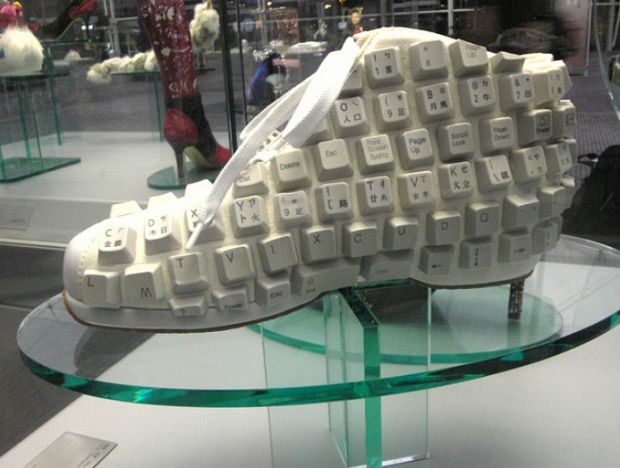
On a glass museum stand, a laced high form is armored in beige and gray keyboard keys—letters, Japanese characters, Esc, Delete, Print Screen, and more—following every curve. A slim metallic heel peeks at the back. Soft shoe body under hard plastic tiles flips expected materials. Gallery context is honest: this is footwear as exhibit, tech waste as ornament, typing culture literalized on a last.
How to look at experimental footwear
Ask three questions of each design: What is the one idea? What material makes that idea inevitable? What traditional shoe part was sacrificed to keep the idea clean? The seersucker cuff keeps a wearable sandal and adds tailoring. The continuous gray band deletes the conventional heel stem. The keyboard boot deletes fabric surface almost entirely. Different sacrifices, same discipline.
If you design, sketch heels as furniture before you sketch straps. If you collect images for moodboards, mix product shots with exhibition views—the pedestal changes how seriously you take a joke. Unique shoes earn their place when they cannot be explained as “the same pump in a new print.” These fifteen refuse that shortcut, and that refusal is the point of gathering them.

Comments
Continue reading
Women’s Hats, 1913–1915
A historical look at women’s millinery from 1913 to 1915—when Edwardian picture hats narrowed toward wartime angles—told through a gallery of period portraits.
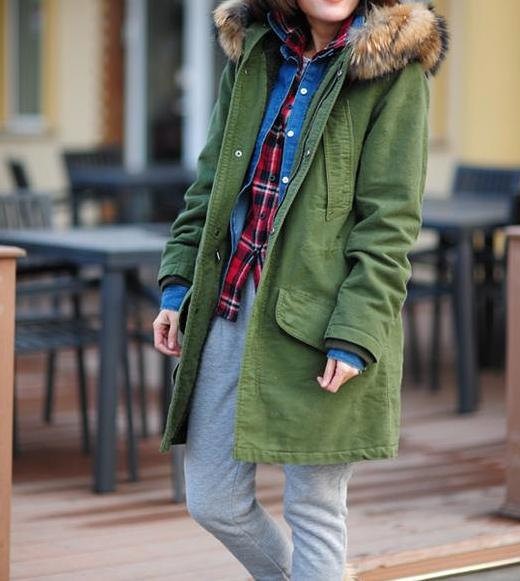
Chic Women’s Coats: Silhouettes That Finish a Winter Outfit
A wardrobe-first look at chic women’s coats—lengths, fabrics, colors, fit checks, and how to wear outerwear so the whole outfit looks decided.
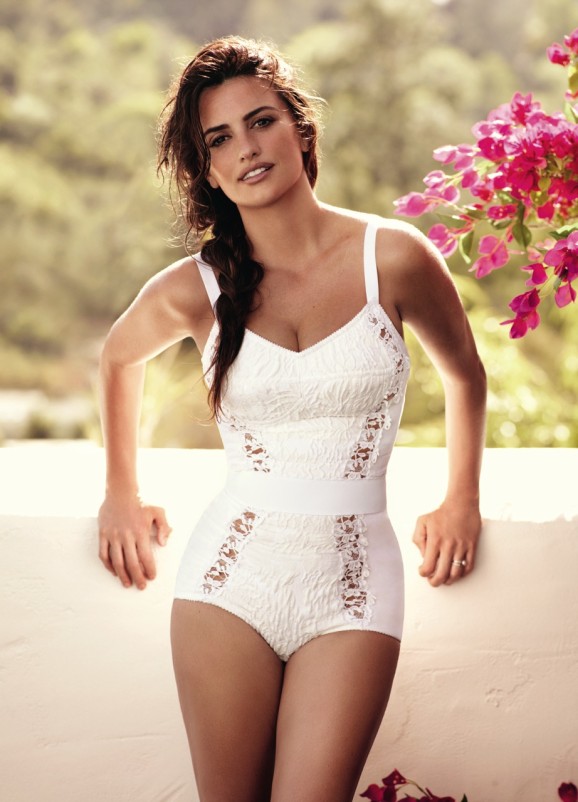
Stunning Female Celebrity Photos: A Craft Gallery
A period-aware gallery essay on staged celebrity portraiture—light schools, wardrobe quotation, and designed intimacy from the supermodel era into the early 2000s.