
10 Simple Wedding Ceremony Backdrop Ideas
Ten simple ceremony backdrop ideas—fabric drapes, greenery, lights, wood arches, hanging florals, found architecture, balloons, textiles, aisle vistas, and paper rosettes on a rustic door.
A ceremony backdrop does one quiet job: it tells guests where to look and gives photographs a finished edge. Simple ideas often work harder than rented walls of flowers—especially when the venue already offers stone, trees, or a handsome door. The ten approaches below stay buildable for couples and friends: paper, fabric, greenery, lights, and found architecture. Scale them to an aisle width, secure them against wind, and leave a clear path for walking and for the photographer’s frame.
Pick one strong material story rather than five competing crafts. Repetition reads as design; clutter reads as panic.
1. Fabric drapes on a simple frame
Two uprights, a crossbar, and lengths of chiffon, muslin, or linen remain the most forgiving backdrop. Gather fabric at the top, let it pool slightly at the ground if the site is clean, and pin a single floral cluster or ribbon streamer where the couple will stand. Neutral fabric suits almost any palette; a soft blush or sage can echo bridesmaids without matching exactly.
Weight the base. Outdoor drapes become sails. Use sandbags, water weights, or stake the frame into soil. Test the height so heads clear the crossbar in photos. Steam or iron wrinkles the night before—cameras exaggerate creases that eyes forgive in person.
2. Greenery wall or hedge panel
A flat panel of eucalyptus, ruscus, olive, or mixed greens creates depth without demanding a full floral budget. Rent a boxwood wall, build a chicken-wire frame and zip-tie stems, or hang garlands in horizontal rows until coverage looks intentional from the last row of chairs.
Keep greenery hydrated. Mist before guests arrive if heat is high. Tuck a few focal blooms at eye level only—scattered flowers everywhere raise cost and visual noise. Greenery backdrops photograph beautifully in both color and black-and-white because texture does the work.
3. String lights and a dark evening
When the ceremony starts near dusk, a curtain of warm string lights on a black or deep-navy drape—or against open twilight—becomes the backdrop. Hang vertical strands evenly, hide cords, and put lights on a dimmer or spare generator plan so the glow stays steady through vows.
Daytime light strands look sparse; save this idea for evening or heavily shaded courtyards. Combine with minimal florals so bulbs remain the star. Ask the photographer to expose for faces first; backdrops of light can fool automatic meters.
4. Wooden arch or triangle with sparse florals
A triangular or rounded wood arch frames the couple without blocking landscape views behind them. Keep florals asymmetric and light—one corner dense, the opposite almost bare—so the structure stays visible. Raw wood suits barns and forests; painted white or soft black suits gardens and modern venues.
Build or rent an arch rated for outdoor use. Cross-brace legs. Never rely on florals alone to hide unstable joints. Guests forgive a simple arch; they do not forgive a wobble during the kiss.
5. Hanging florals and geometric shapes
Suspend a few floral hoops, hexagons, or single stems from a tree limb or overhead beam so the “backdrop” floats rather than stands. Negative space becomes part of the design. This works when the natural background is already strong—ocean, mountain, orchard—and you only need a soft marker for the altar position.
Use fishing line or thin ribbon matched to the sky. Check wind. Hanging pieces spin and tangle; fewer objects, more securely tied, beat a busy mobile. Leave headroom so tall guests and bouquets do not collide with the lowest hoop.
6. Bookcase, window, or found architecture
Sometimes the backdrop is already paid for: a library wall, a tall window with sheer curtains, a stone fireplace, a courtyard niche. Clear visual clutter, add two urns or lanterns, and let the architecture speak. Couples who choose character venues often need subtraction more than decoration.
Walk the camera angles before committing. A gorgeous fireplace that forces everyone into shadow at 4 p.m. is a poor altar. Shift chairs or ceremony time rather than fighting light with more props.
7. Balloon garland done with restraint
Modern balloon garlands in matte, limited colors can frame a ceremony without looking like a child’s party—if you keep the palette tight and the shapes organic rather than rainbow clusters. Anchor the garland to a wall, arch, or freestanding poles; leave the center open for the couple.
Heat and altitude affect balloons. Install close to ceremony time outdoors. Matte and chrome mixes photograph better than glossy primary packs. Pair with greenery sprigs if you want a bridge to floral tablescapes later.
8. Macramé or textile hanging
A large macramé panel, quilt, or handwoven textile hung from a rod offers texture that florals cannot. Choose fibers that match the wedding’s tactile story—cotton for casual, silk blends for formal. Keep florals minimal so knots and weave stay readable in photographs.
Steam or block the textile beforehand. Secure the rod ends so gusts cannot turn the piece into a sail. Textiles suit indoor lofts and covered porches best; prolonged damp outdoors risks staining and sag.
9. Seating aisle that becomes the view
Not every ceremony needs a wall behind the couple. Two rows of trees, a double line of lanterns, or petals leading to open sky can make the aisle itself the design, with the couple facing guests and the landscape serving as living backdrop. This is simplest when the vista is the reason you booked the site.
Mark the standing spot with a subtle rug, board, or low floral cluster so the photographer and officiant share the same target. Without a vertical backdrop, ceremony sound and guest sightlines matter more—test microphone needs early.
10. Paper rosettes on a weathered door
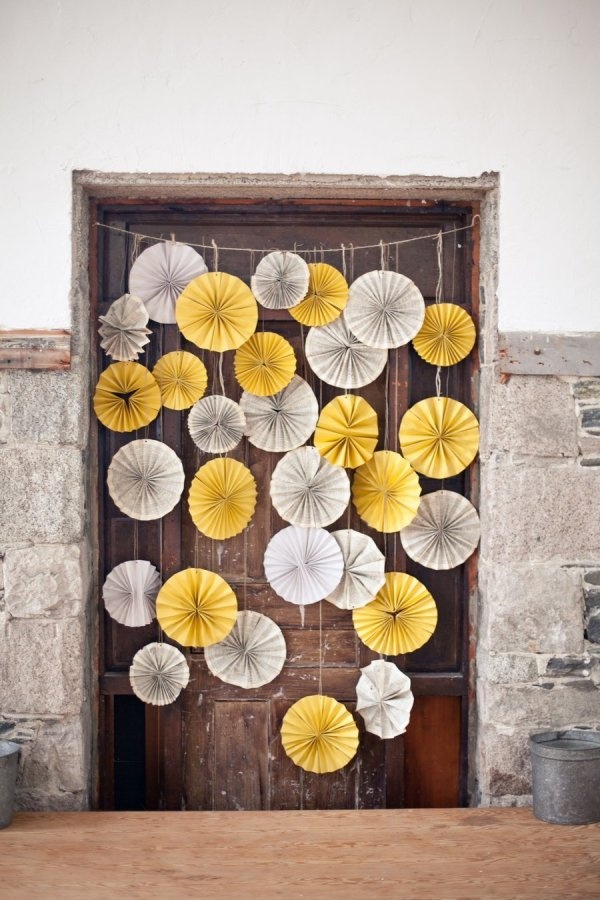
Accordion-folded paper rosettes—mustard, cream, grey, some cut from book pages with visible text—hung on twine across a dark paneled door set in stone make a backdrop that is inexpensive, graphic, and literary. Stagger heights so the upper door fills with texture while the lower panels and porch floor stay calm. Metal buckets or planters at the threshold ground the scene.
Make rosettes in batches the week before; hang them the morning of so paper stays crisp. Use a consistent palette and vary only size. Twine across the doorframe should be taut and discreet. This idea shines for rustic venues, bookish couples, and anyone who wants handmade character without fresh-flower cost at the altar.
Choosing and finishing
Match backdrop effort to guest count and wind. A paper-rosette door or textile hanging suits intimate courtyards; freestanding drapes and arches need ballast for open fields. Confirm venue rules on nails, flame, and cleanup. Tell the florist and photographer which idea you chose so bouquets and lenses do not fight the background.
On the day, stand where you will say vows and look back through a phone camera. If the frame feels busy, remove one element. Ceremony backdrops succeed when they disappear into the memory of faces and words—and reappear later, cleanly, in the photographs you keep.

Comments
Continue reading
Attic Bathroom Design Ideas: Light, Layout, and Roof-Friendly Fixtures
Design ideas for converting an attic into an extra bathroom—working with slopes, skylights, wet-zone materials, eaves storage, and fixture placement.
Ladder Shelving Repurpose Ideas: DIY Bookcases, Dividers & More
Turn an old ladder into shelving, a room divider, towel rack, or narrow desk—practical DIY steps, safety checks, and styling tips with photo ideas.
Cool Home Lifehacks That Actually Save Time
Practical household tricks—kraft-paper lists, safer nailing, fridge bottle stops, mint-tin drawers, phone stands—using things you already own.